


The Council of Representatives (COR) meeting was held in Washington, D.C., on March 8-10, 2018. Activities on March 8 included the training of the new representatives as well as the plenary session. At the plenary, council members were addressed by the following four individuals who declared their intention to run for APA president: Armand Cerbone, Jean Lau Chin, Steve Hollon and Sandy Shullman. The following provides a summary of reports, updates and items on the agenda of the full meeting. Overall, your council representatives believe that major decisions were made that will be beneficial to the association and profession. The documents and guidelines mentioned in this report will be made available by APA.
APA finances
In advance of the meeting, a series of webinars regarding the financial state of APA were held. Questions regarding the state of APA finances were addressed at the main meeting.
- As reported in the October 2017 edition of The Score, the APA headquarters building was refinanced in order to use a portion of the equity for strategic initiatives. COR was informed that $25 million (USD) was taken out from the refinancing of the headquarters of which $20 million has been set aside in a separate portfolio to fund strategic initiatives, and $5 million has been placed in a debt service fund. The strategic investment plan will consist of projects developed by the new CEO, Arthur Evans. It is anticipated that these projects will be systematically evaluated.
- The most recent financial figures for 2017 show the total assets of the association (investments, property and equipment, cash, accounts receivable and other assets) to be $268 million (see Figure 1). In 2016, the total assets were $235 million. Figure 2 includes the consolidated liabilities and net assets of the association for 2014 to 2017.
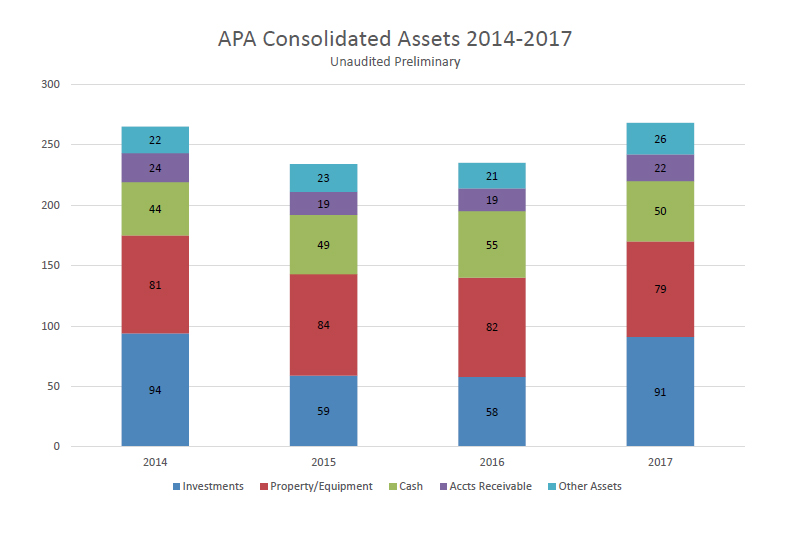
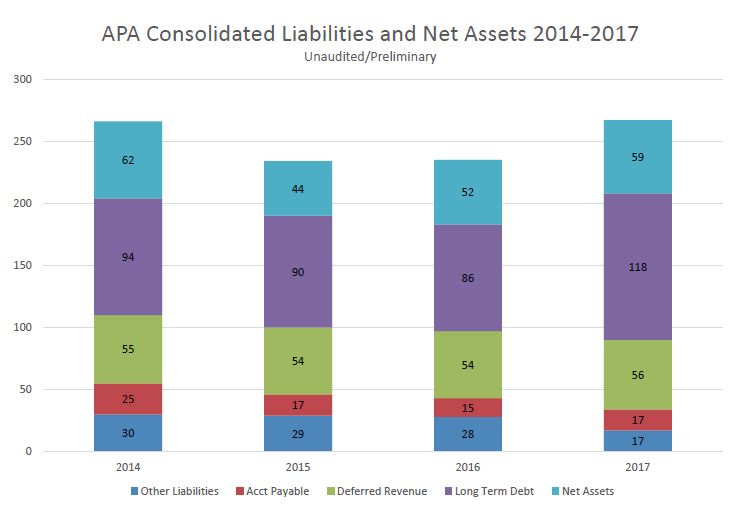
Figure 2. APA Consolidated Liabilities and Net Assets 2014-2017
CEO report
The CEO reported that he will be hiring a chief diversity officer. This newly created position will allow APA to respond to recurring concerns of the membership. The CEO is also in the process of hiring new leaders in the areas of communications, professional practice, science, public interest and ethics. These leaders will also be called chief officers of their respective areas.
President’s report
The current APA president, Jessica Henderson-Daniel, reported on her initiative of identifying and honoring Citizen Psychologists. This initiative is aimed at recognizing psychologists engaged in significant activities that improve the lives of people. Candidates for these awards can be nominated from all echelons of society.
Legal report/update
The APA general counsel, Deanne Ottaviano, reported that the litigation pertaining to the “Independent Review Relating to APA Ethics Guidelines, National Security Interrogations, and Torture” (aka the Hoffman Report) is still working its way through the courts.
APA Practice Organization (APAPO) report
This report was provided by the vhair of the Committee for the Advancement of Professional Practice, Lindsey Buckman and Katherine Nordal, the outgoing executive director of the APAPO. In the report, the following priorities of the APAPO were outlined:
- To work to add psychologists to the Medicare definition of a “physician.”
- To protect the psychological and mental health provisions of the Affordable Care Act.
- To oppose budget cuts to public mental health programs within restructured Medicare/Medicaid.
A variety of accomplishments by the APAPO were identified, including the creation of the mental and behavioral health registry for clinical data. This registry is aimed at tracking and reporting outcome measures for accountability and quality improvement, as well as for use in research.
Other updates, reports and votes
Multicultural guidelines and diversity
- Council was given a presentation regarding the application and dissemination of the multicultural guidelinesopens in new window (PDF, 1.13MB) which were approved in August 2017.
- Council received an update from the Council Diversity Work Group (CDWG) established in February 2016. The update indicated that all new business items for Council must consider the diversity impact of the relevant motion. Additionally, Council was updated regarding the approval of the CDWG as an ongoing committee of the association. The full report of the CDWG was received and accepted with 98 percent approval.
Items on which votes were taken include:
- Master’s level training and practice in psychology — Approved with 92 percent support. The discussion of the item started by outlining three majors issues: a) accreditation, b) title and c) scope of practice. Because of the complexity of this topic, it was decided that at this meeting Council would only consider the issue of accreditation. Thus, the motion that was passed stated that “Council supports pursuing accreditation of master’s level programs in areas where APA already accredits.” Because APA only currently accredits PhD programs in clinical, counselling and school psychology, exploring accreditation in other areas is not being considered at this time.
- Joint membership agreement — approved with 89 percent support. This item establishes support for the creation of a 501(c)6 organization, tentatively named the APA Institute for Psychology in which all members of APA (a 501(c)3 organization) will have membership starting in January 2019. This structure will permit flexible involvement, without a mandated cap, in activities including advocacy for psychologists and psychology, and the delivery of benefits to members across all areas within the organization. With this restructuring, APA should be better positioned to fulfill its mission to advance science, education, practice and public service.
- Clinical Practice Guideline for Multicomponent Behavioral Treatment of Obesity and Overweight in Children and Adolescents: Current State of Evidence and Research Needs — Approved with 73 percent support. Much of the discussion on this item indicated that the current state of research and evidence regarding the topic of the guideline is limited. Importantly, these limitations are acknowledged in the document and the guideline for appropriate behavioral treatment is based on the current state of research. The group presenting the guideline hopes that in addition to providing basic evidence supporting multicomponent behavioral treatment, this document will spur additional research in the area.
- Resolution on pregnant and postpartum adolescent girls and women with substance abuse related disorders — Approved with 99 percent support. This resolution is intended to serve as a communication tool encouraging research, practice and public policy with regard to this complex topic.
Items postponed until August 2018 because they were in need of some changes or clarification:
- Transparency of decisions. The motion regarding the recording, identification and dissemination to the membership of individuals’ votes was discussed. However, in light of the need to devise and prepare the logistical support necessary to accomplish the aims of this motion, the motion was withdrawn and its proposers asked the board of directors and council leadership team to prepare a revised motion for consideration in August including a viable mechanism for accomplishing its purpose.
- Amendments to association rules 210: Finance. After discussion, the item was postponed because it did not contain a written explanation regarding the rationale for the amendments. It will be reconsidered in August, after the explanation for the changes is provided.
Items which were approved by consent include:
- Rescission of 1991 resolution on the use of dolls in forensic evaluations.
- Guidelines on core learning goals for master’s degree graduates in psychology.
- Guidelines for psychological practice with girls and women.
- Report from the working group on health disparities in vulnerable boys and men.