

For this History Matters column, we celebrate the 30-year anniversary of Duane Rumbaugh’s presidency of Div. 6 by highlighting his 45-year research partnership in comparative psychology with the chimpanzee Lana.
At the APA convention 30 years ago, Duane M. Rumbaugh (1929-2017) delivered a Div. 6 presidential address titled, “Comparative Psychology and the Great Apes: Their Competence in Learning, Language and Numbers.” The talk summarized the findings from Rumbaugh’s first three decades of research with chimpanzees and other nonhuman primates. It was an interim report, as it turns out, Rumbaugh would continue to study primate behavior and cognition for nearly three full decades beyond his Div. 6 presidency. And for 75 percent of this fascinating and productive 60-year career of primate research, Rumbaugh enjoyed the partnership of a remarkable chimpanzee (Pan troglodytes) named Lana (1970-2016).
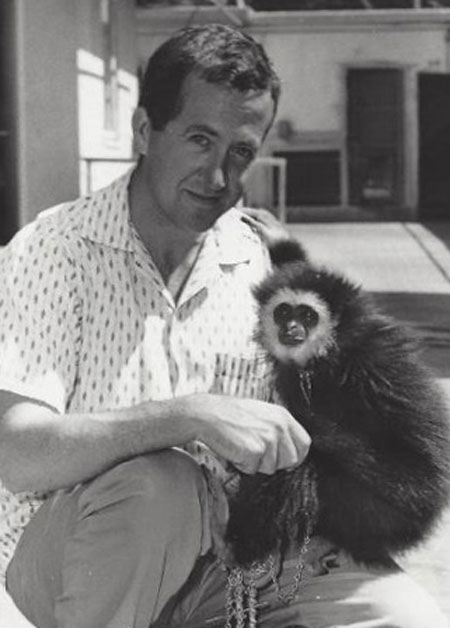
Duane and Lana met at the Yerkes Primate Center in Atlanta, about a year after she was born. Rumbaugh, who had been trained as a general experimental psychologist in the Spence-Hull tradition, had studied the maze behavior of rats for his MA (1951, Kent State U.) and PhD (1955, U. Colorado) projects; however, as a faculty member at San Diego State College in 1958, he became increasingly interested in studying learning by testing the monkeys and apes at the zoo. On the strength of this research, he had subsequently been recruited in 1969 to the Yerkes Center at Emory University as associate director and chief of primate behavior. At the encouragement of Yerkes Director Geoffrey Bourne, Rumbaugh proposed an innovative approach to studying whether great apes could learn a human-like language. His goal was to enhance experimental precision and objectivity into the attempt to answer longstanding questions about ape intelligence and communication. Young Lana was the first chimpanzees assigned to the project, and she became the focal participant because of her willingness voluntarily to explore and to interact with the apparatus.
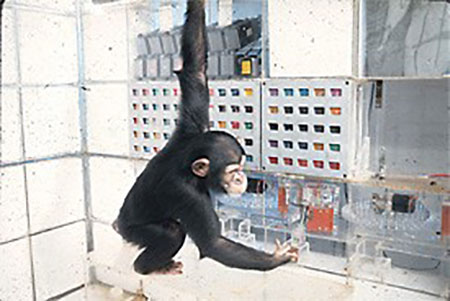
The project that Rumbaugh and his team of collaborators proposed for Lana involved a computer-based communication system in which visuographic symbols called “lexigrams” represented words. A grammar was invented to govern the combination of these symbols into sentences. Consequently, Lana and her human caretakers could use the computerized keyboard to ask and answer questions, to make requests, to comment, to control automated dispensers and so forth. Lana’s use and comprehension of these communicative symbols were tested and reported in published articles and subsequently summarized in Rumbaugh’s (1977) book, "Language Learning by a Chimpanzee: The Lana Project." The work also generated considerable interest and discussion, both complimentary and critical, within the scholarly literature as well as within the popular media.
Lana’s success in learning to use the computer-based lexigram keyboard for communication paved the way for other chimpanzees (e.g., Sherman, Austin, Ai, Panzee) and bonobos (e.g., Kanzi, Panbanisha) to be trained in similar ape-language projects. Her lexigram learning also inspired researchers to develop and test key-board-based language interventions for non-speaking children and young adults with intellectual disabilities, particularly as computers became more portable and thus more useful as alternative and augmentative communication devices. While the focus of language-acquisition studies turned to these other participants, Lana remained active in research, as Rumbaugh began to study her capacity to master a different type of symbols: Arabic numerals that represented different quantities.
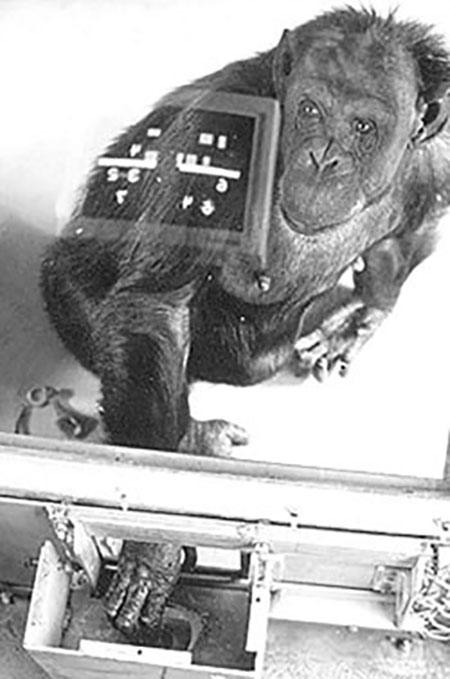
Rumbaugh and his collaborators trained Lana to label quantities with numeric symbols and to enumerate productively so as to produce a number of responses corresponding to the value of a symbol. As with the language work (which also continued with her through these years), Lana excelled in this research and taught much to Rumbaugh and the other scientists and caregivers who worked with her. These findings were recorded in additional publications by Rumbaugh and his colleagues and were summarized in the presidential address that he delivered when the APA convened its 1988 meeting in Atlanta. Many Div. 6 members remember this meeting for the opportunity Rumbaugh provided to tour Georgia State University’s Language Research Center and to meet Lana.
Lana continued voluntarily to engage in a wide range of research activities, right up to her death at the age of 46 years. She continued to use the lexigram keyboard and in 2000 was shown to have excellent retention of the symbols she learned in the 1970s, many of which had been removed from her keyboard decades earlier. She enjoyed interacting with human researchers and caregivers, for instance by responding to the numerousness or other characteristics of physical stimuli they presented, including stimuli that were only represented in Lana’s memory. She eagerly played game-like computerized tasks that revealed her capacity for executive attention, learning, memory, planning, self-control and other competencies. Rumbaugh and his collaborators documented these abilities in at least 200 articles and chapters. Scientists continue to analyze Lana’s data for more insights about the human and nonhuman primate mind.

Rumbaugh retired from Georgia State University in 2001 but continued to study Lana and other nonhuman primates, albeit remotely and at the more leisurely pace of retirement. In his final book, "With Apes in Mind: Emergents, Communication and Competence," Rumbaugh (2013) discussed his lifelong journey of discovery in comparative psychology. As he wrote the final paragraphs of the memoir, he reflected on where the journey had taken him and on those who had traveled with him: “And above all, who is my best chimpanzee confidant, my consult? It’s Lana. I love Lana! She was and is the grandmother of all of my professional life. She has taken me hand in hand and led the way throughout this account…But of them all, who is my queen? Lana! Laurels for Lana!” (p 273).
Duane Rumbaugh died on June 22, 2017, just seven months after the passing of his beloved Lana. Just days before his death, Duane was talking science and helping to plan a conference organized in Lana’s honor. Together, Duane and Lana taught us so much about primate behavior, communication and cognitive competence. They also taught us about the friendship that can develop across animal species, and some of the ways that such partnerships can enrich our lives as well as our science.