

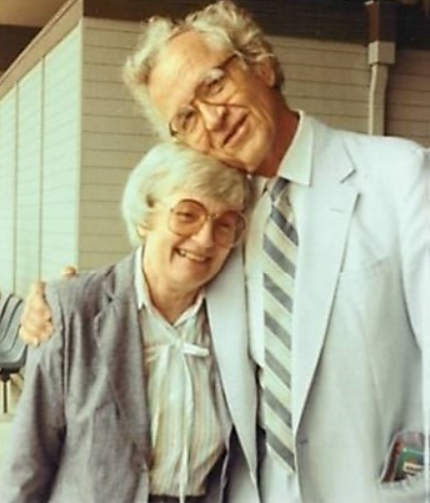
 In 1979 Sony introduced the Walkman. If you had about $200, you could listen to your favorite disco music cassettes while dancing in roller skates. Margaret Thatcher was sworn in as the first woman elected Prime Minister of the United Kingdom. Everyone knew where and what Three Mile Island was. A new Toyota Corolla cost about $3,700, plus another 86 cents for a gallon of gas. The Entertainment and Sports Programming Network — you know it as ESPN — launched with the laughable idea of showing sports 24/7. And APA’s Div. 6 convened in New York, led by professor Frances K. Graham of the University of Wisconsin, Madison. Graham was just the second woman (six years after Brenda Milner, PhD) to be elected president of Div. 6. (Author’s note: In the historian’s column on Margaret Harlow that appeared in the last newsletter, a masculine pronoun was accidentally used to describe Graham — a typo made more embarrassing by the fact that I had already started working on the present column.) Previously, Graham had served our division as member-at-large on the Executive Committee, Council Representative and Secretary-Treasurer for the first six years after our division reemerged from its decade-and-a-half merger with Div. 3.
Frances Jeanette Keesler was born Aug. 1, 1918, in Canastota, New York, to Norma (Van Surdam) and Clyde Keesler. Her parents were college-educated — Norma as a librarian turned accountant and Clyde as an engineer and inventor — and so despite the Great Depression, borrowed the money to ensure that Frances could attend Pennsylvania State University after she graduated from Prospect Park High School, near Philadelphia. She enrolled at Penn State as a mathematics major with plans for a career in accounting until forced by curriculum requirements to take an introductory psychology course. It changed her life. About that 1936 course, she recalled: “Before the semester ended, I had been converted. I announced my decision [to major in psychology] to my parents and asked permission to finish my undergraduate degree early so that the money for my final undergraduate year could finance the first graduate year….It was my first experience with teaching that viewed a field of knowledge as developing, as involving not only what was already known, but also what needed to be found out” (pgs. 171, 172-173). The switch to psychology was also accompanied by a shift in focus toward complementary coursework in anatomy, biology, chemistry, genetics and physics. Through careful planning and hard work, Keesler indeed earned her BA degree a year early, despite changing majors. In 1938, the 19-year-old Frances was admitted for graduate study at Yale University with support from a one-year Mary E. Ives Fellowship from her alma mater. A year later, Yale used a small fellowship for women to keep Frances from transferring to Bryn Mawr for financial reasons.
In addition to these financial difficulties, the young scholar experienced challenges in finding a faculty member who would advise a female student. However, Clark Hull, PhD, welcomed the promising young scholar into his lab to study conditioning of rats. One of the things that originally attracted Frances to Yale for graduate study was the opportunity to study infants, and so she also sought out these research experiences, completing three-year apprenticeships with Pauline S. (Pat) Sears, PhD, in a child psychiatric clinic, and with Dorothy P. (Dottie) Marquis, PhD, studying conditioning of neonates. Frances Keesler Graham (for she and fellow graduate student David Graham, son of accomplished neurophysiologist Helen Tredway Graham, were engaged in 1939 and married in 1941) completed the requirements for the PhD in experimental psychology in 1942. Her dissertation, directed by Clark Hull and Donald Marquis, was titled Transfer of Conditioned Inhibition and Conditioned Excitation.
After graduation, Fran and Dave Graham moved to Washington University, St. Louis, where he continued his medical training and where she worked in a variety of nontenture-track research positions until 1957. This period in Missouri was interrupted twice, once for a move (1945-1946) back to Pennsylvania when David was called to duty in the Medical Corps for WWII and more notably from 1948-1951, when she held a tenure-track faculty appointment (instructor, subsequently promoted to assistant professor) at Barnard College in New York, while her spouse interned in psychosomatic medicine at Cornell Medical School. Writing about the St. Louis period in Graham’s life and career, Keen (2013) noted, “It was during the mid-1940s that Fran’s penchant for turning any opportunity into gold shone forth. She had a half-time position in neuropsychiatry, which was strictly clinical work. Fran had homilies she was fond of quoting, and one was ‘If in a desert, study cacti.’ True to form, she began doing research on patients and with Barbara Kendall developed the Memory-for-Designs test for detecting brain damage that is still in use (Graham & Kendall, 1946, 1960). She gave the patent to the American Psychological Association, as she did not deem it fitting for a scientist to be involved in marketing a product” (pg. 941). To date, more than 200 published studies have been conducted worldwide with the Graham-Kendall neuropsychological assessment tool.
This was also a period of family growth for the Grahams, with children Norma (born in 1944), Andrew (1945) and Mary (1952). In her 1988 autobiography, Graham wrote with candor about the challenges of work/life balance and the sacrifices required to be a psychologist, wife and mother. In 1953, she began collaborating with Alexis Hartmann from pediatrics and Miriam Pennoyer, a pediatrician, on an NIH-funded research project investigating the effects of anoxia in neonates. Subsequently, she served as PI with these same collaborators on a seven-year grant from NIH, covering her salary as a research associate and supporting her growing scholarly program. Two years later, she also obtained grant support to develop neuropsychological assessments for preschool children with various brain injuries.
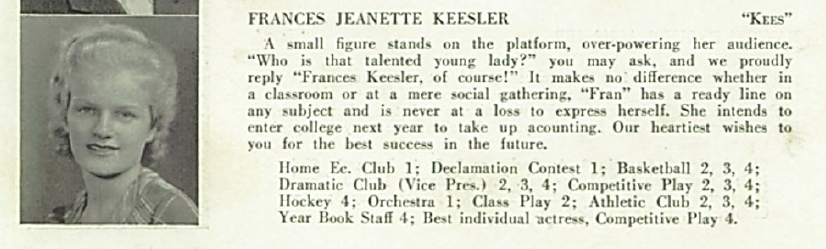
In 1957, Fran and Dave Graham were recruited by the University of Wisconsin, Madison. Her initial position was research associate in the Department of Pediatrics and later joined the psychology faculty at the rank of lecturer. When she received a Research Scientist Award from the NIMH in 1964, Graham became a tenured associate professor; indeed, tenure was an unanticipated requirement of the new Research Scientist Program, and so UW had to grant tenure or return the funds. Promotion to full professor would follow four years later, with half of her academic time assigned to Pediatrics and half to Psychology. The NIMH Research Scientist Award was renewed regularly — it ultimately sup-ported her salary and scholarship for 25 years — and in 1980, Graham was also appointed to an endowed Hilldale Research Professorship at Wisconsin. She was continuously funded by federal grants until 1993, well into her next faculty appointment. Frances was hired as a professor of psychology at the University of Delaware in 1986 and retired three years later. (David Graham retired with the move to Delaware and was adjunct faculty in psychology until his death in 1999.) Frances Graham was Emerita Professor of Psychology at Delaware from 1989 until her death on April 19, 2013.
In a 1993 interview for the Society for Research on Child Development Oral History Project, Graham described the three phases of her research career. Phase one was the pioneering developmental neuropsychology research on the effects of prenatal oxygen deprivation on cognition and behavior, subsequently extended to studies of children with other types of brain injury. Phase two began with discovery, with postdoc Rachel Clifton, of the cardiac orienting response, the automatic psychophysiological responses (heart rate deceleration) corresponding to attention capture by a surprising stimulus. This work, building on seminal studies of the orienting response by Russian researchers like Pavlov and Sokolov, resulted in several classic and highly cited publications in the history of psychophysiology. The third phase was characterized by work on the startle reflex, the autonomic responses (cardiac acceleration, blink) that accompanies it, and the effects of prestimulus events in inhibiting it. In this work she was able to link reflexive responses with attention-related brain responses. Some of Graham’s many scholarly contributions are listed later in this article.
For this work, Frances K. Graham received many honors in her career. She received the G. Stanley Hall Medal from the American Psychological Association’s Div. 7 (Developmental Psychology), the Gold Medal Award from the American Psychological Foundation and the William James Fellow Award from the American Psychological Society. Three scholarly organizations recognized Graham with their Distinguished Contributions Awards: the Society for Psychophysiological Research, the Society for Research In Child Development and APA (see the 1991 American Psychologist reference below for the full commendation). She was elected to the National Academy of Sciences in 1988. Each year in her honor, the Pennsylvania State University Social Science Research Institute awards the Frances Keesler Graham Early Career Professorship to support innovative research programs. Among the many honorific service appointments Graham accepted in her amazing career, she was appointed by President Jimmy Carter to the Presidential Commission on Ethics in Medicine and Biomedical and Behavioral Research, she chaired the AAAS Section on Psychology and she was elected president of the Society for Psychophysiological Research, the Society for Research on Child Development and of course, of our society.
Whether it was called “physiological psychology” or “behavioral neuroscience” or some other title, Div. 6 has a proud history of contributions that have illuminated the relation between brain and behavior and that have profoundly affected the treatment of children and adults with neurocognitive challenges. Few in our history illustrate this statement better than Frances Keesler Graham, that brilliant and hard-working young woman whose future research, instruction and service contributions (and personal life) were radically redirected by one introductory psychology course, which she remembered as being taught by Fred Brown, PhD, one year removed from his own PhD in clinical psychology from Minnesota. It begs the exciting question: Is a future discipline-changing president of SBNCP sitting as a student in one of the classes we are teaching right now?
A summary of Graham’s accomplishments
- Development of early neuropsychological assessment instruments for neonates and children, including the Graham-Kendall Memory-for-Designs test and an instrument for scoring behavioral observations of newborns, known as the Graham-Rosenblith scales (which, in turn, influenced development of the Brazelton).
- Development of tools and methods for identifying many physiology-psychology relations, establishing herself as an expert in psychophysiology.
- Almost 100 publications, including influential reports such as “The more or less startling effects of weak prestimulation” (Psychophysiology, 1975) reporting the systematic manipulations of interstimulus interval that suggested separate attention-orienting and attention-intensity responses in infants and adults.
- Classic and definitional publications like “Heart-rate change as a component of the orienting response” (Psychological Bulletin, 1966) and summary chapters like “Attention: The heartbeat, the blink and the brain” that synthesized psychophysiological evidence of the interplay between automatic, preattentive processing and selective attention in stimulus processing.
- Important early neuropsychological studies of anoxia, brain injury, anencephaly and phenylketonuria (PKU), such as “Precocious cardiac orienting in a human anencephalic infant” (Science, 1978) that established foundational findings and had practical implications for the treatment of children with these conditions.
To learn more about Frances K. Graham
Keen, R. (2013). In memoriam: Frances Keesler Graham (1918-2013). Psychophysiology, 50, 941-942.
Graham, F. K. (1988). Frances K. Graham, 1918-. In A.N. O’Connell and N.F. Russo (Eds.), Models of Achievement: Reflections of Eminent Women in Psychology Vol. 2, Lawrence Erlbaum Associates, Inc.
Awards for Distinguished Scientific Contributions: 1990: Frances K. Graham. American Psychologist, Vol 46(4), Apr 1991, 292-293
The SRCD Oral History Project interview with Professor Graham: https://srcd.org/sites/default/files/documents/graham_frances_keesler_interview.pdfopens in new window
Historian’s column clarification
In the previous issue of the newsletter, I attempted to contrast the Wisconsin newspaper’s report of Margaret Harlow’s death. On the one hand, the title was marginalizing (“Mrs. Harry Harlow dies”); on the other hand, the announcement exaggerated her accomplishments by claiming that Margaret Harlow was joint recipient of the National Medal of Science for 1967. For clarity, no mention of Margaret Harlow was made when President Johnson awarded the National Medal of Science Award to Harry Harlow, Feb. 13, 1968.
A request from the SBNCP historian
If you have photos, notes, minutes or other archival materials from Div. 6’s history, please email me, David Washburn, PhD. I’d be happy to scan and return, or otherwise to archive, relevant information of historical interest. I am particularly eager to acquire photos from previous meetings and of previous officers. Thank you.