

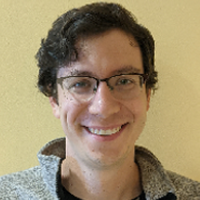
 A few years ago, I was scrolling through Twitter and saw a captivating video of a giant rat in a harness and leash being used to sniff out land mines in Cambodia. Like a search and rescue dog—but better—these African Giant Pouched Rats (Cricetomys ansorgei) were identifying landmines quicker than the current technology and they could detect Tuberculosis too! All this work was being carried out by a humanitarian non-profit organization called APOPOopens in new window (Anti-Persoonsmijnen Ontmijnende Product Ontwikkeling, or in English, Anti-Personnel Landmines Detection Production Development). Recently, I had the chance to sit down with the Head of Training and Innovation at APOPO, Cindy Fast, PhD. Fast earned her PhD in Psychology from UCLA in 2014 and then did a postdoc at Rutgers in Behavioral and Systems Neuroscience. She has studied the behavior of many animals from hermit crabs to pigeons, mice, and rats. In our discussion, I learned that my initial presumptions of these pouched rats were incorrect, that working at a non-profit like APOPO is very much like being a PI at a university, and so much more.
Work at APOPO
JUSTIN (JV): I love learning about the unique biology of non-model rodents and when I stumbled upon the African Giant Pouched Rats and APOPO I liked the seemingly special ability of their olfactory sense to remember smells and maybe form a relationship with a person. So, I am interested if you could tell us more about their story and yours.
CINDY (CF): Yeah, I don't think a lot of people are familiar with the African Giant Pouched Rat. When I first read the publications from APOPO, I envisioned that they probably had like little kangaroo pouches, but they get their name from their cheek pouches. They are more closely related to hamsters, and they hoard their food in these cheek pouches, and of course, they're giant. They're about the size of a small cat, around 2.5 lbs. That makes them entirely different from lab rats. It's an entirely different species.
In terms of, olfactory abilities, I wouldn't be able to say that they are special or unique in that regard. Many animals have really phenomenal olfactory abilities, whether it's dogs, mice, and even honeybees. Our rats probably have comparable olfactory abilities. But what is unique about them is their lifespan. Rodents live around 2 or 3 years, right? But our rats have an average lifespan of about 8 years.
This is on par with scent detection dogs. So, you have this small nocturnal animal with a highly developed sense of smell that lives a long time. Our oldest rat, her name was "Happy", she just passed away last year at 11 years old. So, they have a very long working career after the training that's needed for them to do the work. That's really the most unique thing about them.
The whole idea of using pouched rats for scent detection came from an engineering student that was doing a master's program in Belgium. He was tasked with solving a humanitarian problem and coming up with a novel solution. He loved the continent of Africa and wanted to solve a humanitarian problem there, so he chose the landmine problem. He came across a paper where someone had trained gerbils for the detection of TNT. And he had pet rats as a child and he said, well, if you can train a gerbil to do this, then I know you can train a rat to do it because rats are so clever. So, he started collaborating with another university that had connections here at the Sokoine University of Agriculture in Morogoro,Tanzania. Where we're at today. And they had a Pest Management Center that was looking at trying to control these giant pouched rats devastating crops. The professor thought this is the perfect rat for you because he has a long lifespan. He has a really great sense of smell. He’s big, so he's not going to tire easily while he's searching for landmines, but he's not so big that he would actually set them off. Unlike dogs or people walking, the rat can walk directly on a landmine and never detonate it.
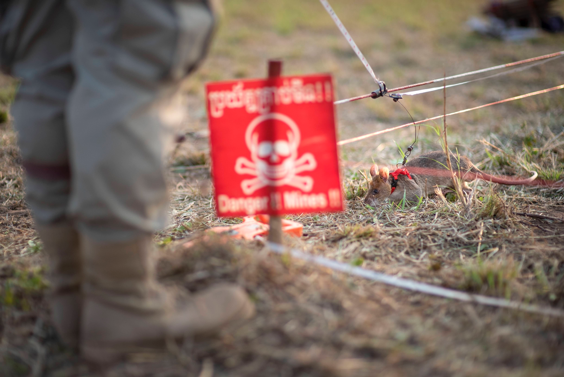
A pouched rat sniffing out landmines in Cambodia.
Photo credit: APOPO
JV: That's very cool. It sounds crazy. That it was just this little project that a student was assigned to do and then it became bigger...way bigger than he probably ever envisioned. I never considered the age aspect that when you put so much time into training an animal, their lifespan is really important. That makes the rats an interesting model to study age-related diseases and decline of the nervous system.
CF: I am glad you picked up on that. One thing I am always looking at is the rat’s performance and I expect to see a gradual decline, but you don’t see that at all. What you see is they maintain super high accuracy and then it just drops off. And it’s not because they are no longer capable of smelling, they lose motivation for the work. Now, we’ve built that into our protocols and once we see that a rat is no longer greeting us in its home cage, we do a health check and if everything checks out we take a closer look at their performance. They’re usually performing relatively well but not completing the task or taking much more time. They’re spending more time grooming and sleeping, they’re not really motivated.
JV: I was also wondering since they have such long lives, do they have special relationships with their handlers and other people?
CF: These rats don't actually pair bond with their handlers the way that a scent-detection dog might. And that's another benefit of training a scent-detection rat. Once we train them here in Tanzania, we can send them all over the world very easily because they're small enough to ship and transport easily. Then, as long as the trainers and handlers on the ground know how the rat has been trained, the rat can just pick up without missing a beat and go straight to work. With dogs, they pair bond so the handler has to go with the dog wherever it's going to do its work.
JV: Okay, so it has many advantages over a dog. I've also been really curious to know about any individual differences in learning and whether they all can learn. Maybe it takes longer for some other ones to learn. And how do you deal with that? Some might not ever learn or have real difficulties and can't meet the criteria to become sent detection, TNT landmine rats.
CF: That's one of the things that I've been working on since I joined the team. One aspect we have looked at improving is our knowledge and understanding of the rats themselves. How are they smelling things? How do they learn about stuff? What is their memory like? What's the most effective method of communication with the rat, in terms of reinforcement? And what motivates them? All of these things factor into learning and memory and behavior. Particularly in a scent-detection rat. So by applying all of that with our trainers, we've grown our knowledge and improved our skills and techniques in how we train the rats. Now, we have fewer dropouts, but not every rat makes the grade. I just crunched the numbers and for 2022, we had 6% of our rats drop out of the training program. That was 5 rats out of 82.
JV: Wow, that's nothing.
CF: Yeah, it's a big success but still you have these 5 rats. One of the things that I really like about APOPO is that we value our rats as colleagues. They're not just test tubes that you throw away after you've learned something. We are their stewards, and we're responsible for their well-being. So we do have retirement programs set up after they've had long working careers, we jokingly call it our Florida. The rats can retire in Florida and have these nice very enriched environments to live out their days. Kind of in rat luxury.
But a rat who's only a year old doesn't want to spend 7 years in Florida. There's so much to do. We've had a lot of success in reassigning a rat to another scent-detection program. If they're not cut out for landmine detection, maybe they are really phenomenal at TB detection. I think we forget about TB, or Tuberculosis, in the US in particular because it's pretty much eradicated. But it was the world's deadliest infectious disease until COVID. Now, it's the second deadliest infection. So we have rats trained to sniff out TB in human patient samples. A rat who doesn't do well in landmine detection still saves lives by just switching what his scent target is and learning to detect TB instead. We've also had a few rats though who flunked out of landmine detection, they flunked out of TB, but then we put them on our research program for search and rescue. Send a rat into a collapsed building and find a trapped survivor, and this rat that flunked all other training programs is a superstar search and rescue rat.
We've also done a study in collaboration with the University of Antwerp that was able to quantify personalities in our rats. We suspect their personality relates to learning aptitude for certain tasks. For a landmine detection rat, he or she has to systematically search an open field environment. For a nocturnal rodent, being exposed to an open field is not always the best or most comfortable. If they have high trait anxiety, they may never do well at landmine detection because they’re competing with a state of anxiety and fear. If you transition them to a controlled laboratory environment, sniffing patients’ samples in an enclosure then they really shine.
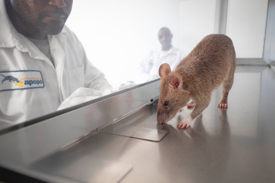
Carolina, the African Giant Pouched Rat, is checking this sample for traces of Tuberculosis. In resource poor areas of Africa, rats like Carolina are catching TB when routine microscopy falls short.
Photo credit: APOPO
JV: That’s incredible and such a good way to take advantage of these animals, by switching to a different scent to detect in a different environment. I wanted to jump back to Tuberculosis. I read that the rats are better at detecting TB than a say a more standardized test, is this true?
CF: Yes and no. We do know that the rats can sniff out the bacteria that causes the disease. But there are World Health Organization endorsed methods for diagnosing TB. Bacterial culture is the gold-standard, but it takes a long time. You have to wait 15 days or more to diagnose a patient or treat them. Plus, in resource poor areas of the world, a patient may travel to the city to get a test then they go back to their community and trying to find them again to start treatment is next to impossible.
Another option is molecular assays, which are super sensitive. But they require a really expensive machine with a lot of maintenance and stable power. Which, again, is something resource poor areas of the world don’t have.
Another option is microscopy, but when you have a low concentration it is very hard to see the bacteria. But the rat can smell it. We partner with health clinics using microscopy and then bring the samples back to our lab for the rats to sniff. If they indicate a sample the clinic found positive, we click and reward the rat. If they indicate a sample that the clinic said was negative, we flag it and use more sensitive concentrated smear microscopy to confirm the rat’s detection. Then we call the clinic to provide the results within 24-hours so the patient can begin treatment right away. With this model we have increased case detection by around 40%.
Career Background
JV: This is all very neat and we could talk for hours, but how did you get started, and what initially motivated you to pursue a doctorate in Psychology and Behavior?
CF: I’ve actually always been attracted to animal behavior, and was training pet ducks when I was very young. When I was an undergrad, I wanted to be a forensic psychologist to determine what made the criminally insane deviant in hopes of developing more effective rehabilitation and also preventing others from ever being deviant and the whole world would be a better place. Totally achievable, right? haha
JV: Oh, totally achievable, especially when you’re young.
CF: But during undergrad I really loved my courses on neuroscience and the professor took me aside and asked if I would be interested in getting involved in research. I was a little reluctant at first because I was such an animal lover and was unsure I could join the “dark side” of animal research. But I was super surprised to find out that rats were treated with so much respect and well cared for, and there are many measures in place to make sure they had comfortable lives and were treated well.
What I realized was that with research you can really understand the core of why we behave the way that we do. Our learning and memory guide our decision making. And, it’s much easier to ask those questions in animals because you can control their experiences. That’s what really motivated me to get a doctorate, and UCLA was perfect because of its collaborative environment. I could work with hermit crabs, pigeons, and rats. I collaborated to do neurosurgeries and imaging of immediate early genes and DREADDs.
JV: What motivated you to leave that higher level of science with specific questions on olfaction to a more applied setting?
CF: There were a couple of things. As my research expanded into neural mechanisms I got more interested in age-related cognitive decline, especially since losing smell is one of the first symptoms of Alzheimer’s disease. My goal was always to work with animals to eventually translate this into a meaningful impact to help people. But it got much harder for me to sacrifice animals every day. I know that the work is incredibly valuable and I am so glad that people are doing it but personally it wasn’t for me.
Then, APOPO was just perfect for me because it was applying all those same principles of learning to improving human lives directly. For example, I can say today my rat identified 20 TB patients. I have also visited minefields in Cambodia and watched one of the rats I trained find an unexploded ordnance that was right next to a children’s school. I certainly miss some aspects because I wish I could literally look inside this rat’s brain but I don’t do it.
JV: That’s such a great story. I also saw that you have an entire lab of students and postdocs so you are still managing a full lab like a PI would at a university.
CF: It’s actually very similar to a university. We have senior and junior researchers and student interns and postdocs. A big part of my job is working together with those students and the research team, analyzing results, securing grants. There’s less bureaucracy and it’s like we work together as a family.
JV: That essentially sounds like a PI. So are there opportunities for other people interested in working with APOPO that they could pursue it as a career?
CF: If you want to be directly involved with the rats for training and research or breeding, it's here in Tanzania. But we deploy our rats to operational programs where there's potential for research as well in places like Cambodia, Angola, Ethiopia, and Mozambique. And soon we'll have rats in Azerbaijan as well. In terms of TB detection, TB is a huge concern in places like India, so there’s a chance we could set up programs in these places. For our search and rescue research, maybe it’s the United States where we have lots of natural disasters and the rats could be quickly mobilized to these sites.
JV: What about other groups that are non-profit and do applied animal behavior applications?
CF: There are a few of them, most of them are using dogs. And it’s usually sector specific. There are groups training dogs for detection of wildlife or security applications at airports or urban search and rescue. There is a really great organization called Search Dog Foundation in the U.S. that is non-profit and they actually rescue dogs from shelters to train them to be search and rescue dogs.
JV: It’s too bad you can’t adopt rescued rats and train them like the dogs.
What would you say is your biggest accomplishment since starting at APOPO in 2016?
CF: This is a tough question. There’s just so much we are doing as an organization and so much to be proud of. One is really building the knowledge of my team. Most of my team are Tanzanians that don’t have access to psychology topics that we have at American universities. Concepts of reinforcement in neuroscience are completely novel. But by increasing knowledge of these concepts, it has really improved the efficiency of our training. I also think it has really empowered our team. Once they understand what the rat is going through, it is easier for them to troubleshoot training. That’s something I’m really proud of is empowerment that has come from training. I’ve started a new program for trainers to become a Technical Advisor in Training. It allows our Tanzanian trainers to travel to places like Cambodia, where rats are working, to work with the local team in real minefields. I had a Tanzanian woman who didn’t have a passport before joining our team, who is now leading a team of Cambodian deminers, working with rats that she trained here.
But at the end of the day we’re all working as a team, and why I joined APOPO is to save lives. Together as a team we’ve had 211 trained and accredited rats since I’ve joined the program, and each one of these has saved more than one life. That’s, I think, the hardest to top.
JV: As you started explaining what your biggest accomplishment was, I started to realize that it’s not about just one big achievement. You are constantly accomplishing something big by saving lives every day there in Africa, and even globally. That's a big accomplishment.
Is there anything else you might want to mention or talk about?
CF: I was curious if some of the members of APA Division 6 attend the CO3 Meeting, The International Conference on Comparative Cognitionopens in new window. It’s a wonderful conference that is held annually in Melbourne, Florida around spring break.
JV: That sounds really interesting, and I’ve never heard of it. I think members of our society would definitely be interested.
CF: Also, one other thing is that I think I have always believed in diversity and the strength and importance of it, but since being at APOPO, I see it daily. In terms of how we can innovate. I feel that creativity is driven by diversity. If you have a variety of backgrounds and knowledge and experiences, each one contributes something different. And, collectively it is much more creative and innovative, as long as everyone has a voice. When I talk to other groups I say to not be afraid to try new things. Opportunity doesn’t necessarily knock, but you don’t know if that door is locked if you don’t try to open it. To me, that’s connected to the whole innovation and creativity. I know that a lot of scientists struggle with “imposter syndrome” where you feel that you don’t really fit in. This isn’t your niche. But we’re all scientists and if you aren’t perfectly in that niche it is probably your strength because you are going to be more creative.
JV: Exactly! You are going to see things that other people don’t see.
Thank you so much for meeting with me.
CF: It was great to meet you and thank you for reaching out.
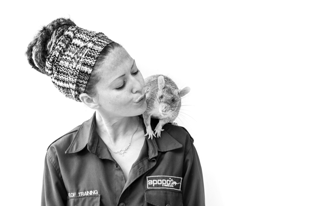
Dr. Cindy Fast and Kennedy.
Photo credit: APOPO
If you would like to know more about APOPO and their training protocols, follow the link below. You can also donate to APOPO by sponsoring a rat and you’ll get monthly updates on how many lives you’ve saved.
Scientific publications by APOPOopens in new window
Justin Varholick, PhD
Early Career Psychologists Network Rep.