

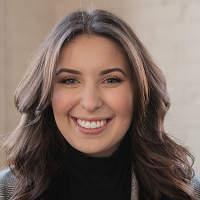
 I am currently a fifth-year doctoral student at Lehigh University studying counseling psychology with the goal of pursuing a career in geropsychology. For the past year and a half, I have been thinking about the families battling Alzheimer’s disease in the midst of the COVID-19 pandemic. Within my clinical work, I have heard countless stories of informal caregivers to individuals living with cognitive impairment who have felt incredible loss through decreased contact with family and friends, loss of respite services, and increased loneliness during this pandemic. I felt called to do more with my emerging expertise in geropsychology to not only help foster older adults’ wellbeing on an individual basis, but also more broadly on a systems level. That is why this January I began a volunteer advocacy position as an Alzheimer’s Congressional Team Member for the Alzheimer’s Impact Movement. In this role, I serve as one of the main points of in-district contact to Congresswoman Susan Wild (PA-7) and her congressional team. I integrate my training as a research-practitioner with my personal experience as a young caregiver to inform my advocacy efforts.
After both of my grandmothers passed away from Alzheimer’s disease, I began a life-long endeavor to advocate for older adults and informal caregivers within the field of psychology. This passion led me to pursue my doctoral degree and become more involved in professional organizations such as APA’s Div. 20. Through my involvement and leadership in several Div. 20 special interest groups and its mentor-mentee program, I learned about the importance of community in harnessing our collective voice to create change. This professional community led me to expand my community involvement more locally. Through my advocacy on the Alzheimer’s Congressional Team, I work closely with other advocates from my community. Advocacy has made me more engaged in the local community that my graduate school is located within and allowed me to step outside of academia in a way that is fulfilling to both my educational goals and personal relationships.
As a psychologist-in-training, I see firsthand how many of the policy priorities for the Alzheimer’s Impact Movement would be beneficial, and even life-changing, for many of my clients and their families. For example, I recently had the opportunity to meet with Congresswoman Susan Wild during the 2021 virtual Alzheimer’s Impact Movement Advocacy Forum. Two other advocates from my district and I shared personal stories with our Congresswoman related to three policy priorities to advocate for her support. In particular, I asked my congresswoman to support the bipartisan Equity in Neuroscience and Alzheimer’s Clinical Trials (ENACT) Act (S.1548/HR.3085), which seeks to increase representation of traditionally underrepresented groups in Alzheimer’s clinical trials. I conveyed my professional opinion about why equitable representation in research and clinical trials is of primary importance to the future of our field. My team was incredibly grateful to learn that Congresswoman Wild has since cosponsored all three bills we advocated for and recently joined the Congressional Task Force on Alzheimer’s disease.
Through becoming more involved in my professional communities and local communities, I have been able to join the national conversation about policies that will better the lives of many older adults in our country. Often, the personal is professional, and we can use our expertise as scientist-practitioners to advocate for older adults in our communities. Many organizations like the Alzheimer’s Association make it really easy to begin advocacy. There is also an APA Division 20 Special Interest Group (SIG) dedicated to Aging Policy and Social Activism (APSA). I hope that my story helps to inspire other students to engage in advocacy or build community around areas of adult development and aging that you are passionate about to continuously work to uplift older adults on both the individual and systems levels.