

As a developmental psychologist and thanatologist (someone who studies dying, death and non-death losses, and grief), I frequently find myself having to navigate challenges which can make or break a student’s success in my courses. Many are the variety all instructors face (illness, preexisting mental health concerns, neurodivergence, second-cousin’s goldfish’s grandmother died, etc.). Yet for some of us, the challenges are compounded by those which come within the course context, due to the evocative nature of what we are trying to teach. I have spent countless hours reading and studying how others approach trauma-informed pedagogy (all of which have influenced my current approach). More recently, several colleagues and I started a mind-meld - if you will - trying to capture how we approach teaching about death and dying, which we refer to as “Thanapedagogy” (full credit to Ilene Cupit, and Carla Sofka, Janet McCord, and myself during a late night preparing a talk on this in our hotel!).
However, pedagogical strategies for sensitive materials aren’t new, and Crumpton (2017, 2020) offers a (composite) list of best practices:
- Identify triggering material
- Invite students to consult the trigger warning
- Connect the topic to teaching landmarks
- Be attuned to affect and body language
- Have grounding exercises at the ready
- Listen for and point out themes
- Be intentional about self-disclosure
- Communicate a clear stopping point for the dialogue
These are strategies I use and employ all the time, but they are focused on the “what,” and part of our Thanapedagogy is about the “why” and the “how.” I care deeply about doing the best I can—I *am* that student who cried about my first A minus in graduate school. My long-suffering mum reality checked me with: but you got all A’s?!? To which I sobbed “But it’s a tarnished A!” To that end, I offer you my personal strategies that shape my attitudes, perspectives, and beliefs, on how I try to be a “Straight AAAA” Teacher.
- Appreciate
- Anticipate
- Accommodate
- Accept
The first step in my sequence is to Appreciate. Appreciation includes developing awareness, sense of awe, and habits to promote noticing the value of something and valuing challenges along the way…(Hurney et al., 2020, citing Fagley, 2016).
What we need to first appreciate is that it has been quite some time for many of us (shhh!) since we were on the other side of that desk. When we enter that educational sphere, we know not only the topic, but exactly what we are going to cover. I can’t tell you how many times I have taught Traumatology (as an elective, mind you), only to have a student share they are a recent trauma survivor, and had no idea they would be triggered (???). I must remind myself that not only am I the content expert (relatively speaking), but they are still maturing, and there is something so compartmentalizing and safe when a topic has an ‘ology’ after it. If a student shares their struggle with me early enough, I can help them navigate best options, using university resources available to them. Oftentimes, I find out too late for this approach, and my first indicator is late assignments, then multiple missed assignments, then an email with a shame-filled apology and a full confession of what they are experiencing. Other times it’s a series of unfortunate events that justify each deficit—akin to my goldfish satire earlier on. In these instances, I must purposefully and mindfully remind myself I am not their moral compass. At the end of it all, I don’t need to invest in finding the truth—the fact they felt the need to be dishonest is its own form of vulnerability and cry for help. It also frequently lets me know that they have learned that sharing their feelings isn’t safe—even if it’s test anxiety and not a true course content “trigger.” I’ve learned to acknowledge the need for an extension (yes, go to your friend’s pet rock’s funeral) and ask, “what can I do to better support you in the course/completing your assignments?”
The second A in my sequence is to Anticipate. I borrow from Blackburn’s (2020) trauma-informed pedagogy as I apply how I try to anticipate, but recognizing that I am not a fortune-teller, so I need to be open to discovery for what I failed to anticipate.
The first key in anticipating, is in the preparation—for myself, and in preparing my students! Although one might assume that trauma and courses on death and dying are the most triggering thing one might teach, I frequently find myself using my Thanapedagogy when teaching other potentially trauma-tizing courses…such as advanced statistics and psychometrics. One way I prepare my students is by setting their expectations for how challenging something might be. A fabulous former TA and I developed a legend for how scary the readings might be—neutralized by humor in that my students quickly learn I am a crazy animal-loving professor. Each reading on the syllabus is assigned an Alien Cat with the following ‘rubric.’ Since I started using this, I have found that I have fewer complaints about how difficult or unreasonable assigned readings are, and most encouraging of all, is that students will self-assign the more challenging readings for class discussions or article deconstruction papers.
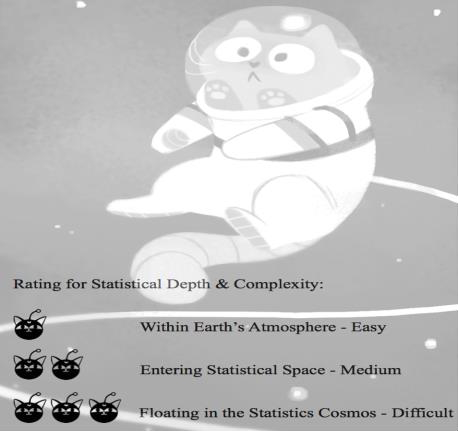
The next part of anticipating is being prepared for what might happen in the moment. I need to consider the class medium—are we online or in person, traditional v. non-traditional (life-stage), undergrad v. graduate students, etc. If it’s in person, we have to think ahead to how we might redirect, if necessary, how to interrupt a student who is oversharing without repelling them, how to intervene if two or more students start to argue. I’ll be honest, online is easier to interrupt (assuming we see the posting before others do!) …but even then, we run the risk of wounding a student. I never just delete a student’s overshare post or argument. What I have done in those cases is to unpublish the course, send a group announcement so they don’t panic the course has disappeared (depending on the course I may say I needed to fix links, reset something, etc.), I contact the student who is oversharing or arguing, explain why it’s problematic (which varies depending on the nature of the event), and offer them the choice in editing or deleting the concerning post. I empower them to course-correct.
In the moment anticipation is much more challenging in person, in that I can’t predict how others may respond, so it may require a blatant reset, where I acknowledge we have gone off-track, and offer to meet after class with any who wish.
The third step in my sequence is to Accommodate. Most literature on accommodations are tied specifically to learning disabilities and ADA, or experiential programs/materials. For the case of things outside of a formal student success-based accommodation, I ask myself the following questions:
- How can assignments be “triaged” based on student needs?
- What is the overarching course learning goal?
- What is the actual function of the assignment? (e.g., to demonstrate topic competency, or to demonstrate writing proficiency, etc.)
- What is a true measure of success? (i.e., for this program, course, assignment, and student)
Based on my answers to the above, I can triage options that best suit the needs of the course and the student. Some examples of accommodations I have used include:
- Alternative assignments already available
- Focus on sections/topics (e.g., if topic A is problematic, can competency still be achieved by doubling up on topic B? Is it a required course, or an elective—more flexibility in the latter!)
- Is some form of a buddy system between students an option without compromising the confidentiality of the student in crisis?
- Missed/late/dropped assignment v. program policies (can the student still pass by skipping an assignment or submitting it later?)
- Knowing in advance what my university’s policies are on retroactive withdrawals
- And my last resort, is the dreaded “Incomplete.” Many times, this may be the only option available - but BEWARE. If a student has too much work to complete before the university extension deadline, or their work was of insufficient quality regardless of timeliness, this is merely extending the discomfort for the student, and yourself. I look for a student to have no more than half the coursework remaining, and that they were in good standing (grade-wise) for assignments which were completed. If either of those questions is answered with a no, then retaking the course is often the most compassionate route for that student’s success.
My fourth and final step in the sequence is to Accept. This one is often the hardest for those of us who enjoy the controlled theatre of the classroom! We can’t avoid discomfort –theirs or ours, when teaching and learning about evocative topics. I try to help students to create brave spaces, not safe ones—being open to asking questions instead of assuming, to allow for misunderstandings, to be as clear as possible, and to model how to ask forgiveness when appropriate. We have to lean into learning—theirs and ours. The majority of my most successful approaches or tools in my toolbox are the direct result of classroom chaos that I had to navigate without knowing how to swim in that particular quagmire. And that leads to my last consideration: to remind myself that I will screw up. Repeatedly. Just channel 1990’s Blockbuster: Be kind—rewind—reset.