


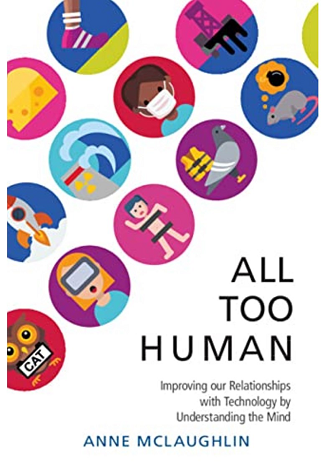
 Why do people fear air travel, but text while driving? How were the travesties at the Abu Ghraib prison like a nuclear meltdown? What is the best way to throw a rocket at a robot? These are just a few questions addressed by the field of human factors psychology. These scientists use knowledge of how people think and why they act to improve the design of our world. In All Too Human, McLaughlin introduces the field with vivid and topical stories that hinge on cognitive processes such as attention, memory, and decision-making. From the covid-19 pandemic, to abandoned scuba divers, conspiracy theories, and the travails of online dating, McLaughlin draws on a century of research into the human mind to explain our past and predict our future.
From the author
“I’ve always felt strongly about being an ambassador for our field, especially in a world where no one seems to know what we do or why we do it. I really felt this in Division 21 as we continued to shrink, and even felt it in HFES when it came to getting the message out about our research and methods to the general public. In writing this book, I took a page from the science writers I admired, bringing in history, narratives, and personal anecdotes to explain content about memory, attention, perception, and methods. Each chapter can stand on its own, because I thought instructors would like to pick and choose from the topics I cover. But they also flow together from applied content, to basic cognitive processes, and finally to general usability methods by the end of the book.
“My book is not a textbook—it certainly doesn’t take the place of a text like Engineering Psychology and Human Performance. I wanted it to be an approachable side text, one that will make for lively class discussions and leave students with an appreciation of our field.”
About the author
 Anne McLaughlin is professor of psychology at North Carolina State University, USA. She has worked as an educator and researcher in the field of human factors psychology and directs cutting-edge research on human behavior and cognition with research projects funded by NASA, the National Institutes of Health, and the National Science Foundation.