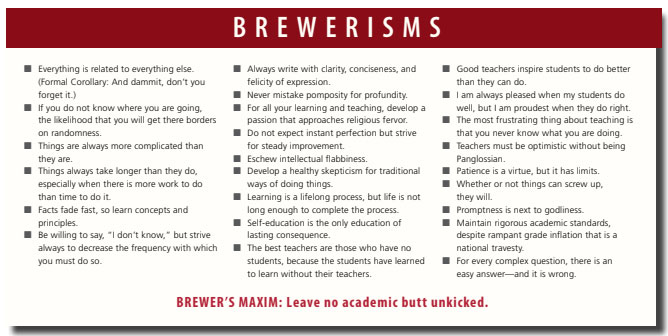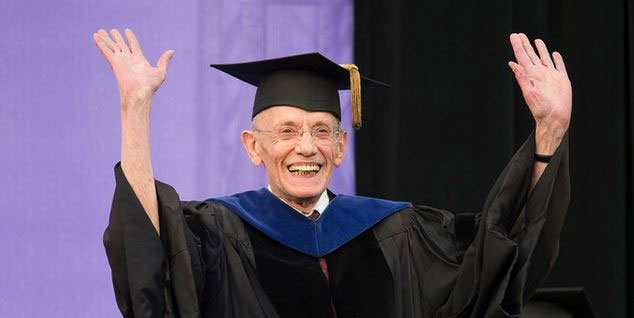
For this newsletter’s look into the distinguished history of Div. 3, we peek back just a few decades to the life of Charles L. Brewer, PhD, the scholar who preceded me as historian for our society. Professor Brewer — few in our field have served that title with such pride and distinction — died peacefully on March 30, 2018, at the age of 85. He contributed extensively to psychology in the areas of scholarship and service, but he is known best for his commitment to and achievements in teaching. As evidence of this, the American Psychological Foundation’s annual recognition for exemplary teaching, which Brewer received in 1989, was renamed the Charles L. Brewer Distinguished Teaching of Psychology Awardopens in new window in 2003.
Charles Brewer was born in Pine Bluff, Ark., on May 10, 1932, to Gazelle (Fikes) and Otis Brewer. Bo, as Charles was called at least into his college years, showed an early predilection for teaching, often playing school as a young child. Even at five or six years of age, a favorite activity was to pretend to be the teacher, writing on a chalkboard and calling on neighborhood kids as his “students.” This interest in teaching was accompanied by a passion for learning. Young Brewer excelled in and out of the classroom at Watson Chapel High School in Pine Bluff. He was class president and a star athlete, playing football and serving as captain of the varsity basketball team, for which he earned all-state honors
Following graduation in 1950, Brewer enrolled in Hendrix College in Conway, Ark., about 75 miles south of home. His favorite professor there was John P. Anderson, PhD, who had matriculated Columbia University. Anderson not only introduced Brewer to psychology but also served as one of his lasting role models for instruction. After earning his Bachelor of Arts from Hendrix in 1954, Brewer worked as a teaching apprentice at Little Rock Central High School in a Ford Foundation program designed to encourage liberal arts college graduates to become teachers. There he worked with another teaching mentor, Emily Penton, a Furman graduate, who further shaped Brewer’s pedagogical philosophy and skills.
 "From the beginning, I knew I wanted to teach. The question is, 'What do you want to teach?'"
(Photo taken from Bo Brewer’s 1951 Hendrix College yearbook.)
Brewer subsequently enrolled at the University of Arkansas for graduate study in counseling, working with Donald Kausler, PhD (1927-2008). Kausler had earned his doctorate at Washington University St. Louis, under the direction of Wilse (Bernie) Webb. With Kausler, Brewer published his first two articles, both studies of the Taylor Manifest Anxiety Scale, both of which appeared in 1959. He earned a MEd in counseling before a two-year stint in the Army interrupted his schooling but not his learning. He served in Intelligence as the chief of Southeast Asia desk at the Psychological Warfare Center in Tokyo Japan. There Brewer helped to analyze radio and television output from Hanoi. It was work Brewer greatly enjoyed, as it was filled with new experiences and new learning. During this time, he was also able to teach psychology in Tokyo at an extension campus of the University of Maryland.
Brewer returned to the University of Arkansas to earn another master’s degree (MA, 1959) in general experimental psychology. The next two stops in Brewer’s circuitous route would take him back out of his home state, first to a teaching position at the College of Wooster in Ohio for two years and then into the psychology doctoral program at Indiana University to work with memory researcher Lloyd Peterson and learning researcher Isidore Gormezano. However, a bout with appendicitis and a realization about the type of faculty position he would ultimately want — one that emphasized teaching rather than research productivity — led Brewer to return to the University of Arkansas to study with Hardy Culver Wilcoxon (1921-1996), a comparative psychologist who had trained at Yale as Hull’s last doctoral student. The two experiments in Brewer’s 1965 dissertation, published in 1969 in Journal of Experimental Psychology, were careful and rigorous but rather derivative parametric manipulations of presentation rate, duration and stimulus meaningfulness on paired-associate learning of consonant-vowel-consonant nonword syllables. He found that meaningfulness and stimulus duration decreased learning time but that presentation rate only affected learning of low-meaningfulness syllables. Brewer (1969) concluded that the “findings also suggest the need for more systematic analysis of what S’s actually do during a learning trial” (pg. 159) — an intriguing comment from a psychologist who would spend the next five decades focused on what and how students actually learn.
By the time the dissertation was published, Brewer was a faculty member at Elmira College in New York, where he spent three years teaching. One day he received an unprompted phone call from Provost Francis (Frank) Bonner of Furman University, inviting Brewer to Greenville, S.C., to interview for an associate professor faculty position. Bonner found Brewer’s combination of research credentials and teaching experience to be ideal for his vision of what the psychology department should becom and charged Brewer to revamp psychology into a rigorous academic curriculum rooted in behavioral science. Brewer had revised the psychology curriculum at Elmira and so was equal to the task. In 1967, Brewer, his wife Marjorie (Suhs), whom he met at Wooster and wed in 1962, and their daughter Stephanie (born in 1966) journeyed to South Carolina, where they would remain as part of the Furman community for the next five decades.