

On May 5, 2023, our Early-Career Committee held a virtual event entitled, “Candidate Perspectives on the Academic Job Market.” Our goal was to empower candidates on the academic job market, and to inspire search committees to be more equitable and inclusive in their practices. Thanks to the over 60 people who tuned in via zoom! Our event included perspectives from three amazing panelists who were recently successful on the academic job market in psychology: Paige Boydston, PhD (Pittsburg State University), Nayantara Kurpad.PhD (St. Mary’s College of Maryland), and Cristina Zepeda, PhD (Vanderbilt University).

Candidate Perspectives event panelists: Paige Boydston, PhD, Nayantara Kurpad, PhD, and Cristina Zepeda, PhD
To start our event, we shared some data we collected via an informal survey. The survey was circulated via various society listservs and was completed by about 40 candidates who had recent experience with the academic job market. Most of these respondents were from Cognitive or Developmental psychology, located in North America or Europe, and were current graduate students, postdocs, or assistant professors. Below, we present a summary of responses.
Question 1: What are some words or phrases that capture how you feel or felt about being on the academic job market?
The most common responses were “stressful”, “time-consuming,” “exhausting,” and “overwhelming”. Candidates also noted more positive feelings, such as excitement and hope.
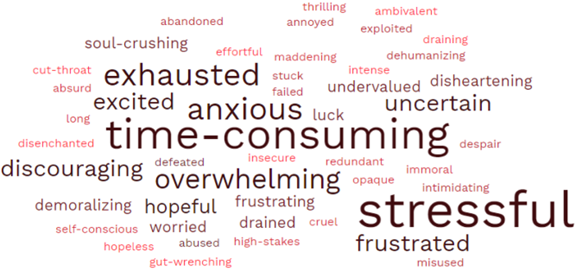
Wordcloud depicting candidate responses to how they feel or felt about being on the academic job market.
Question 2: How did you find a job or jobs to apply for?
Candidates found jobs in a variety of places. Here are the most common responses:
-
Listservs run by societies like Division 2opens in new window, Division 3, SPARK Society,opens in new window or the Cognitive Development Societyopens in new window
-
Personal network (e.g., emails from colleagues)
-
Social media (e.g., Twitter, LinkedIn, Google)
-
Specific college or university websites (e.g., to find jobs in a particular region)
Question 3: What were some factors that influenced your decision to apply to particular jobs?
The most common response was “location”. Candidates also mentioned factors such as:
-
Type of institution (e.g., teaching vs. research focus, private vs. public)
-
“Fit” with position (based on research, qualifications, culture, etc.)
-
Responsibilities of position (e.g., teaching load)
-
Institution or department reputation
-
Salary
Question 4: When the question was phrased in a slightly different way - What were some factors that influenced your decision to NOT apply to particular jobs? - candidates mentioned some additional factors:
-
Specific application requirements, such as requiring letters of recommendation up front or requesting overly specific statements (e.g., “how will you contribute to the mission of our college?”)
-
Unreasonable job expectations/high workload
-
Perceived lack of qualifications
-
Low pay and/or lack of resources
-
Job contingent on grant funding
-
Department drama
Question 5: Have you had any positive experiences while on the academic job market?
Candidates mentioned a multitude of positive experiences, summarized below along with supporting quotes from respondents.
-
Support from colleagues and peers
-
“People have been extremely generous. I have always felt support from peers to read materials, to boost my confidence in applying for positions I may not feel competitive for, and to commiserate with.”
-
-
The process
-
Learning about oneself
-
“Being on the academic job market helped me hone my skills as a communicator. It forced me to learn how to better explain my work to those outside of my field.”
-
“Refining materials, developing a teaching philosophy, understanding and contextualizing my contributions to diversity”
-
-
Campus interviews
-
“Getting to talk about research and potential futures all day? Amazing”
-
“I enjoyed visiting different colleges and seeing how they were run”
-
-
Feedback and validation
-
“…hearing kind words from chairs of departments or chairs of search committees after the interviews were done, whether I got the job or not, just felt so good!”
-
-
Getting the job!
Question 6: Have you had any negative experiences while on the academic job market?
Being on the job market can feel like a rollercoaster of ups and downs. Here were some of the negative experiences reported by candidates.
-
Applications and the waiting game
-
“…having to balance job applications while also conducting research and doing your 'other' job”
-
“Most of my negative experiences come from the dread that takes place when you are waiting to hear back from someone.”
-
-
Uncertainty
-
“Just the uncertainty of not knowing different places timelines as you are trying to make decisions”
-
“The timing of receiving offers was stressful, because when an offer came in, it was hard to know whether another school I’d interviewed with was still considering me.”
-
-
Disorganization
-
“For an on campus interview, they asked me to prepare a teaching talk with two weeks' notice. Then a week out, gave me additional constraints that changed the entire approach I had to take for the talk.”
-
“Zoom interview questions that were unclear.”
-
-
Lack of communication
-
“No response from a position I interviewed for.”
-
Unfortunately, this response was very commonly reported.
-
-
Rejection
-
“Getting rejected from a job after the on campus visit with the most generic email.”
-
“There is a bit of whiplash that comes from getting excited about a potential job then never hearing back from them.”
-
Note that some of these negative experiences can be avoided by cognizant search committees!
With these general experiences in mind, our primary advice for search committees involves taking an applicant-centered approach by keeping three principles in mind: (1) Transparency, (2) Respect, and (3) Equity and Inclusivity.
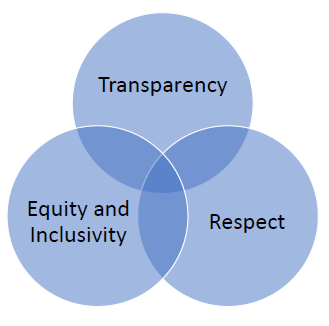
Taking a candidate-centered approach involves keeping three principles in mind: (1) Transparency, (2) Respect, and (3) Equity and Inclusivity.
Below we provide some specific ways to make the search process transparent, respectful, equitable, and inclusive – from the job ad to the job offer:
Tips for Job Ads
-
Make sure applicants know the expectations for the position, such as desired experience, research/academic background, and values. Provide a timeline for the search process.
-
Be specific about job responsibilities, expectations, and daily activities. For example, what courses will the candidate be expected to teach, and what does a 3-3 teaching load really mean?
-
When asking for materials from applicants, add details about what should be included and acceptable lengths (e.g., a 2-4 page research statement with sections on past research, future directions, and how you will involve students in your research). Be specific about what you are looking for (e.g., “evidence for teaching effectiveness” could take multiple forms, such as student evaluations of teaching, sample syllabi, or recorded lectures). Include details about how you will evaluate potential candidates (e.g., what rubric will you use for evaluating DEI statements?).
-
Respect candidates’ and colleagues’ time and consider whether you need all materials provided up front. For example, perhaps certain statements and letters of recommendation can be provided after the first cut is made.
-
Applicants will be referencing department, college, university, and faculty-members’ websites as they put their materials together. Make sure these sites are up-to-date and fix any broken links.
-
Include or link to helpful reference information, such as the department’s faculty handbook, course catalog, information about where to live, policies on parental leave and dependent tuition assistance, benefits, housing and relocation services, faculty affinity groups, collaborations, the departmental philosophy regarding DEI and current initiatives, and information about the community (e.g., local colleges/universities, local conferences, community partners, and location about the distance to attractions, airports, etc.)
For an example of a transparent job ad, visit Skidmore’s 2022 Open Rank Tenure Stream in Psychology searchopens in new window.
Tips for off-site interviews
-
Before the interview: Tell candidates what to expect. Who will be on the call? How long will the call last? How many questions will be asked? Will there be a specific protocol that will be followed during the interview? (e.g., cameras on or off, no follow up questions will be asked to ensure each candidate has a similar experience).
-
Type questions into the chat for applicants to reference, especially if you are asking multi-component questions. Even better: Provide the interview questions ahead of time, so candidates can enter the interview feeling confident and prepared!
-
End the meeting with a search process timeline. Where are you in the process? When will they hear from you? (e.g., “We had zoom interviews with 7 applicants, we are inviting 2-3 out for on-site interviews next month.”).
-
Follow up with updates as soon as you are able. Let them know if they made the next cut and how that cut was decided. Provide any relevant feedback to candidates.
Tips for on-site interviews
-
Provide candidates with their schedule well in advance, and clearly explain expectations for each event. For example, who will be attending the candidate’s job/teaching talk? What should they expect from their meeting with graduate students versus a meeting with the dean? Will they have to provide their credit card when checking in to their hotel?
-
On-site interviews can be exhausting! Build multiple breaks into the candidates’ schedule. Make sure everyone who meets with the candidate respects the schedule so candidates have enough time to get to their next meeting or take a break as needed.
-
Be flexible in the process! Consider that different candidates will require different accommodations. Provide examples of possible accommodations you can offer so applicants feel empowered to ask for them (e.g., a portable microphone for the job talk, smaller group dinner, dietary accommodations, access to a fridge, a lactation room, travel funds for family members that will be traveling with the applicant, etc.). Provide a contact who is not involved in hiring decisions who can answer questions about any accommodations.
-
All that said, try not to make schedules that vary drastically between different applicants (e.g., one applicant gives a job talk at the beginning of the day, another at the end of the day), as these differences can unintentionally bias judgments.
Tips for the offer & negotiation process
-
Once the candidate accepts the offer, let the other applicants know. Provide feedback and be kind ˗offer words of encouragement/acknowledgement of the challenging process. Consider asking them for feedback on the process, too!
-
Ask recent hires if they would be willing to share their startup requests or give additional advice about the process to incoming faculty (e.g., things they wished they’d known to do or ask for).
Finally, meet with everyone who was involved in the search process to discuss what went well and what could be improved while ideas are fresh on people’s minds. Acknowledge any mistakes and strive for improvement in future searches.
Thank you to our event panelists and survey respondents for these great suggestions! This is by no means a complete list of suggestions, but we hope it helps search committees make improvements to the process.
Here are some additional resources that may be useful for both candidates and search committees to reference:
-
PsychJobSearch.Wikidot.comopens in new window - Crowdsourced site intended to provide information to applicants about the status of academic job searches in all areas of psychology.
-
PINE Lab Job Market Resourcesopens in new window - Advice for applicants about navigating all parts of the academic job market.
-
Berkeley’s Rubric for Assessing Candidate Contributions to Diversity, Equity, Inclusion, and Belongingopens in new window.