

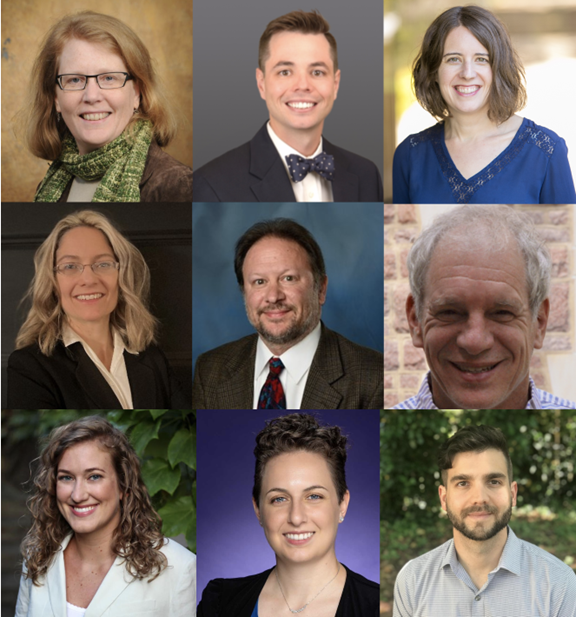
 Division 3 Leaders: Top Row (L to R): Kristi Multhaup, Gene Brewer, Marianne Lloyd; Middle Row: Anne Cleary, Jeffrey Katz, Mark McDaniel; Bottow Row: Nadia Brashier, Michelle Rivers, Laurent Prétôt
Kristi Multhaup
Institution: Davidson College
Role: Division 3 President (2022-23)
Webpageopens in new window
Twitteropens in new window
Biography: Kristi has served multiple leadership roles within Division 3, including Newsletter Co-Editor and Member-at-Large. Her research focuses on cognitive aging, particularly memory. Her student collaborators have expanded her thinking into new areas, such as collective memory.
Fun fact: Kristi is on the leadership team for Women in Cognitive Scienceopens in new window!
“I belong to APA and Division 3 because I believe psychologists of all specialties must work together. The size of an organization like APA is needed to effectively advocate for issues I care deeply about, such as science funding. I ran for President to (a) help the division expand its traditional partnerships and learn what the membership needs from the leadership team, and (b) show faculty at liberal arts colleges and primary-undergraduate institutions that they can hold leadership positions in professional societies.”
Gene Brewer
Institution: Arizona State University
Role: Division 3 President (2023-24)
Webpageopens in new window
Twitteropens in new window
Biography: Gene’s lab studies how people control their attention and memory in service or pursuing goals. He has served multiple leadership roles within Division 3, including Member-at-Large and APA Council Representative.
Fun fact: Gene enjoys teaching and mentoring the next generation of students!
“I work with APA Division 3 because I think it is a wonderful opportunity to contribute to a large group of psychological scientists and practitioners. Also, I have always found Division 3 to be a warm and collegial environment with great colleagues who truly care about the future of our discipline. There are many benefits from being a member of Division 3 including opportunities for networking, promoting psychological science, and learning more about how experimental psychology can contribute to important societal issues.”
Reach out to Geneopens in new window!
Marianne Lloyd
Institution: Seton Hall University
Role: Treasurer (2020-23)
Webpageopens in new window
Twitteropens in new window
Biography: Marianne’s research is focused on memory and how it makes a difference in the laboratory by studying illusions, in the classroom by studying how alternative grading approaches impact students, and in satisfaction with one's spiritual life by studying how spacing effects play out in perceptions of faith. In the past, Marianne served as Division 3 Secretary. She is also involved in leadership for the SPARK societyopens in new window and the Psychonomic Societyopens in new window.
Fun fact: Marianne loves teaching research methods, running at a comfortable pace, and spending time with friends and family!
“As a leader in Division 3, I have met dedicated and thoughtful folks who want to make a difference for the next generation of academics and scientists. I enjoy meeting people from the discipline outside of my research area.”
Anne Cleary
Institution: Colorado State University
Role: APA Council Representative (2023-26)
Webpageopens in new window
Twitteropens in new window
Biography: Anne studies human memory processes and metacognitive aspects of memory, conducting research on familiarity-detection, deja vu, tip-of-the-tongue experiences, and how all of these relate to curiosity, information seeking, and learning. What keeps Anne motivated as an educator are all of the constant new developments in research on the science of learning as it applies to education.
Fun fact: Anne began playing piano for the first time at age 41 and continues to regularly take lessons and play!
“I see Division 3 as representing a field of psychology that is underrepresented within APA (experimental/cognitive psychology), giving that field a place at the APA table. APA's Science Directorate can be a useful resource for psychological scientists, and APA's journals are among the top in our field. APA also takes Diversity, Equity, and Inclusion very seriously and carries out important work in this area, both within and outside of the organization. Finally, APA has a significant presence in Washington DC, which is important on many fronts, such as for communicating to congress the important work of psychologists.”
Jeffrey Katz
Institution: Auburn University
Role: Member-at-Large (2021-24)
Webpageopens in new window
Biography: Jeff’s research focuses on the comparative mechanism of learning and cognition. Ongoing projects involve behavioral and functional neuroimaging methods to investigate dog-human attachment and the behavioral and neural correlates of working dogs. Jeff is a long-standing member of Division 3 and has previously served as the Program Chair and on the Fellowship Committee.
Fun fact: Jeff loves to teach, and his hobbies include hiking, geocaching, birding, and playing guitar!
“Jeff’s research focuses on the comparative mechanism of learning and cognition. Ongoing projects involve behavioral and functional neuroimaging methods to investigate dog-human attachment and the behavioral and neural correlates of working dogs.”
Mark McDaniel
Institution: Washington University in St. Louis
Role: APA Council Representative (2023-26)
Webpageopens in new window
Biography: Mark’s research focuses on human learning and memory, with an emphasis on prospective memory, encoding and retrieval processes in episodic memory and applications to educational contexts. Mark’s current projects are revealing individual differences in learners’ tendencies to abstract or learn examples in their learning of concepts, ranging from neuroimaging to classroom investigations, and developing effective learning-strategy training for students. These projects intersect with one of the greatest rewards in education — applying the science of learning to assist students in becoming enthusiastic, capable learners.
Fun fact: Mark has been applying learning techniques to develop skills in a new favorite hobby: Pickleball!
“I am a leader in Division 3 to help the division thrive and serve our members. Division 3 helps develop connections with a diverse range of experimental and cognitive psychologists, in terms of interests, career level, background, and demographic characteristics.”
Nadia Brashier
Institution: Purdue University
Role: Program Committee Chair (2022-23)
Webpageopens in new window
Twitter
Biography: Why do people believe that coronavirus is a bioweapon or that Biden stole the 2020 election? Nadia studies memory and judgment across the lifespan, with a focus on cognitive “shortcuts” people use to evaluate truth. Her lab uses behavioral and neuroimaging tools to investigate why young and older adults fall for misinformation. Nadia is a first-generation college graduate and is happy to provide career advice to those who come from a similar background.
Fun fact: Nadia was named a Rising Star by the Association for Psychological Science in 2022!
“Cognitive science can inform solutions to real-world problems, like the misinformation crisis and eyewitness misidentification. My role in the division allows me to shine a spotlight on scientists doing excellent applied research.”
Michelle Rivers
Institution: Texas Christian University
Role: Early-Career Committee Chair (2021-24)
Webpageopens in new window
Twitteropens in new window
Biography: Michelle’s research aims to (1) identify, (2) develop, and (3) describe the underlying cognitive mechanisms of techniques that improve self-regulated learning and metacognition, both in educational settings and across the lifespan. They have served multiple leadership roles within APA, including advocating for graduate student voting rights within the organization, developing diverse programming for students and ECRs, and serving as an associate editor for the graduate-student run journal, Translational Issues in Psychological Science. Michelle is passionate about sharing cognitive science research with diverse audiences and runs the blog cogbites.orgopens in new window
Fun fact: When they’re not in the lab, Michelle enjoys connecting with nature, listening to podcasts, and figure skating!
“As a Division 3 representative, I work with my fellow leaders to support and empower early-career scientists. Some of our current initiatives include highlighting exciting research on our Division 3 Twitteropens in new window account (and developing programming in which ECRs and more senior researchers can learn from each other.”
Laurent Prétôt
Institution: Pittsburg State University
Role: Early-Career Committee Member (2021-24)
Webpageopens in new window
Twitteropens in new window
Biography: Laurent’s research examines the psychological mechanisms underlying behavior, with a focus on the factors influencing decision-making at two levels: evolutionary and developmental. His evolutionary work investigates decision-making in ecological dilemmas, using a cross-taxon comparative approach. His developmental work complements his research with animals by exploring the factors influencing children’s decision-making in social dilemmas. Exploring how decision-making changes over evolutionary and ontogenetic times allows us to better understand the full scope of species’ behavior.
Fun fact: Laurent’s previous workopens in new window showed that a species of cleaner fish (Labroides dimidiatus) outperforms several primate species on a cognitive test!
“Joining the Early Career Committee of Division 3 has been one of my best experiences in academia. It is an immense privilege to represent young scientists and promote them through various initiatives, including showcasing their work on social media, organizing events to help them navigate the academic job market, and advocating for their needs as they transition from one stage of their career to another.”