


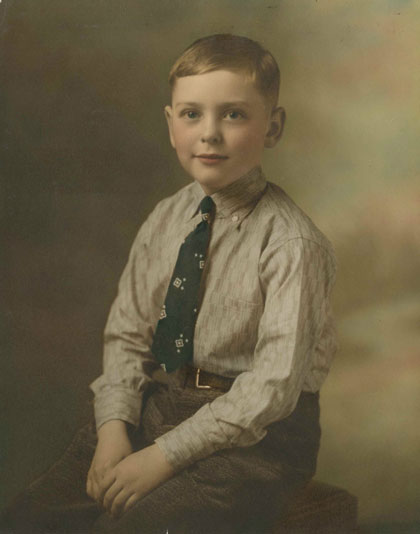
He went to OSU’s career counseling center and took a battery of interest and aptitude tests. The results indicated that he had an aptitude for math, was good with details, and enjoyed working with people. So, he applied to OSU’s doctoral program in psychology and was accepted.

OSU’s psychology department has a long history, starting in 1907 and awarding its first PhD in 1917 (Wherry, 1968). From the beginning, the department’s policy was to encourage students to study “all recognized phases of psychology and to retain them under a unitary organization” (Weiss, 1927, p. 434). Kirk’s concentration was in experimental psychology (minor in industrial), with much of his work focusing on psychoacoustics. During the 1952–53 academic year, Kirk was awarded a research assistantship under Francis Robinson (counseling faculty). In the 1953–54 academic year, he was awarded a teaching assistantship — a position he held for two and a half years while completing the PhD requirements (Kirk, 1955 ).

In 1955, at the age of 25, Kirk completed his dissertation: Learning, a major factor influencing preferences for high fidelity reproducing systems. This research combined his love of music with his newly developed skills in experimental psychology.
After graduating from OSU, he accepted a position at the Baldwin Piano and Organ Company in Cincinnati, Ohio, as a senior psychoacoustic engineer. He spent three years there studying how to improve the sound quality of their acoustic and electronic pianos and organs. At that time, Baldwin had research contracts with the Communication and Navigation Laboratory at Wright-Patterson Air Force Base in Dayton, Ohio. This research involved finding ways to improve speech communication in high-ambient-noise environments, and Kirk was involved in many of these studies.
While at Baldwin, Kirk was already showing evidence of scholarly productivity. He published three peer-reviewed articles along with four technical reports on psychoacoustics. In addition, his research on speech communication systems led to his receiving a patent for a microphone (U.S. Patent No. 2,958,740, 1960). This patent resulted from his research on methods for providing communication in high ambient noise areas such as around jet aircraft. He created a novel noise-canceling microphone that was approximately the size of a half-dollar. The microphone was positioned on the user’s forehead instead of in front of the mouth (“Psychology Professor Receives US Patent,” 1959).

In 1957, while still working at Baldwin, Kirk taught an introductory psychology class in the Evening Division at the University of Kentucky, Northern Center in Covington, Kentucky, now called Northern Kentucky University. This experience rekindled an interest in teaching that he first developed as a teaching assistant at OSU. Soon thereafter, he applied for and was offered a position as an assistant professor in psychology at Baylor University in Waco, Texas).
Kirk joined the Baylor University faculty in the fall of 1958. At that time, Baylor’s psychology department had just started its doctoral program, and Kirk was hired to aid in the developing a strong research program (“Business School, Psychology Add Four Faculty Members,” 1958). Kirk’s work at this time largely focused on psychoacoustics (the study of responses to sound), which was a new area for Baylor’s experimental psychology program (“Dr. Kirk Brings Baylor University New Field of Study This Year,” 1958).
By all accounts, Kirk was exceptional at his job. He quickly earned tenure and promotion to associate professor in 1960. Not long after, in 1964 he was promoted again to full professor, and from 1969-76 he directed the psychology department’s graduate program.
When Kirk started at Baylor, new professors in psychology were given statistics courses to teach because no other faculty wanted to teach them. Such was the case with Kirk. His first teaching assignments were an undergraduate introductory statistics course and a graduate course on experimental design. While these were not courses in which he had special expertise, he soon developed a love for teaching the content.
After teaching quantitative courses for several years, Kirk decided that he wanted more training in statistics and quantitative methods. In 1971, he was awarded a National Science Foundation postdoctoral fellowship to study mathematical psychology at the University of Michigan. Several years later, he was awarded a position as a visiting professor of psychology and statistics at Seinan Gakuin University in Fukuoka, Japan.

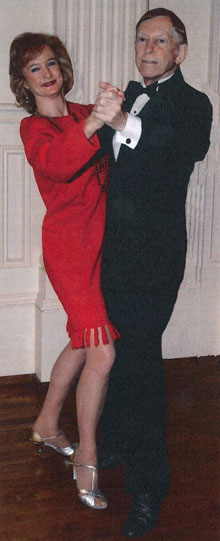
After his return to Baylor, Kirk was involved in two major events. First, he met Jane Abbott, a new professor of piano at Baylor, on a blind date. The two fell in love and married on June 26, 1983. In the early 1990’s they developed a new passion: ballroom dancing. They have been dancing, teaching dancing and competing ever since, and have twice won the Texas State Senior Games ballroom championships in foxtrot, waltz and rumba.
Second, Kirk organized the doctoral program in behavioral statistics in 1976. This program lasted until 1991, when it evolved into an interdisciplinary Institute of Statistics — a joint effort of the Departments of Psychology & Neuroscience, Mathematics, and the School of Business. After directing the program for 25 years, Kirk stepped down to devote more time to writing and research. In 2004, the institute became the Department of Statistical Science.
Kirk is a master in the field of quantitative methods, both in terms of scholarship and pedagogy. He has more than 130 publications, including seven statistics books. His first book, “Experimental Design: Procedures for the Behavioral Sciences” is now in its fourth edition and was designated a Citation Classic (Institute for Scientific Information, 1979). His introductory statistics book is in a fifth edition and is widely used.
During his long and distinguished career, he has been the recipient of many honors and awards. He is a past president of the Society for Applied Multivariate Research, the Southwestern Psychological Association, and Div. 5 of the American Psychological Association (APA). He is a fellow of five divisions of APA (Divs. 1, 2, 5, 13 and 21). He also is a fellow of the American Association for Psychological Science and the American Educational Research Association.
Kirk’s scholarship has earned him multiple awards. He is Distinguished Professor of Psychology and Neuroscience. This title, given rarely at Baylor, is reserved for professors whose outstanding scholarship and national reputation for excellence in his or her academic discipline greatly exceed the bounds of scholarship exemplified by most if not all other faculty members in that academic unit at Baylor (Tenure-Track/Tenured Faculty, 2016). In 2017 he was honored by the Texas Psychological Association with their Distinguished Lifetime Achievement Award.

In addition to his scholarship, Kirk has received numerous awards for his teaching. In 1992 Baylor gave him the Outstanding Tenured Teacher in the College of Art and Sciences award. In the following year, he earned the title Master Teacher—the university’s highest teaching award. Master Teacher appointments were created to be the highest honor granted to Baylor faculty members for sustained excellence in teaching at Baylor University. The appointments are based on the profound impacts of faculty members in the classroom and on students’ lives as judged by the record of the faculty members’ achievements and the observations of the various nominators. (Master Teachers at Baylor University, 2013)
In 2005, APA Div. 5 gave him the Jacob Cohen Award for Distinguished Contributions to Teaching and Mentoring. He won the 2012-13 Cornelia Marschall Smith Professor of the Year award at Baylor for his “superlative teaching and outstanding research contributions.” More recently, in 2015, he won APA’s Charles L. Brewer Award for Distinguished Teaching of Psychology.
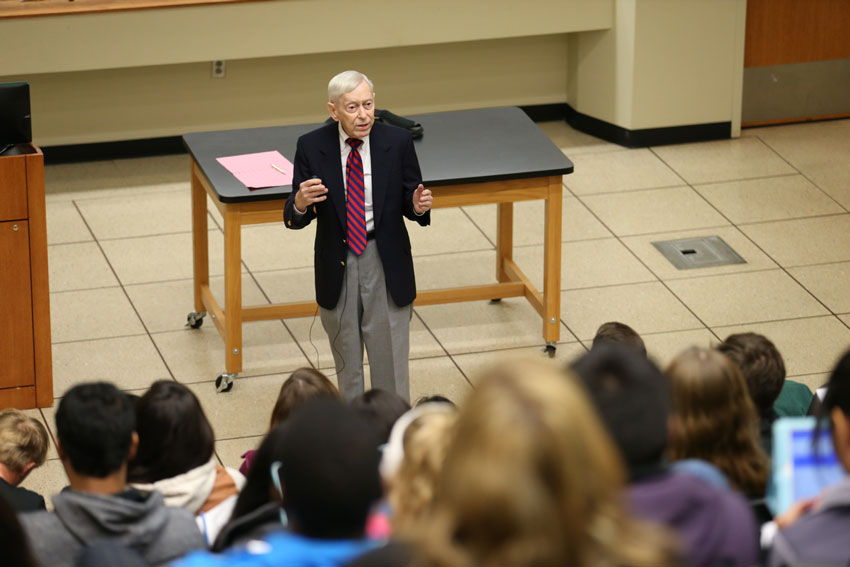
Kirk’s greatest legacy, however, might be the impact he made in the classroom. During his 60 years at Baylor, he supervised more than 20 PhD students and has taught statistics to virtually every psychology major for more than 50 years—literally thousands of students. He has been a model of excellence in the way he has carried out his scholarship and the joy with which he approached his teaching. More than anything, we are grateful that we have had a chance to interact with such a distinguished scholar, Master Teacher and wonderful gentleman.
References
Business School, Psychology Add Four Faculty Members (1958, 18 September). Baylor Lariat, p. 1
Charles l. Brewer Award for Distinguished Teaching of Psychology. (2015). American Psychologist, 70, 384-385. doi:10.1037/a0039387
Dr. Kirk Brings Baylor University New Field of Study This Year (1958, 18 November). Baylor Lariat, p. 1
Institute for Scientific Information. (1979). This week’s citation classic. Current Contents Social & Behavioral Sciences, 45, 55.
Kirk, R. E. (1960). U.S. Patent No. 2,958,740. Washington, DC: U.S. Patent and Trademark Office.
Kirk, R. E. (1955). Learning, a major factor influencing preferences for high fidelity reproducing systems. (Unpublished doctoral dissertation). Ohio State University, Columbus, OH.
Tenure-Track/Tenured Faculty (2016). In Baylor faculty handbook. Retrieved from https://www.baylor.edu/provost/index.php?id=948458opens in new window
Psychology Professor Receives US Patent (1959, 2 October). Baylor Lariat, p. 1
Roger Kirk is Beating the Odds (2015, Spring), Baylor Arts & Sciences Magazine, 22-29.
Weiss, A. P. (1927). The psychological laboratory of Ohio State University. Journal of Experimental Psychology, 10, 434-445. doi:10.1037/h0070131
Wherry, R. J. (1968). A statistical history of the department of psychology at The Ohio State University 1907-1968. Columbus, OH: The Ohio State University
W.R. White Meritorious Service Award: Roger E. Kirk. (2016, Fall). Baylor Magazine. Retrieved from https://www.baylor.edu/alumni/magazine/1501/index.php?id=936198