




 This article reports two tests of a model whereby hassles partially mediate the effects of adaptive coping on outcomes. That is, it attempts to determine whether adaptive coping could reduce adverse outcomes and contribute to positive ones, partly by diminishing people’s exposure or negative response to hassles. We use the tentative word, “could”, because our studies are cross-sectional, rendering causal inference inconclusive. Correspondingly, we titled this article a “pilot testing”. Elsewhere, we rejected an obvious alternative model, that adaptive coping mitigates the adverse impact of hassles by showing that hassles and adaptive coping both strongly affect outcomes, positive and negative without interacting (Kohn & O’Brien, 1997; Kohn et al, 2023).
Hassles are mundane irritants, frustrations, and setbacks which, taken singly, have little adverse impact, but cumulatively, are important sources of stress, e.g. time-pressure, interpersonal conflicts and cash-flow problems (Kanner et al., 1981). As to coping, research suggests that problem-focused coping works better with stressors seen as controllable and emotion-focused coping with ones considered uncontrollable (Ben Zur et al., 2005; Conway & Terry, 1992; Forsythe & Compas, 1987; Zakowski et al., 2001) in accordance with the goodness-of-fit hypothesis (Forsythe & Compas, 1987; Zakowski et al., 2001). This may explain why individual coping styles add little to stressor-exposure alone in accounting for outcomes (Day & Livingstone, 2001; Kohn et al., 1994; Lu, 1991; Nakano, 1991).
Superficially, the goodness of fit hypothesis and supporting data undercut the usefulness of individual coping measures. Our theoretical response is adaptive coping, a dispositional individual-difference variable (Kohn, 1996; Kohn et al., 2003). This is consistency of responding in a stress-reducing manner to stressful situations and of acting to prevent them from arising to begin with. In other words, adaptive coping is both reactive and preventive (Kohn & Filardo, 2003; Schwarzer and Knoll (2003). Theoretically, it combines three elements: sound judgment in assessing stressful situations for controllability, and deciding how best to cope with them; determination to act on one’s judgment, despite personal inertia and social opposition; and self- control in regulating one’s emotional response to stress and avoiding counterproductive emotional responses to stressors, e.g. outbursts at work superiors or legal authorities. Adaptive coping thus reflects not mere flexibility, but rather consistently appropriate and, therefore, generally effective flexibility.
The mediation hypothesis implies that the beneficial effects of adaptive coping on outcome are partially mediated through hassles exposure. This is because adaptive copers tend to minimize their exposure to hassles, experience them less intensely, or both. As well, they are predisposed to maintain better adjustment and morale regardless of level of stress-exposure, hence the direct unmediated impact of adaptive coping on outcome. Presumably, this reflects adaptive copers’ prior history of reduced exposure or emotional response to hassles via mediation.
Study 1
Study 1 tested the mediation model with three positive-outcome variables: personal- emotional, academic and social adjustment to university by undergraduates. The predictors were adaptive coping and hassles. The mediation model predicted that hassles would partially mediate the effects of adaptive coping on all three kinds of adjustment. A serious limitation of Study 1 (like Study 2) is that it’s cross-sectional rather than longitudinal. This limits the conclusiveness of causal inferences from a well-fitting model.
Because the mediation model does not directly deal with correlated structural errors, we treated these empirically. In practical terms, such correlations between structural errors mean that predictors missing from the model for pairs of criterion variables are not independent, i.e., that the criterion variables either shared some of the same missing predictors or that the missing predictors correlated across criterion variables. For instance, social support (Taylor, 2011) which was not part of the model could be a missing predictor for any pair of criterion variables.
Method
The participants were 178 volunteering undergraduate psychology students at York University, 34 men and 144 women. (The large female preponderance was characteristic there at the time of data collection.) Participants ranged in age from 18 to 24 (M = 21.26, SD = 1.34).
After a brief explanation to prospective participants, those volunteering signed a consent form. They then responded to the following materials in the order indicated: demographic information, the Personal Functioning Inventory (PFI; Kohn et al., 2003), the Inventory of College Students’ Recent Life Experiences (ICSRLE; Kohn et al., 1990) and the expanded version of the Student Adjustment to College Questionnaire (SACQ; Baker & Siryk,, 1986). Participants then received a verbal debriefing that explained the study more thoroughly than the initial explanation and consent form had.
The PFI, a 30-item balanced measure of adaptive coping, exhibited strong internal consistency and stability as well as correlating negatively with perceived stress, positively with problem-solving confidence and self-ratings for adaptive coping, and, to demonstrate discriminant validity, no significant relationship with abstract curiosity (Kohn et al., 2003). The ICSRLE, a 49-item hassles scale, has shown good internal consistency and high positive correlations with Cohen et al.’s (1983) Perceived Stress Scale (Kohn et al., 1990). The expanded version of the SACQ (Baker & Siryk., 1986), a 69-item scale, consists of subscales for personal/emotional, academic and social adjustment plus institutional attachment. (We omitted institutional attachment from our analyses because it shares items with social and academic adjustment.) The SACQ showed acceptable reliabilities, ranging from 0.79 to 0.92, for all subscales. Baker and Siryk (1984) demonstrated convergent and discriminant validity for the original version via correlations between the subscales with criteria that were more relevant to one particular subscale than to the others, e. g. freshman grade-point average for academic adjustment. Validation of the extended version included a high rate, 78%, of correct self- identification of strength or weakness in whatever areas of adjustment an interviewed student had an extreme SACQ score.
Major analysis for the mediation model was via path analysis. Data screening, means, SDs, reliabilities and correlations are based on SPSS 26 and path analyses on the student version of LISREL 9.1.
Results and Discussion
Data Screening. Data screening revealed one multivariate outlier. Accordingly, we excluded them from all further analyses, leaving an effective N of 177.
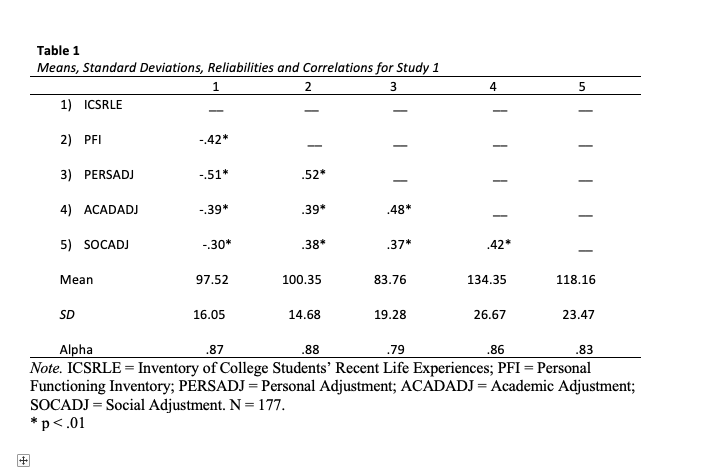
Correlations, Descriptives and Reliabilities. Means, SDs, correlations and reliabilities appear in Table 1. All reliabilities proved acceptable, ranging from 0.79 for the SACQ’s personal/emotional adjustment subscale to 0.88 for the PFI. Hassles and adaptive coping showed a moderate negative correlation. Whereas hassles correlated negatively with personal-emotional, academic and social adjustment, adaptive coping related positively to all three. Finally, the three adjustment subscales intercorrelated positively.
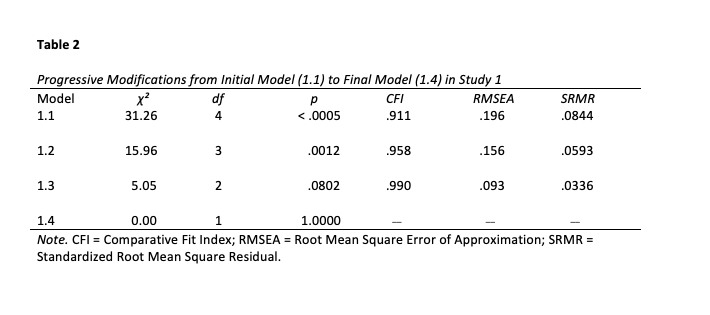
Path Analysis. We made no initial assumptions about whether any of the structural errors for the criterion variables were correlated. Accordingly, we tested four versions of our model. Model 1.1 which assumed no correlations among criterion variables fit poorly as Table 4 shows. The largest ModificationIndex in this model, 14.58, was for correlated structural errors for social adjustment and academic adjustment. Accordingly, we freed this correlation in Model 1.2 which Table 2 shows also fit poorly in terms of chi-square and RMSEA values. Because the highest Modification Index in Model 1.2, 83.03, was for the correlation between structural errors for personal adjustment and academic adjustment, we freed this correlation in Model 1.3. The result was distinctly improved fit, as Table 2 shows; however, there remained a significant Modification Index, 4.93, p < 0.05 for the correlation between structural errors for social adjustment and personal adjustment. When we freed this correlation in Model 1.4, the fit achieved thereby proved perfect, χ2 (1, N = 177) = 0.00, p = 1.00. The fact that freeing parameters one by one rendered earlier models nested within later ones permitted use of the subtractive chi-square method to test the significance of improved fit for each change. All models after Model 1.1 showed significantly improved fit over their immediate predecessors. Chi-square values, with 1df for each change, were as follows: 15.30, p < 0.001 for Model 1.1 to Model 1.2; 10.91, p < .001 for Model 1.2 to Model 1.3; and 5.05, p < 0.05 for Model 1.3 to Model 1.4. Although perfect fit is gratuitous at 0 df, this is not so from 1 df up, as Cramer (2003) illustrated. Nonetheless, it would be reassuring to show that the basic model still fits acceptably with the inclusion of more predictors with more missing paths and hence more degrees of freedom. We also wished to establish generalizability from positive to negative outcomes. Study 2 addresses these issues. The estimated paths for the final model appear in Figure 1. All were statistically significant. Despite the model’s perfect fit, the squared multiple correlations for endogenous variables were quite modest: 0.18 for hassles, 0.38 for personal emotional adjustment, 0.22 for academic adjustment and 0.17 for social adjustment. The substantial contributions of adaptive coping to hassles and to all three adjustment variables nevertheless contrasts sharply with the weak contributions of coping measures to outcomes in earlier research (Day & Livingstone, 2001; Kohn et al., 1994; Lu, 1991; Nakano, 1991). Notably, the hypothesized mediation effects for adaptive coping through hassles to adjustment all proved significant: 0.21 for academic, z = 3.20, p = 0 .0014; 0.12 for social, z = 2.14, p =0 .0324; and 0.19 for personal, z = 4.06, p < 0.00006.
Study 2
Study 2 used three criterion variables: perceived stress, psychiatric symptomatology and somatization. It also included major life events as an exogenous predictor. Major life events are dramatic negative occurrences which, even singly are commonly expected to have considerable adverse impact, e.g. bereavement, and criminal victimization. Surprisingly, research clearly indicates that, cumulatively, hassles over a week to a month are far more impactful than cumulative major life events over six months to two years (Chamberlain & Zika, 1990; Chan & Lee, 1992; de Benedittis & Lorenzetti, 1992; Fernandez & Sheffield, 1995, 1996; Kanner et al., 1981; Landreville & Vezina, 1992; Lewis et al., 2015). In fact, several studies concluded that hassles fully mediate the impact of major life events on adverse outcome (Fernandez & Sheffield, 1996; Johnson & Sherman, 1997; Rowlison, 1992; Stefanek et al.,2012). An important difference between major life events and hassles is this: Whereas one can view major life events as mere happenstance, this is not so for hassles. There is little correlation between individual major life events because there’s little reason why, for example, bereavement and criminal victimization should correlate. (In fact, the alpha reliability of the major-life events measure in Study 2 was merely 0.11.) In contrast, hassles measures have proven to be both internally consistent and stable over time (Chamberlain & Zika, 1990; Da Costa et al., 1999; Fillion et al., 2001; Hannan et al., 2015; Hazel & Hankin, 2014; Kao & Lynn, 2009; Kohn & Filardo, 2003; Travis et al., 2003; Vollrath, 2000). This makes it seem possible that adaptive coping affects both how well one deals with hassles and how many one encounters. This accords with Schwarzer and Knoll’s (2003) view that coping has reactive and preventive aspects. The mediation model posits that hassles mediate the effects of both adaptive coping and major life events on adverse outcomes. We assume mediation to be partial for adaptive coping for reasons stated above and full for major life events as per the literature (Fernandez & Sheffield, 1996; Johnson & Sherman, 1997; Rowlison, 1992; Stefanek et al., Spiel, 2012).
Method
The participants were 128 volunteering introductory psychology students at York University, 24 men, 103 women and one person who didn’t indicate gender on the questionnaire. (Again, the substantial female preponderance was characteristic of introductory psychology classes at York University at time of testing). Participants’ mean age was 21.02 (SD = 4.49). After hearing the study explained, and filling out the consent form, volunteers responded to the following in the order indicated: demographic information; the ICSRLE (Kohn et al., 1990); the List of Threatening Experiences (LTE; Brugha, et al., 1985), a 12-item checklist of major life events which are both common, and "moderate to marked" in long-term threat; the PFI (Kohn, et al., 2003); the Perceived Stress Scale (PSS; Cohen et al., 1983), a 14-item measure of subjective distress; the Hopkins Symptom Checklist-21 (HSCL-21; Green et al., 1988), a 21-item measure of psychiatric symptomatology; and the Health Problem Inventory-Revised (HPI-R; Kohn et al., 1994), a 20-item measure of recent experience with minor physical ailments (e.g., colds, digestive upsets and flu). The ICSRLE, PSS, HSCL-21 and HPI-R were all time- referenced to the past month, and the LTE to the past six months. Responses to the LTE simply indicated having had the itemized experience (Yes) or not (No). We described the psychometric information for the ICSRLE and PFI in Study 1. The LTE has demonstrated strong consistency of respondents' reports over a one-day interval and strong agreement with the reports of collaterals (Brugha & Cragg, 1990). These authors also showed that respondents viewed the events listed as "moderate to marked" in long-term threat. The PSS and the HSCL-21 have adequate test-retest and internal-consistency reliabilities (Cohen et al., 1983; Deane et al., 1992, respectively). As for validity, the PSS correlates predictably with life-events scores, clinical symptomatology and utilization of health services (Cohen et al., 1983). The HSCL-21 has proven to distinguish clinical and nonclinical populations, to reflect therapeutic progress, and to correlate with measures of anxiety as well as psychiatrically rated symptomatology (Deane et al., 1992). Finally, the HPI-R shows good internal consistency, represents 20 of the most commonly reported minor physical ailments, and correlates positively with hassles (Kohn, Gurevich et al., 1994; Kohn et al., 1997). The HSCL-21 includes several items with somatic concerns. In fact, its content apparently reflects three factors: subjective distress, somatic distress and concerns about one’s effectiveness (Cepeda-Benito & Gleaves, 2000; Green et al., 1988).
Results
Data Screening. Data screening revealed that the HSCL-21 and HPI showed substantial positive skew (z = 3.58, p = .0004 and z = 3.30, p = .001, respectively) and identified eight univariate outliers, all on the LTE. Accordingly, we removed the outliers, leaving an effective N of 120, and subjected HSCL-21 and HPI scores to the common-log transformation, which reduced skew effectively (z = 0.28, p = 0.78 and z = -0.87, p = 0.38, respectively).
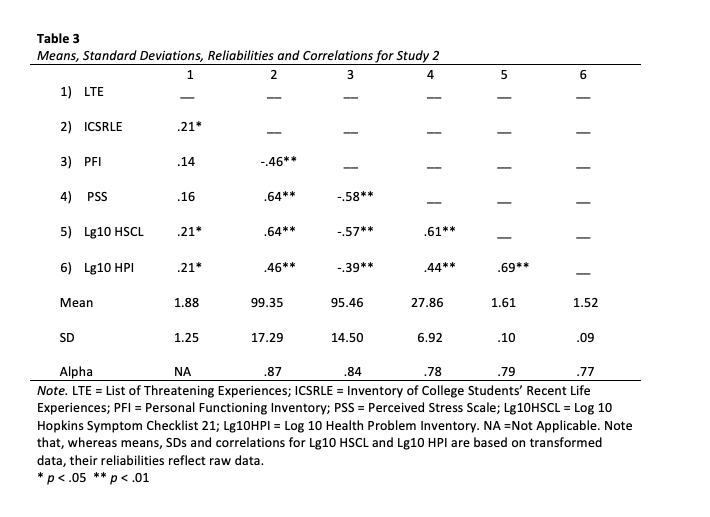
Correlations, Descriptives and Reliabilities. Table 3 shows the means, SDs, alpha reliabilities and intercorrelations for the major variables. All reliabilities were adequate, save the LTE’s, as reported, which we deemed “not applicable” for reasons stated. The LTE exhibited weak but significant positive correlations with the ICSRLE, Lg10 HSCL-21and Lg10HPI. The ICSRLE and PFI correlated moderately highly with all three adverse-outcome measures, positively for the ICSRLE and negatively for the PFI. The ICSRLE and PFI showed a moderately strong negative relationship. Finally, the three outcome measures all intercorrelated positively.
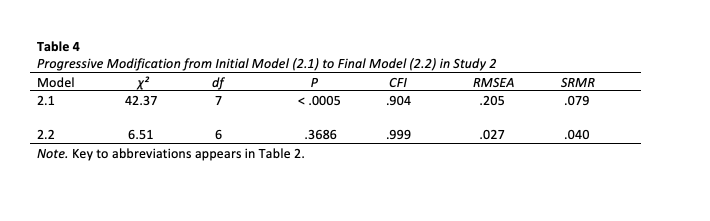
Path Analysis. The original version of the mediation model showed unacceptable fit as Table 4 shows. The Modification Index for the correlation between structural errors for Lg10HSCL-21 and Lg10 HPI was large at 35.86. Accordingly, we freed this correlation in our final model for which we can offer a plausible explanation, namely that the HSCL-21 has some content which reflects somatic distress, the defining content of the HPI. Anyhow, Table 4 shows that Model 2.2, showed excellent fit to the data. Furthermore, the chi-square difference test with 1 df, took a value of 35.86, p = 0.001, indicating significant improvement for Model 2.2 over Model 2.1. The final model appears in Figure 2. It is notable that the path from the LTE to the ICSRLE does not meet the usual criterion for statistical significance. The path coefficient is 0.15, z = 1.83, p = .0672 (two-tailed). The decision to retain this path reflects two considerations. First, our sample size is modest for a path analysis. Second, several published studies found that major life events affect exposure to daily hassles (e.g., Fernandez & Sheffield, 1996; Johnson & Sherman, 1997; Rowlison, 1992; Stefanek et al., 2012). These circumstances make a Type 2 error for this path plausible. The final model, shown in Figure 2, showed excellent fit to the data: x2(7, N = 120) = 7.05, p = 0.4239; CFI = 1.00; SRMR = .0387 and RMSEA = 0.00753. Furthermore, it accounted for substantial variability in its endogenous variables: 0.23 for the ICSRLE, 0.52 for PSS, 0.50 for Lg10HSCL-21 and 0.25 for Lg10HPI. It is notable that these values generally exceed those found in Study 1. Again, the substantial contributions of adaptive coping to all three outcome variables contrasts sharply with the weak correlations of individual coping measures with outcomes in earlier research (Day & Livingstone, 2001; Kohn et al.,1994; Lu, 1991; Nakano, 1991). Also, the hypothesized mediation effects for adaptive coping through hassles to outcomes all proved significant: -0.21 for PSS, z = - 4.20, p = 0.00006; -0.21 for Lg10HSCL, z = -4.19, p = 0.00006; and -0.16 for Lg10HPI, z = 3.29, p= 0.0011. Regrettably, the results for mediation of major life events through hassles approached but didn’t meet the usual 0.05 criterion for significance: .070 for PSS, z = 1.78, p = 0.075; 0.071 for Lg10HSCL, p = 0.075; and 0.054 for Lg10HPI, z =1.69, p = 0 .091. Again, we choose to retain these effects in the model because of the extensive literature supporting them, our modest N and their close approximation to statistical significance.
General Discussion
Our work was designed to test the hypothesis that hassles mediate the effects of major life events fully and adaptive coping partially on outcomes. The results are quantitatively consistent with the mediation hypothesis vis-à-vis both positive and negative outcomes. These results do not, however, prove the validity of our mediation path models. What they do show is that our models fit their respective datasets, making them clearly preferable to alternatives that do not. The results also indicate that the concept of adaptive coping may prove more valuable predictively than earlier more specific coping-style constructs like problem-focused and emotion-focused coping (Carver et al., 1989; Endler & Parker, 1990a, 1990b; Folkman & Lazarus, 1980) as well as avoidance-focused coping (Carver et al., 1989; Endler & Parker, 1990; Miller, 1990). This is because the concept of adaptive coping enables one to deal with the apparent fact that which coping style works best depends on the controllability of immediate stressors (Ben Zur et al., 2005; Conway & Terry, 1992; Forsythe & Compas, 1987; Zakowski et al., 2001). As to the argument that goodness-of-fit theory explains why traditional coping measures add so little to the prediction of adverse outcomes over and above stressor-exposure (Day & Livingstone, 2001; Kohn et al. 1994; Lu, 1991; Nakano, 1991), we found the PFI to contribute substantially to all outcomes, positive and negative, with its combination of direct and indirect effects. Our studies have limitations aside from being cross-sectional. One is that the sample sizes, notably for Study 2, are modest for path-analytic research. Another is that we found it necessary in Study 2 to include pathways that failed to achieve the usual standard of statistical significance. Both studies could use replication and extension. For example, one could incorporate additional predictors such as, say, social support (Taylor, 2011). Finally, our work also has practical implications. Seemingly, having both reactive and preventive aspects makes adaptive coping a particularly valuable quality to enhance via, say, stress-management programs. The development and testing of ways to achieve this should prove worthwhile.
References
Baker, R. W., & Siryk, B. (1984) Measuring adjustment to college. Journal of Counseling Psychology, 31(2), 179-189. https://doi.org//10.1037/0022-167.31.2.179opens in new window
Baker, R. W., & Siryk, B. (1986). Exploratory intervention with a scale measuring adjustment to college. Journal of Counseling Psychology, 33(1), 31-38. https://dx.doi.org./10.1037/0022-0167.33.1.31opens in new window
Ben-Zur, H., Yagil, D., & Oz, D. (2005). Coping strategies and leadership in the adaptation to social change: The Israeli kibbutz. Anxiety, Stress & Coping: An International Journal, 18, 87-103. https://doi.org/10.1080/10615800500093702opens in new window
Brugha, T., Bebbington, P., Tennant, C., & Hurry, J. (1985). The List of Threatening Experiences: A subset of 12 life event categories with considerable long-term contextual threat. Psychological Medicine, 15(1), 189-194. https://doi.org/10.1017/S003329170002105Xopens in new window
Brugha, T. S., & Cragg, D. (1990). The List of Threatening Experiences: The reliability and validity of a brief life events questionnaire. Acta Psychiatrica Scandinavica, 82(1), 77-81. https:// doi.org/10.1111/j.1600-0447.1990.tb01360.opens in new window
Carver, C. S., Scheier, M. F., & Weintraub, J. K. (1989). Assessing coping strategies: A theoretically based approach. Journal of Personality and Social Psychology, 56(2), 267. https:// doi.org/10.1037/0022-3514.56.2.267opens in new window
Cepeda-Benito, A., & Gleaves, D. H. (2000). Cross-ethnic equivalence of the Hopkins Symptom Checklist-21 in European American, African American, and Latino college students. Cultural Diversity and Ethnic Minority Psychology, 6(3), 297-308. https://doi.org/10.1037/1099-9809.6.3.297opens in new window
Chamberlain, K., & Zika, S. (1990). The minor events approach to stress: Support for the use of daily hassles. British Journal of Psychology, 81(4), 469-481. https:// doi.org/10.1111/j.2044-8295.1990.tb02373.xopens in new window
Chan, D. W., & Lee, H. B. (1992). Hassles, life events, and health status among Chinese college students in Hong Kong. International Journal of Psychosomatics, 39(1-4), 44-55. https://ezproxy.library.yorku.ca/login?url=https://www.proquest.com/scholarly-journals/hassles-life-events-health-status-among-chinese/docview/618278006/se-2opens in new window
Cohen, S., Kamarck, T., & Mermelstein, R. (1983). A global measure of perceived stress. Journal of Health and Social Behavior, 24(4), 385-396. https:// doi.org/10.2307/2136404opens in new window
Conway, V. J., & Terry, D. J. (1992). Appraised controllability as a moderator of the effectiveness of different coping strategies: A test of the goodness of fit hypothesis. Australian Journal of Psychology, 44(1), 1-7. https://doi.org/10.1080/00049539208260155opens in new window
Cramer, D. (2003). Advanced quantitative data analysis. Maidenhead, UK: Open University Press.
Da Costa, D., Larouche, J., Dritsa, M., & Brender, W. (1999). Variations in stress levels over the course of pregnancy: Factors associated with elevated hassles, state anxiety and pregnancy-specific stress. Journal of Psychosomatic Research, 47(6), 609-621. https://doi.org/10.1016/S0022-3999(99)00064-1opens in new window
Day, A. L., & Livingstone, H. A. (2001). Chronic and acute stressors among military personnel: Do coping styles buffer their negative impact on health? Journal of Occupational Health Psychology, 6(4), 348-360. https://doi.org/10.1037/1076-8998.6.4.348opens in new window
Deane, F. P., Leathem, J., & Spicer, J. (1992). Clinical norms, reliability and validity for the Hopkins Symptom Checklist-21. Australian Journal of Psychology, 44(1), 21-25. https://doi.org/10.1080/00049539208260158opens in new window
de Benedittis, G., & Lorenzetti, A. (1992). The role of stressful life events in the persistence of primary headache: Major events vs. daily hassles. Pain, 51(1), 35-42. https://doi.org/10.1080/00049539208260158opens in new window
Endler, N. S., & Parker, J. D. A. (1990). Coping Inventory for Stressful Situations: Manual. Toronto: Multi-Health Systems, Inc.
Fernandez, E., & Sheffield, J. (1995). Psychosocial stressors predicting headache occurrence: The major role of minor hassles. Headache Quarterly, 6(3), 215-220. https://ezproxy.library.yorku.ca/login?url=https://www.proquest.com/scholarly-journals/psychosocial-stressors-predicting-headache/docview/618919683/se-2opens in new window
Fernandez, E., & Sheffield, J. (1996) Relative contributions of life events versus daily hassles to the frequency and intensity of headaches. Headache: The Journal of Head and Face Pain, 36(10), 595-602. https://doi.org/10.1046/j.1526-4610.1996.3610595.xopens in new window
Fillion, L., Kohn, P., Gagnon, P., Van Wijk, M., & Cunningham, A. (2001). The Inventory of Recent Life Experiences for Cancer Patients (IRLE-C): A decontaminated measure of cancer-based hassles. Psychology & Health, 16(4), 443-459. https://doi.org/10.1080/00049539208260158opens in new window
Folkman, S., & Lazarus, R. S. (1980). An analysis of coping in a middle-aged community sample. Journal of Health and Social Behavior, 21(3), 219-239. https://doi.org/10.2307/2136617opens in new window
Forsythe, C. J., & Compas, B. E. (1987). Interaction of cognitive appraisals of stressful events and coping: Testing the goodness of fit hypothesis. Cognitive Therapy and Research, 11(4), 473-485. https://doi.org/10.1007/BF01175357opens in new window
Green, D. E., Walkey, F. H., McCormick, I. A., & Taylor, A. J. (1988). Development and evaluation of a 21-item version of the Hopkins Symptom Checklist with New Zealand and United States respondents. Australian Journal of Psychology, 40(1), 61-70. https://doi.org/10.1080/00049538808259070opens in new window
Hannan, J., Youngblut, J. M., Brooten, D., Bazzani, D., Romero, N. R., Chavez, B., & Picanes, J. (2015). Psychometric properties of newly translated Spanish Life Events Inventory and Daily Hassles Scale. Journal of Nursing Measurement, 23(2), 315-325. https://doi.org/10.1891/1061-3749.23.2.315opens in new window
Hazel, N. A., & Hankin, B. L. (2014). A trait-state-error model of adult hassles over two years: Magnitude, sources, and predictors of stress continuity. Journal of Social and Clinical Psychology, 33(2), 103-123. https://doi.org/10.1521/jscp.2014.33.2.103opens in new window
Johnson, J. G., & Sherman, M. F. (1997). Daily hassles mediate the relationship between major life events and psychiatric symptomatology: Longitudinal findings from an adolescent sample. Journal of Social and Clinical Psychology, 16(4), 389-404. https://doi.org/10.1521/jscp.1997.16.4.389opens in new window
Kanner, A. D., Coyne, J. C., Schaefer, C., & Lazarus, R. S. (1981). Comparison of two modes of stress measurement: Daily hassles and uplifts versus major life events. Journal of Behavioral Medicine, 4(1), 1-39. https://doi.org/10.1007/BF00844845opens in new window
Kao, H. S. & Lynn, M. R. (2009). Use of the measurement of medication administration hassles with Mexican-American family caregivers. Journal of Clinical Nursing, 18(18), 2596-2603. https://doi.org/10.1111/j.1365-2702.2008.02752.xopens in new window
Kohn, P. M. (1996). On coping adaptively with daily hassles. In M. Zeidner, & N.S. Endler (Eds.), Handbook of coping: Theory, research, applications. (pp. 181-201). Oxford: John Wiley & Sons.
Kohn, P. M. & Filardo, E.-A. (2003, February). Adaptiveness, hassles exposure, and outcome: A longitudinal comparison of three models. [Poster presentation] Annual meeting of the Society for Personality and Social Psychology, Los Angeles and Universal City, CA, United States.
Kohn, P. M., Gurevich, M., Pickering, D. I., & MacDonald, J. E. (1994). Alexithymia reactivity, and the adverse impact of hassles-based stress. Personality and Individual Differences, 16(6), 805-812. https://doi.org/10.1016/0191-8869(94)90225-9opens in new window
Kohn, P. M., Hay, B. D., & Legere, J. J. (1994) Hassles, coping styles, and negative well-being. Personality and Individual Differences, 17(2), 169-179. https://doi.org/10.1016/0191-8869(94)90023-Xopens in new window
Kohn, P. M., Lafreniere, K., & Gurevich, M. (1990). The Inventory of College Students’ Recent Life Experiences: A decontaminated hassles scale for a special population. Journal of Behavioral Medicine, 13(6), 619-630. https://doi.org/10.1007/BF00844738opens in new window
Kohn, P. M., & O'Brien, C. (1997). The Situational Response Inventory: A measure of adaptive coping. Personality and Individual Differences, 22(1), 85-92. https://doi.org/10.1016/S0191-8869(96)00176-6opens in new window
Kohn, P. M., O'Brien, C., & Pickering, D. I. (1997). Adaptiveness: A moderator of the adverse impact of hassles? Personality and Individual Differences, 22(6), 895-899. https://doi.org/10.1016/S0191-8869(96)00275-9opens in new window
Kohn, P. M., O'Brien-Wood, C. Pickering, D. I., & Decicco, T. L. (2003). The Personal Functioning Inventory: A reliable and valid measure of adaptiveness in coping. Canadian Journal of Behavioural Science/Revue Canadienne Des Sciences Du Comportement, 35(2), 111-123. https://doi.org/10.1037/h0087193opens in new window
Landreville, P., & Vézina, J. (1992). A comparison between daily hassles and major life events as correlates of well-being in older adults. Canadian Journal on Aging, 11(2), 137-149. https://doi.org/10.1017/S0714980800011685opens in new window
Lewis, J. V., Abramowitz, S., Koenig, L. J., Chandwani, S., & Orban, L. (2015). Negative life events and depression in adolescents with HIV: A stress and coping analysis. AIDS Care, 27(10), 1265-1274. https://doi.org/10.1080/09540121.2015.1050984opens in new window
Lu, L. (1991). Daily hassles and mental health - a longitudinal study. British Journal of Psychology, 82(4), 441-448. https://doi.org/10.1111/j.2044-8295.1991.tb02411.xopens in new window
Miller, S. M. (1990). To see or not to see: Cognitive information styles in the coping process. In M. Rosenbaum (Ed.), Learned resourcefulness: On coping skills, self-control, and adaptive behavior (pp. 95-126). New York, NY: Springer.
Nakano, K. (1991). The role of coping strategies on psychological and physical well-being. Japanese Psychological Research, 33(4), 160-167.
Rowlison, R. T. (1992). Major life events, hassles, and adaptation in adolescence: A comparison of alternative theoretical models using structural equation modeling. Available from APA PsycInfo®. (618197682; 1992-77430-001). https://ezproxy.library.yorku.ca/login?url=https://www.proquest.com/dissertations-theses/major-life-events-hassles-adaptation-adolescence/docview/618197682/se-2opens in new window
Schwarzer, R & Knoll, N. (2003). Positive coping: Mastering demands and searching for meaning. In S.J. Lopez & C.R. Snyder (Eds.), Positive psychological assessment: A handbook of models and measures (pp. 393-409). American Psychological Association, Washington, DC. https://doi.org/10.1037/10612-025opens in new window
Stefanek, E. Strohmeier, D., Fandrem, H., & Spiel, C. (2002). Depressive symptoms in native and immigrant adolescents: The role of critical life events & daily hassles. Anxiety, Stress & Coping, 25, 201-217.
Taylor, S. E. (2011). Social support: A review In H. S. Friedman (Ed.), Oxford library of psychology. The Oxford handbook of health psychology (pp. 189-214). New York, NY, US: Oxford University Press. https://doi.org/10.1093/oxfordhb/9780195342819.013.0009opens in new window
Travis, S. S., Bernard, M. A., McAuley, W. J., Thornton, M., & Kole, T. (2003). Development of the Family Caregiver Medication Administration Hassles Scale. The Gerontologist, 43(3), 360-368. https://doi.org/10.1093/geront/43.3.360opens in new window
Vollrath, M. (2000). Personality and hassles among university students: A three-year longitudinal study. European Journal of Personality, 14(3), 199-215. https://doi.org/10.1002/1099-0984(200005/06)14:3<199::AID-PER372>3.0.CO;2-Bopens in new window
Zakowski, S. G., Hall, M. H., Klein, L.C., & Baum, A. (2001). Appraised control, coping, and stress in a community sample: A test of the goodness-of-fit hypothesis. Annals of Behavioral Medicine, 23(3), 158-165. https://dx.doi.org/10.1207/S15324796ABM2303opens in new window
Figure 1. Path Diagram for Final Mediation Model, Study 1
Note: All three adjustment variables come from the Student Adjustment to College Questionnaire. For key to abbreviations, see Table 1. *p < .05 **p < .01

Figure 2. Path diagram for Final Mediation Model
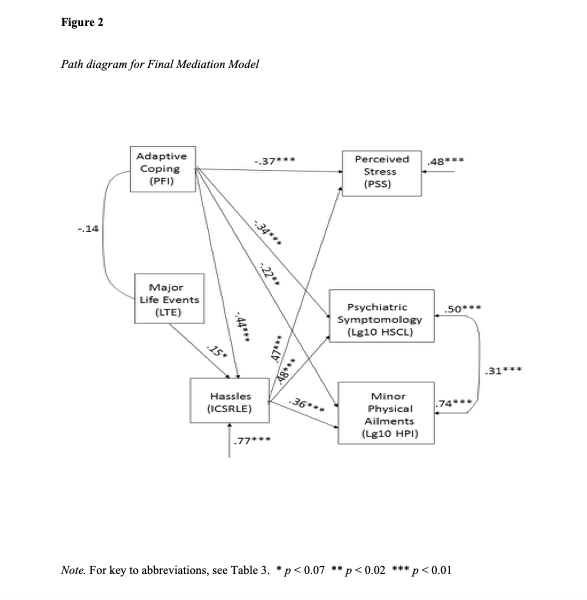
Note: For key to abbreviations, see Table 3. * p < 0.07 ** p < 0.02 *** p < 0.01