
 Janet Carlson, associate director and research professor, Buros Center for Testing. The Buros Center operates as a non-profit research center within the University of Nebraska-Lincoln.
Although some reports suggest a decline in test usage over the past 25 years or so, a survey conducted by Vaile Wright et al. (2017) suggests test usage appears stable, with 80% of professional psychologists who responded indicating that they spend 24% of their direct service time conducting psychological assessments. Further, these researchers report that a “large majority of psychologists believe psychological assessment is a valuable aid in making diagnostic decisions and treatment recommendations” (p.77). Likewise, mainstream media recently reported that institutions of higher education—Yale, Dartmouth, and MIT, for instance—have begun to require standardized test scores once again as part of admission requirements, perhaps reflecting renewed appreciation of the value of testing. Knowledge of testing and expertise in test use remain distinctive features of psychology, education, and related professions. For example, in a national study of school psychologists, Benson et al. (2019) reported ample use of tests and assessments, with most school psychologists conducting multi-method assessments that include standardized tests with excellent psychometric properties. Scrutinizing test quality and testing practices remain important concerns and are among the primary functions of the Buros Center for Testing. For information about the history and impact of the center and its work, readers may consult the Buros Center for Testing website, Carlson (2023), and Reynolds (2010).
Providing information and critiques of commercial tests
Last year marked 85 years since Oscar Buros began publishing critical reviews of commercially available tests in the Mental Measurements Yearbook (MMY) series. First published in 1938 (Buros, 1938), the MMY is in its 21st volume (Carlson et al., 2021) and published by a research center that bears the Buros name at the University of Nebraska-Lincoln. The Buros Center also provides detailed descriptive information tests in the MMY series as well as two other reference series: Tests in Print (TIP), published in 2022 in its tenth edition (Anderson et al., 2021), and Pruebas Publicadas en Español (PPE), published in 2023 in its third edition (Schlueter et al., 2023). As the name implies, PPE provides descriptions of tests published wholly or partially in Spanish. Across these three series, prospective test users may obtain information about and critiques of thousands of commercially available tests. Data that form the content of the books are also available via database subscriptions offered by EBSCO Information Services and Ovid Technologies. These data are updated every 6 months. Three database products are available that provide content from (a) all volumes of MMY; (b) all volumes of MMY and the most recent edition of TIP; and (c) all volumes of MMY and the most recent editions of TIP and PPE.
Publications from the Test Reviews and Informationopens in new window unit concern tests in 18 categories that address or rely upon mental processes (see Table 1). Test publishers choose to participate in our review process by sending three complete copies of tests we request for review consideration. As described in Carlson and Geisinger (2012), we depend on a cadre of testing experts in a variety of fields to review tests meeting our review criteria: commercially available, published in English, with documentation of test development and technical information. With several procedural safeguards in place (e.g., to preserve test security, to avoid conflicts of interest), tests are matched with qualified reviewers. Invited reviewers receive a complete copy of the test they are to review together with explicit instructions for completing reviews, including an outline (with descriptions of sections), guidelines, and submission instructions. Once received, reviews undergo a rigorous editorial process, beginning with fact checking, proceeding to technical/content editing, followed by copyediting, proofreading, and communication with reviewers and test publishers. These steps help to ensure the accuracy of the published test reviews.
In addition to published volumes and database subscriptions, test reviews become available for purchase on an ecommerce site, Test Reviews Onlineopens in new window (TROL), once completed. A searchable site, TROL provides basic information on thousands of tests at no charge, including test name, acronym, purpose, author, publication date, publisher (and contact information), and notes (e.g., that a test has gone out of print). Complete descriptive information and expert reviews may be purchased on a per test title basis. A digital edition of PPE may be purchased on the ecommerce site as well.
Enhancing test selection and responsible use
Excellent and comprehensive information about tests and assessments is helpful to test users only if they know how to use that information effectively. To address this reality, the Buros Center expanded its functions by establishing an Assessment Literacyopens in new window unit in 2011. This unit offers online opportunities and resources that strengthen one’s knowledge and skills in test selection, development, and use in accordance with relevant standards and guidelines for responsible test use. Assessment Literacy provides an array of webinars, workshops, instructional modules, conferences, and other resources. The Buros Center is an approved provider of continuing education (CE) and continuing professional development (CPD) programming. Attending most live events, watching recorded videos (and passing a quiz), or authoring a test review typically qualify for CE or CPD credits. It is our practice to record webinars, workshops, and panel presentations and to make the recordings available for viewing through a video libraryopens in new window for a nominal charge. Many videos have no charge associated with viewing them or have charges only if one also wishes to obtain CE or CPD credits.
Open-access resources available from Assessment Literacy include (a) links to a series of guides and digital resources that support the identification and selection of appropriate measures; (b) links to glossaries of testing, assessment, and measurement terms; (c) links to more than 30 professional standards, codes, and guidelines that address testing and assessment practices in numerous professions; (d) digitized copies of archival books published by the Buros Center; and (e) the Social and Emotional Learning (SEL) Assessment Technical Guidebookopens in new window, developed as a result of a project funded by the Spencer Foundation and led by the Buros Center. The SEL Guidebook is a user-friendly technical guidebook for educators involved in selecting and overseeing the use of SEL assessments with students in PreK through Grade 12. Under the Resources tab on our website, one finds a set of seven instructional modulesopens in new window that provide examples of how instructors use the MMY to teach students to understand and evaluate measurements as well as how to identify and select high-quality instruments. The set includes a variety of levels and specialties, and each module offers instructional support materials.
Other activities and services
The Center added a Psychometric Consultingopens in new window operation in 1994 to provide technical assistance—primarily evaluation, oversight, and accreditation—to proprietary testing programs, including licensure and certification tests, as well as K-12 and statewide assessment programs. Consult the Buros Center’s Standards for Accreditation of Testing Programs (PDF, KB)opens in new window for further information.
The Center also publishes Applied Measurement in Educationopens in new window, a scholarly journal dedicated to the application of educational and psychological measurement to the educational process.
Our physical facility is home to the Oscar K. Buros Library of Mental Measurementsopens in new window, a special reference library containing publications of the Buros Center, books and journals pertaining to measurement, and what is believed to be the world’s largest collection of tests (see Figure 1).
References
Anderson, N. A., Schlueter, J. E., Carlson, J. F., & Geisinger, K. F. (Eds.). (2022). Tests in print X. Lincoln, NE: Buros Center for Testing.
Benson, N. F., Floyd, R. G., Kranzler, J. H., Eckert, T. L., Fefer, S. A., & Morgan, G. B. (2019). Test use and assessment practices of school psychologists in the United States: Findings from the 2017 national survey. Journal of School Psychology, 72(Feb), 29-48. https://doi.org/10.1016/j.jsp.2018.12.004
Buros, O. K. (Ed.). (1938). The nineteen thirty eight mental measurements yearbook. New Brunswick, NJ: Rutgers University Press.
Carlson, J. F. (2023). Improving the science and practice of testing: The legacy of Oscar Krisen Buros. The American Journal of Psychology, 136(2), 183-191. https://doi.org/10.5406/19398298.136.2.07
Carlson, J. F., & Geisinger, K. F. (2012). Test reviewing at the Buros Center for Testing. International Journal of Testing, 12, 122-135.
Carlson, J. F., Geisinger, K. F., & Jonson, J. L. (Eds.). (2021). The twenty-first mental measurements yearbook. Lincoln, NE: Buros Center for Testing.
Reynolds, C. R. (2010). The road to Huskerville: How did the Buros Institute get from New Jersey to Nebraska? In R. A. Spies, J. F. Carlson, & K. F. Geisinger (Eds.), The eighteenth mental measurements yearbook (pp. 810-816). Lincoln, NE: Buros Institute of Mental Measurements.
Schlueter, J. E., Anderson, N. A., Carlson, J. F., & Geisinger, K. F. (Eds.). (2023). Pruebas publicadas en español III: An index of Spanish tests in print. Buros Center for Testing, University of Nebraska-Lincoln.
Vaile Wright, C., Beattie, S. G., Galper, D. I., Sawaqdeh Church, A., Bufka, L. F., Brabender, V. M., & Smith, B. L. (2017). Assessment practices of professional psychologists: Results of a national survey. Professional Psychology: Research and Practice, 48, 73-78.
Table 1
Test entries in The Nineteenth Mental Measurements Yearbook (19th MMY),The Twentieth Mental Measurements Yearbook (20th MMY), and The Twenty-First Mental Measurements Yearbook (21st MMY)
| Number (Percentage) of Test Entries | |||
|---|---|---|---|
| Category (rank in 21st MMY) | 19th MMYa | 20th MMYb | 21st MMYc |
|
Behavior Assessment (1) |
13 (7.1%) |
25 (13.0%) |
30 (16.4%) |
|
Personality (2) |
33 (18.0%) |
16 (8.3%) |
28 (15.3%) |
|
English & Language (2) |
18 (9.8%) |
26 (13.5%) |
28 (15.3%) |
|
Neuropsychological (4) |
13 (7.1%) |
12 (6.2%) |
17 (9.3%) |
|
Vocations (5) |
46 (25.1%) |
21 (10.9%) |
15 (8.2%) |
|
Intelligence/General Aptitude (6) |
11 (6.0%) |
15 (7.8%) |
13 (7.1%) |
|
Miscellaneous (7) |
12 (6.6%) |
19 (9.8%) |
12 (6.6%) |
|
Developmental (8) |
10 (5.5%) |
16 (8.3%) |
9 (4.9%) |
|
Speech & Hearing (9) |
4 (2.2%) |
7 (3.6%) |
8 (4.4%) |
|
Reading (10) |
8 (4.4%) |
10 (5.2%) |
7 (3.8%) |
|
Education (11) |
5 (2.7%) |
9 (4.7%) |
5 (2.7%) |
|
Sensory Motor (12) |
4 (2.2%) |
4 (2.1%) |
4 (2.2%) |
|
Achievement (12) |
2 (1.1%) |
11 (5.7%) |
4 (2.2%) |
|
Mathematics (14) |
2 (1.1%) |
1 (0.5%) |
3 (1.6%) |
|
Science (15) |
0 (0.0%) |
1 (0.5%) |
0 (0.0%) |
|
Foreign Languages (15) |
1 (0.5%) |
0 (0.0%) |
0 (0.0%) |
|
Fine Arts (15) |
1 (0.5%) |
0 (0.0%) |
0 (0.0%) |
|
Social Studies (15) |
0 (0.0%) |
0 (0.0%) |
0 (0.0%) |
a Percentages reflect proportions in The Nineteenth Mental Measurements Yearbook (Carlson, Geisinger, & Jonson, 2014); n = 183.
b Percentages reflect proportions in The Twentieth Mental Measurements Yearbook (Carlson, Geisinger, & Jonson, 2017); n = 193.
c Percentages reflect proportions in The Twenty-First Mental Measurements Yearbook (Carlson, Geisinger, & Jonson, 2021); n = 183.
Figure 1
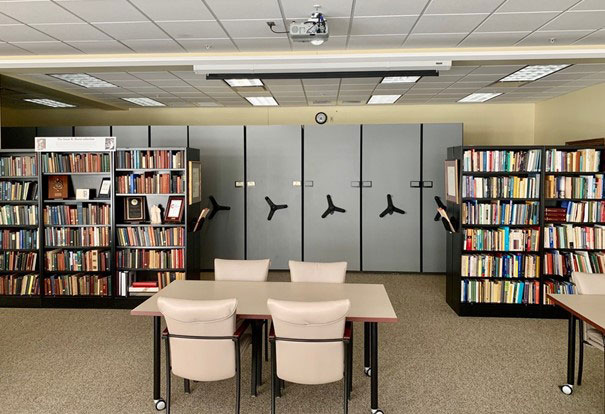
The primary collection housed in the Oscar K. Buros Library of Mental Measurements consists of approximately 9,000 educational and psychological tests, acquired across many decades. The Buros Library also contains about 2,000 books related to measurement, testing, and assessment, including many classic texts by renowned authors. A special collection of about 600 books were owned originally by Oscar Buros, all bearing his signature on the end-pages.