


 Imagine two students—one from a rural school and one from an urban center—sitting for the same standardized test. Both have mastered the material, yet one struggles with certain items, not because of ability, but because the questions assume cultural references unfamiliar to them. Is the test really measuring what it claims to measure? This is the essence of differential item functioning, or DIF.
DIF may sound like a technical term buried in the language of psychometrics, but at its heart, it deals with a question everyone cares about: fairness in testing. Over the decades, the concept of DIF has grown from a narrow focus on biased test items into a broader framework for understanding how social, cultural, and psychological contexts shape test performance (Zumbo, 2007a, 2023).
This article highlights the key themes from a thread in my research program and connects them with the story I have come to call From Rome to Vancouver, tracing a journey from definitions and detection to explanation and inclusion.
Two faces of DIF
DIF has always carried two meanings. First, it describes a phenomenon: when individuals from different groups—yet with the same underlying ability—respond differently to the same test item. Second, it refers to the statistical methods used to detect those differences.
The problem is that these two meanings often get blurred. Too many discussions of DIF jump straight to techniques, leaving its deeper purpose—ensuring fairness and valid interpretation of test scores—underexplored. Recognizing this duality helps us see DIF not only as a technical challenge but also as a way to think critically about the purpose of testing itself. The evolution of DIF research.
Over time, DIF research has unfolded in successive stages (Zumbo, 2007a):
- First generation: identifying item bias in high-stakes exams, often tied to legal and policy concerns about fairness.
- Second generation: clarifying the distinction between impact (true differences between groups) and bias (irrelevant item features) and refining statistical methods.
- Third generation: shifting the focus to explanation—asking why items behave differently and what this reveals about the test-taker's context, cognition, and culture.
- Fourth generation (emerging): reframing DIF as more than a problem to be fixed. Instead, it becomes a window into human diversity, offering insights into how people's experiences, histories, and communities shape the ways they approach tests (Zumbo, 2023).
This emerging fourth-generation perspective reflects a broader move toward explanation-focused validity: using DIF not just to flag items, but to understand human variation better and to design assessments that respect the richness of lived experience.
A journey from Rome to Vancouver
The shift toward explanation took a major leap with the integration of DIF and explanatory modeling. On a long flight home from lecturing in Italy in 2003, the idea emerged: concepts of mediation and moderation—long used in psychology to study how and under what conditions variables affect outcomes—could illuminate DIF, and vice versa.
Soon, research showed how community and sociological factors could act as moderators or mediators of test performance (Zumbo & Gelin, 2005). For instance, gender roles, income level, or rurality may shape how students interpret and respond to items, even when their underlying ability is the same. Seen through this lens, DIF is not just about item wording or technical flaws. It is about how broader social contexts influence what happens when someone sits down to take a test (Zumbo et al., 2015; Zumbo, 2007a, 2023).
The ecological turn
My ecological model of item responding (Zumbo, 2007a, 2007b, 2023; Zumbo et al., 2015) is a conceptual framework that reimagines how we understand test-takers' responses to assessment items, converging on an ecological perspective—especially in the context of differential item functioning (DIF) and test validity.
Core idea
Rather than viewing item responses as isolated cognitive events, my model emphasizes that a complex ecology of interacting factors shapes responses. Instead of isolating the test-taker as an abstract individual, this approach situates them within layers of influence, for example, these may include:
- Test factors: Test format, item content, psychometric dimensionality
- Individual-level factors: cognitive abilities, language proficiency, motivation, prior knowledge
- Social and cultural context: norms, values, educational background, language of instruction
- Environmental influences: testing conditions, school infrastructure, community resources
In essence, the model argues that item responses are not just about the person or the item—they are about the relationship between the person and their environment.
Figure 1 is a graphical portrayal of an instance of my ecological model characterized by four concentric ovals described above.
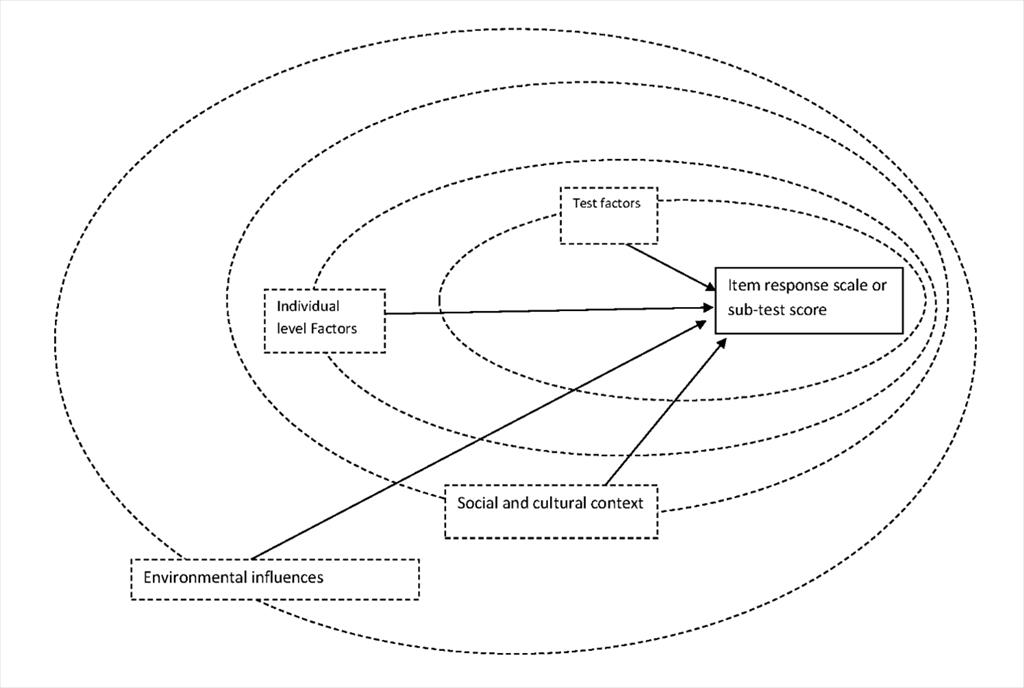
Figure 1. A graphical portrayal of an instantiation of the ecological model characterized by four concentric ovals representing potential explanatory sources of variation for item, test, or scale scores, adapted from Zumbo et al. (2015), who consider an example of large-scale educational testing.
Depending on the in vivo assessment setting, different explanatory sources may be represented as concentric ovals. The outcome variable associated with these explanatory factors can take several forms: (i) responses to an individual item or task, (ii) a sub-scale score from the assessment or a specific dimension of a multidimensional measure, or (iii) an overall test score. Furthermore, depending on the chosen psychometric model, the sub-scale, dimension, or overall score may itself be conceptualized and modeled as a latent outcome variable.
This ecological view challenges the tendency to treat categories such as gender or ethnicity as fixed, "natural" kinds. Instead, they are better understood as social constructs—fluid, context-dependent, and shaped by history and culture (Zumbo et al., 2015; Zumbo, 2023; Zumbo & Lynch, in press). From this standpoint, DIF research becomes a way to study not only tests but also the environments in which they are used.
Why DIF matters today
In its modern form, DIF serves multiple purposes:
- Safeguarding fairness and equity across groups.
- Ensuring that observed differences are not measurement artifacts.
- Evaluating adapted or translated tests for comparability.
- Illuminating the cognitive and social processes of test-taking.
- Testing assumptions about invariance in advanced measurement models.
Rather than being just a statistical exercise, DIF helps explain how tests function in the real world. It also strengthens validity arguments by showing how scores arise, what they mean, and how they may differ across groups (Zumbo, 2007a, 2007b, 2009, 2023).
Bridging methods and meaning
Linking DIF with mediation and moderation also bridges psychometrics with broader psychological research. Both traditions remind us that statistical models are not neutral. They embed assumptions and generate inferences that shape how we understand test results.
This explanation-focused approach reframes validity not as a fixed property of a test, but as an ongoing, contextualized interpretation of score meaning. DIF, mediation, and moderation analyses all contribute to making those interpretations richer, more accurate, and more inclusive.
Looking ahead
The journey from definitions of DIF to ecological and explanatory models marks a profound shift in measurement. DIF is no longer simply about detecting bias; it is about understanding the many ways human diversity shows up in testing.
The emerging fourth generation of DIF research reminds us that tests are not neutral tools and test-takers are not interchangeable units. Every testing event is shaped by the lived experiences, histories, and communities that individuals carry with them. Recognizing this, DIF becomes more than a technical safeguard: it becomes a lens for seeing the richness of human variation and the many ways of being human (Zumbo, 2023).
For psychologists, educators, and policymakers, this perspective underscores an enduring truth: tests are social occasions. By embracing ecological and explanatory approaches, DIF research can continue to advance fairness while helping us build a more inclusive and human-centered science of measurement.
Call to action for assessment researchers and psychometricians
As assessment researchers and psychometricians, we are uniquely positioned to carry this work forward. By incorporating fourth-generation thinking into our research, teaching, and applied measurement practices, we can deepen the field's commitment to equity and broaden its impact. The challenge before us is clear: to use DIF not only as a tool for ensuring fairness, but also as a framework for understanding and honoring the diverse ways people engage with tests.
Bruno D. Zumbo, PhD
Distinguished University Scholar and Professor
Tier 1 Canada Research Chair in Psychometrics and Measurement
University of British Columbia, Canada