

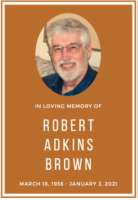
 Robert Adkins (Bob) Brown, PhD, ABPP, died on January 2, 2021, in Sykesville, Maryland. Brown was a professor, clinician, and dedicated advocate for the professional practice of psychology throughout his life.
Best known to colleagues as Bob, his life journey began in a rural school outside Richmond, Virginia. He showed leadership potential from his earliest days, serving his high school as both captain of the basketball team and senior class president. He attended the University of Richmond on a basketball scholarship and went on to receive his MA and PhD in psychology from the University of Iowa. He was a member of Phi Gamma Delta fraternity and graduated with membership in the Society of Sigma Xi and Phi Beta Kappa, among other honors.
He began work at the University of Texas Southwestern Medical School and then moved to the University of Maryland College Park, where he taught for over 30 years until retirement as Associate Professor Emeritus in 2003.
Bob dedicated his professional life to advancing the professional practice of psychology, strengthening the field with emphases on ethical and evidence-based practice. While working at University of Texas Southwestern Medical School, he served as president of the Dallas Psychological Association, the Dallas Society of Clinical Psychologists, and the Dallas Group Psychotherapy Association. After moving to Maryland, both he and his wife, Sue Taylor Brown, became deeply involved with the Maryland Psychological Association (MPA). Sue served as MPA’s first executive director, a role she held for 28 years, and Bob served on numerous committees both before and after serving as the association’s president from 1976-1977.
At the University of Maryland, Bob was an award winner teacher and dedicated mentor to clinical trainees. He held numerous roles over the years including acting director of clinical training, associate director of clinical training, acting head of the clinical program, and director of the psychology clinic.
Bob worked closely with the Maryland Department of Health on numerous committees representing the field of psychology. He served the Maryland State Board of Examiners of Psychologists for several years before becoming a board member and eventually chair from 2008 to 2010.
Steve Sobelman, long-time MPA and Board of Examiners colleague, writes that, “Bob epitomized aspirational traits we admire in a psychologist—upholds high ethical and professional standards, engages in empathic and non-judgmental relationships, employs critical thinking peppered with creativity and flexibility, embraces diversity, appreciates research and reality testing, and engages in self-care, including use of his signature humor. It was an honor to work with him and call him a friend.”
Bob first became involved with Div. 31 as a state representative from Texas in 1971. He served on the board for many years including serving as President in 1984 to 1985. He was elected to the Board of the American Psychological Association in 1993, and among other roles, served as chair of the Board of Professional Affairs from 1996 to 1998. Bob was also a frequent APA accreditation site visitor and served as an associate editor for Professional Psychology: Research and Practice.
Among many service and leadership honors, Bob was recognized with fellowship in APA (Divisions 12, 31, 42, and 43) and the Academy of Clinical Psychology; the Eric J. Hatch Outstanding Faculty Award from IDEALS and AFRAM for promoting relationship enhancement therapy; Distinguished Practitioner of Psychology by the National Academies of Practice; and the Karl F. Heiser Award for Advocacy from APA for enhancing psychology through regulation.
Among his many accomplishments, he was perhaps most proud of the work with the Maryland Psychological Association, which grew under his leadership and the dedicated work of Sue, his wife of 50 years. The family established a fund to further develop leaders in the field in their honor, and they invite others to contribute. For details, please visit this website.opens in new window
Bob will be remembered for his practical and collegial approach to bringing people together and building relationships through listening. Those who worked with him know that he was quick with a pun, loved to travel and read, and enjoyed art, museums, and music. Through his commitment and passion for ethics and evidence, and his ability to bring people together, his legacy to the community of practicing psychologists will live on.