

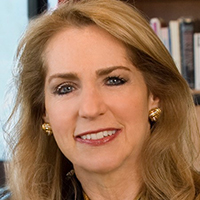
 Meet Dr. Beth Video
Hello, I’m Dr. Beth Rom-Rymer, and I’m thrilled to be a candidate for APA president-elect 2021. My campaign slogan, “Together We Move Forward,” reflects my deep gratitude to all of you in the psychological community, to your tremendous commitment to your patients, your clients, your students and academic colleagues, your probing, far-reaching research inquiries. Thank you, all, for the critically important work you do to move our profession into the future. I’m asking for your #1 vote for APA president-elect on September 15.
It’s been an honor to connect with you, my friends, colleagues, and partners, from around the country and throughout the world, hearing about your interests, your passions, and your concerns. There are many of you whom I’m eager to meet, for the first time, as our community of professionals grows in new and exciting directions. I want to share with you my experience and my vision, and my determination to lead the APA with boldness, decisiveness, inclusiveness, imagination, innovation, judiciousness and compassion.
By the age of 5, I knew that I wanted to be a psychologist. It’s been a treasured journey as I have pursued my dreams and built my career. From the beginning, I’ve been a pioneer in women’s educational opportunities, a co-founder of both a shelter for survivors of domestic abuse and a founder of a comprehensive Program for the survivors of violent crimes in the Tallahassee, Florida State Attorney’s Office. I have been and continue to be an entrepreneurial clinician, a mentor and teacher to generations of psychologists, an author, and a tireless legislative advocate. I am a leader of the Illinois, national, and international movement for psychologists’ prescriptive authority, so that we can comprehensively treat some of the most vulnerable and underserved communities in our land. I have held multiple leadership roles and have received numerous awards from the APA, the Illinois Psychological Association, the National Register, and University Boards of Trustees, among others. I was a chair of the APA Council Leadership Team and I served on the APA Board of Directors. I am in independent clinical and forensic practice, based in Chicago; I am founder, president, and CEO of the Illinois Association of Prescribing Psychologists; and I am the chair and president of the National Register of Health Service Psychologists.
My vision for the APA has six Foundational Pillars of Action:
- identifying evidence-based and evidence-informed treatments for the sequelae of COVID-19;
- identifying empirically-based initiatives to combat the pandemics of racism, police brutality, and to support all social justice initiatives;
- using our effective scientific evidence to contribute to the eradication of global health disparities and to achieve health equity;
- promoting global initiatives to end global warming and creating a world that respects and nurtures ecological balance;
- facilitating greater access to comprehensive, integrative, mental health care by utilizing telehealth and other technologically innovative strategies and by broadening the scope of practice for psychologists to include prescriptive authority;
- providing for the continued growth of an inclusive APA that ensures multi-disciplinary, multicultural and multinational APA leadership with representation from BIPOC, LGBTQIA+, AAPI, differently abled communities.
I will execute my vision with a unique combination of decades of administrative, clinical, forensic, organizational, community mental health, legislative advocacy experience; a practiced expertise in building and elevating broad coalitions of diverse voices; and a proven track record in leading inclusive, grassroots movements that transform our communities.
Please visit my campaign website (Dr.Beth4APAPresident.com) or reach out to me through social media on LinkedIn, Facebook, Twitter and Instagram. Thank you for your support, and for your #1 vote for APA president-elect 2021!
Questionnaire from Dr. Diana Prescott
 Are you a member of the psychological association of your state, province, or territory? Division 31? If so, please list where and when you’ve held memberships:
I am a member of the Maine Psychological Association (MePA), and I previously was a member of the Indiana Psychological Association. I have also been an affiliate member of the D.C. Psychological Association, due to my frequent volunteer work for APA in the D.C. area. (I have not yet renewed this year, due to the pandemic, since I am not traveling to D.C.) I am a member of Division 31. Joining Div. 31 was recommended to me, when I started attending the APA State (now Practice) Leadership (SLC/PLC) Conference in 2004.
What offices or positions have you held in your SPTA, and when?
I was Member at Large on the MePA Policy Council from 1997 to 2008. I also have served as Rural Health Coordinator for MePA. When the APA Committee on Women in Psychology requested a Network representative in the states, I volunteered to serve in this role. I also volunteered to serve as Federal Advocacy coordinator when we did not have one and have served in that role from 2003 to present. I was elected APA Council representative for MePA 11/2007, reelected, and served in this role to 2014. Since 2014, I have been serving in APA leadership roles and remain connected to MePA through the listserv, federal advocacy, continuing education, and the annual meeting.
Describe your activities and accomplishments at the local/SPTA or national level which have strengthened SPTAs.
At the state level, I helped organize area gatherings for the women in psychology, in my role on the Committee on Women in Psychology Network for Maine. The women related at a MePA meeting they felt isolated. The regional groups have met in Portland, Waterville, and Bangor. The Bangor Area Women in Psychology continues to meet monthly during the academic calendar year. During 2008-2014, I helped initiate and co-chaired the Maine Integrated Primary Care Committee. In the state of Maine, I have chaired the Maine Migrant (now Maine Mobile) Health Program board and served as a Board member on the Maine Primary Care Association (MePCA) Board. I am a current member of the Maine Rural Health Action Group (RHAN). I have participated in a monthly CE meeting of the Bangor Area Psychological Society (BAPS). November 10, 2017, I was unexpectedly awarded fellow status at the MePA Fall Conference.
At the national level, I have served on the APAPO Committee for the Advancement of Professional Practice (CAPP) (2017-2018). I served on the APA Committee of State Leaders 2011-2014 and was elected chair-elect in 2013. I received the APAPO Federal Advocacy Award March 12, 2012 at SLC. I have served on the APA Board of Directors as a member-at-large and recording secretary. As part of serving on the APA Board, I was assigned to be the liaison to CAPP (Practice) and the Association of State and Provincial Psychology Boards (ASPPB). I have chaired the Rural Health Interest Group and Caucus and served as secretary for the Caucus of State, Provincial, and Territorial Affairs.
What do you perceive as being the issues of greatest concern to SPTAs, as organizations or SPTA members, and how would you address as APA president?
I am concerned about threats to our profession and initiatives for the public that first are exposed at the state level. I also want to assure there is significant support for the needs of psychologists. I believe the APA Advocacy Coordinating Committee (ACC) provides a vehicle to increase the emphasis on the needs of psychologists. As president, I would be interested in determining how the ACC could be well-informed about the needs of the psychologists who are members of the state associations.
Many of our SPTAs have small staffs and limited resources, depending on APA for financial support and assistance. As president, I would fiercely oppose cuts to support legislative grants to state associations.
I am concerned about psychologists at the state level who have left APA, and I believe we should be talking to them about their reasons for leaving, and initiating change at APA to incentivize them to return to APA membership.
I do believe with the pandemic, psychologists need to more easily be able to work across state lines. PSYPACT is one important vehicle for this effort, and this compact can only be passed at the state level. States need support for this and other state-level legislation enhancing and protecting psychologists.
Telehealth presents an opportunity for psychologists to improve our incomes by augmenting our face-to-face treatment income. We do need to be paid a decent wage for our work. We continue to need to make the case for the importance of the doctoral standard for practice at the state level, and we need scientific evidence to support our case. Psychologists could potentially benefit from diversifying work in ways we have not previously considered, and APA could be helpful sharing models and resources for such diversification.
Considering the APA reorganization around advocacy, what do you see are the biggest challenges integrating SPTAs into the new agenda?
That’s a great question. In thinking about this, I wonder if the fact that SPTAs are generally outside of the APA structure (unlike some of our divisions), if that provides less leverage for our agenda. I do believe it is important to have strong state representation on the ACC. Our state representation can be more effective now at APA, I believe, if we are active across the “pillars” of APA. We may need to intentionally form partnerships between types of psychologists at the state level, assuring our psychologists are running for Boards and Committees and bringing a state perspective to those places within APA. The former State Leadership Conference continues to be a vehicle for promoting state-related issues, but it is broader now as Practice Leadership. Of course, Council is a place where states have a voice in directing the course of APA. It would be important to assure in any future change in Council structure states continue to be well-represented. The State caucus is a helpful vehicle in politically assuring this representation, although technically outside of APA writ large. The expanded Board of Professional Affairs (BPA) is another place where states can have important impact in the direction of APA for state-level issues.
Please add any comments you’d like which are not elicited above that address the affairs of state, provincial, and territorial psychological associations.
I think those who know me well would attest to the fact that I am a strong advocate for the state psychological associations. I have been raised up in leadership through the state associations. I understand the importance of the state interests to APA, and as APA president, I would listen and respond to the concerns and needs of the states.