

Member at Large Candidate Statements
Rebecca Richey, PsyD
 As the immediate past chair of the Committee on Early Career Psychologists (CECP), and the State, Provincial and Territorial association representative of CECP for the last three years, I am eager to continue working with Division 31 to further state/APA association collaborative efforts for ECPs as well as other psychologists. Also, a past president of my state association (Colorado Psychological Association), I have excellent insight into the link between state association needs and APA’s resources. I am prepared to offer this insight as well as support for Division 31’s mission and values. As the CECP representative to Division 31, I felt supported and encouraged and noticed that Division 31 members and leadership went out of their way to welcome ECPs in both state and national association leadership. I was included in important matters pertaining to ECPs and I felt my voice was heard and respected, which is sometimes difficult when one is an ECP. I hope to join the leadership of Division 31 in order to continue this encouraging, welcoming spirit for others and to support the mission and values of Division 31.
Julie B. Wolter, PsyD
 State associations provide such a critical function for professional communities through scientific and practice education, collaboration, advocacy for the profession and assisting the public regarding mental health whether by guiding them to psychologists or connecting with journalists. This work is so meaningful to me, I am active in RI and NH. In NH, I chair NHPA's Behavioral Healthcare Advocacy Committee and director of Professional Affairs, as well as the president of NHPA's Educational Foundation. For RIPA, I am the federal advocacy coordinator and a previous board director. State associations provide that critical connection between APA and the states for grassroots understanding of local political issues, practice concerns, and workforce. I appreciate the struggles state associations can have financially as well as membership and working together with a group of devoted colleagues in finding innovative ways to stay solvent.
Division 31 is an essential division of APA to advocate for SPTAs for important things like increasing grants to state associations to hire directors of Professional Affairs and lobbyists to advocate on the state level during a time of deregulation, anti-transgender bills, women’s rights. I would be honored to participate on a national level on APA's Division 31 Board to support its mission of providing resources and services to SPTAs as well as advocating for SPTAs within APA governance.
Jorge Wong, PhD
 Greetings Div. 31 colleagues. I am Jorge Wong, PhD, and honored to be a candidate for the member at large position on the Division 31 Board. I am a California licensed psychologist with experience in the public and private healthcare systems including small to large nonprofit multiservice healthcare organizations. I have focused primarily on undeserved and ethnic minority communities through behavioral health services in the areas of corrections, community mental health, addiction, homelessness, quality improvement and compliance. I have also been involved in graduate training, executive leadership, advocacy, policy development and community engagement. I currently serve as the CA representative to APA Council of Representatives and the APA Minority Fellowship Program Mental Health Substance Abuse Services Training Advisory Council (MFP-MHSAS-TAC). Previously, I served on the Committees on Professional Practices and Standards (COPPS), the Advancement of Professional Psychology (CAPP), and State Leadership Committee (SLC). I am also the past president of the California, San Francisco, and Santa Clara County Psychological Associations.
I am a proud Banana Slug from the University of California, Santa Cruz, an alum and trustee at Palo Alto University, and currently focused on private practice providing psychotherapy and expert testimony for the probate court. I am the recipient of the 2022 California Psychological Association Distinguished Contribution to Psychology Award, and the 2020 Outstanding Psychologist Award from Division 31. Growing up in Cuba and in San Francisco’s Chinatown, I am a first-generation college graduate and psychologist in my family. I always remembered the advice shared by my mentors of “don’t forget where you came from,” “always give back,” and “mediocrity is common, excellence is a must.” In serving as a member at large on the Board of Division 31, I want to leverage my experience, collaborate with the board, and contribute positively to Division 31’s mission. I am here humbly asking for your vote.
Student Candidate Statements
Phoebe Lewis, MS
 I am a PsyD candidate at Antioch University New England, where I am entering my fourth year. I am a member of the Vermont Psychological Association and serve as newsletter editor and an Executive Committee (EC) member for the Vermont Association for Psychoanalytic Studies (VAPS). I am the only student member on the VAPS EC and appreciate the opportunity to lend my perspectives to this organization.
If the APA is like a tree with extended branches representing its divisions, I see Div. 31 as the roots. This division anchors the APA by facilitating communication, promoting individual and collaborative division-wide efforts, and connecting psychologists with opportunities to grow in leadership and contribute to the field. I would love to support Div. 31’s important leadership efforts that contribute to the APA, and in turn, engender meaningful impact even beyond the Association.
For me, clinical psychology and advocacy are symbiotic. I am passionate about working with refugee and displaced populations and am currently training at a clinic where I work exclusively with this population and survivors of torture. A widely recognized risk factor for suicide in this population – and the focus of my dissertation! – is post-migration living distress, or PMLD. The structural difficulties inherent to living in a new country can be enormously consequential to people’s mental health and overall well-being. The clients I work with are experiencing specific structural inequities that cannot be ignored when developing and implementing treatment.
I mention this clinical background to illustrate that I think systemically and holistically and that this will influence my contributions as a student representative. It goes without saying that we are living through a time in which laws are being wielded as a weapon against many groups, especially the LGBTQ community. The APA code of ethics calls on psychologists to practice beneficence and nonmaleficence, and I see Division 31 as a driving force in this effort by supporting the field as a whole. I would be honored to be considered for this role.
Kymbriona Taylor
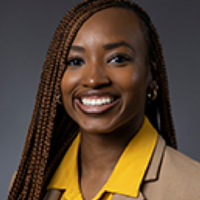 It is an honor to be nominated to serve as the student representative for Division 31’s Executive Board. Through my involvement in the Missouri Psychological Association (MOPA), I have been able to recognize the importance of students being involved in their SPTAs.
I deeply appreciate Division 31 for seeking a student voice in their governance. I believe Division 31 is a wonderful place for students to learn the significance of advocating for psychology, their patients, and society’s marginalized populations. I have served in leadership and advocacy roles at the local, state, and national level including positions as the President of the University of Missouri (MU) Counseling Psychology Student Organization and the Student Affiliates of Seventeen Tri-Chair in the Society of Counseling Psychology (SCP).
As a future psychologist and a woman of color, I have a strong commitment to EDI initiatives. I have been a student consultant for the MU Nurturing Minority Wellness program. I currently work as a research assistant on a photovoice project concerned with inclusion, diversity, and equity. I am a member of MOPA’s Diversity Committee and have participated in our Association’s advocacy efforts.
This past year I had the privilege to represent MOPA at the Practice Leadership Conference. I was able to collaborate with other student leaders about increasing student involvement in SPTAs and improving the experience of current students and the future of our field. This is an endeavor that I plan to commit to in my goal to be an active leader in my SPTA after graduation. As future leaders of psychology, I strongly believe students can learn from our state leaders as well contribute our own insights and perspectives.
I am enthusiastic for the opportunity to collaborate with the leaders and esteemed members of Division 31 to facilitate advocacy and dialogue regarding the political, social, and multicultural issues that impact the work we do with our clients and colleagues in the profession.
Thank you for your consideration.