

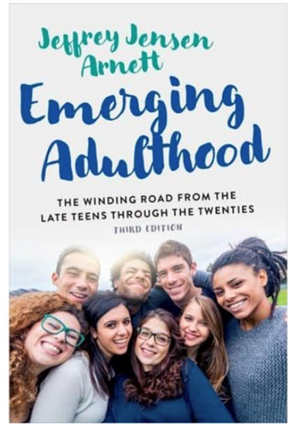
 Review author: Mia Semelman, PsyD
Summary: In this recently released third edition of Emerging Adulthood, the text has been updated to reflect changes in technology and Arnett has added a chapter on cultural variations throughout different countries.
Citation: Arnett, J. J. (2024). Emerging Adulthood: The Winding Road from the Late Teens Through the Twenties(3rd ed). New York: Oxford University Press (432 pages).
Jeffrey Jensen Arnett proposed that development in the late teens and early 20s represents a distinct development period; these young Americans are not quite adult, but not adolescent either. He contrasts this developmental period in the 21st century with the mid-20th century where it was typical to be married and raising children in the early 20s. In the 21st century, for early 20-somethings, marriage and parenthood are many years away, education is likely continuing, job changes are frequent and unfulfilling – the road to adulthood is longer than it used to be.
In the book, he describes characteristics of emerging adults, based mainly on his research over the past 30 years in the United States.
Arnett argues that there are distinguishing features of emerging adulthood which include identity exploration; instability in love, work and residence; self-focus; feeling in-between and in transition; and a sense of optimism and endless possibilities where many dreams are still possible. He responds to critiques of the theory and asserts solid arguments for why a separate term is needed – he says young Americans in this age group are neither adolescent nor fully “adult.” His arguments are supported by research he conducted over the past 30 years.
He opens the book with an intimate look into the lives of four emerging adults to depict the themes. I say “intimate” because Arnett describes the way these individuals look and sound, and the reader may feel like they’re right there with them in the coffee shop. It’s a fun way to let his research come alive. The book spans topics like relationships with parents, romantic and sexual issues, marriage, college, work, media use, religion and values, and social class. He also discusses and reviews rates of prominent psychological issues affecting emerging adults and what contributes to their resilience. He concludes the book with a chapter on the question of what it means to be an “adult” and a chapter on international variations in emerging adults. The writing style of the book is engaging and enjoyable as statistics are woven with pop culture references.
As a clinician, I found the “Wrong Turns and Dead Ends” chapter helpful because Arnett provides some hypotheses for why emerging adults experience diverse mental health problems. He hypothesizes that the decrease in externalizing behaviors and increase in internalizing behaviors may be explained by media use.
His “Love and Sex” chapter covers some interesting topics that emerging adults are navigating in the 21st century. For instance, rates of use and effects of dating apps and pornography on finding love and partnership. However, I would have liked to see more focus on LGBTQ+ populations since identification with and visibility of queer identities have grown significantly in the 21st century. Similarly, I would have been interested in learning more about the way emerging adults may be exploring less traditional relationships such as polyamory, or even feeling fulfilled by a long-term romantic partnership that does not involve marriage. Arnett mostly discusses how most emerging adults still want to get married in the future, but this process is delayed. This may largely be the case, but felt unsatisfying to me.
One of my favorite chapters was “Becoming Adult” where he discusses different definitions of “adult.” Historically, throughout cultures all over the world, marriage represented attainment of full adult status. Nowadays, marriage ranks near the bottom out of 40 possible markers of adulthood, according to many studies throughout developed countries. He says, based on his research throughout the U.S. spanning different ethnic groups and social classes, there is a strong American consensus that adulthood is equated with “self-sufficiency,” or learning to stand alone as an independent person. The three criteria for self-sufficiency are accepting responsibility for yourself, making independent decisions, and becoming financially independent. The question of what it means to be an adult is an interesting philosophical question and Arnett’s perspectives are compelling and grounded in robust research.
Arnett’s text would be a solid addition to any developmental psychology course and it’s also an accessible read for a broad audience such as parents and teachers. Jeffrey Jensen Arnett’s third edition of Emerging Adulthood: The Winding Road from the Late Teens Through the Twenties offers fourteen intimate and thoughtful chapters that give the reader a good sense for the unnerving and exciting uncertainties of this discrete developmental period.