

Review author: Katherine Arenella, PhD
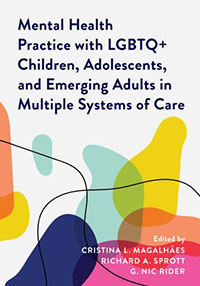 Citation: Magalhães, C.L., Sprott, R.A., & Rider, G.N. (Eds.). (2022). Mental Health Practice with LGBTQ+ Children, Adolescents, and Emerging Adults in Multiple Systems of Care. Washington, DC: Rowman & Littlefield Publishers (428 pages).
Mental Health Practice with LGBTQ+ Children, Adolescents, and Emerging Adults in Multiple Systems of Care emphasizes the importance of an interdisciplinary and holistic approach for young LGBTQ+ clients. The editors have chosen a diverse and expert group of authors who provide key insights into relevant theoretical and developmental considerations, as well as the specific systems of care these clients may interact with, including schools, medical care systems, foster care, justice systems, and a range of behavioral health settings. The editors introduce the book with an overview of the various health disparities and protective factors applicable to this population, and the book is organized into three major sections: (1) theoretical approaches, (2) developmental considerations, and (3) specific systems of care in which mental health professionals might be working with LGBTQ+ children, adolescents and emerging adults.
The book begins with an overview of theoretical approaches applicable to LGBTQ+ interdisciplinary care, covering minority stress theory and resilience (Chapter 1), intersectionality theory (Chapter 2), and the Gender Affirmative Lifespan Approach (GALA) (Chapter 3). In each of these chapters, the authors provide a concise review of these theories and approaches; the authors take care to highlight how each theory can be applied specifically to working with young LGBTQ+ clients.
In the next section of the book the authors discuss developmental considerations, including those for working with gender diverse children (Chapter 4), LGBTQ+ adolescents (Chapter 5), and emerging adults (Chapter 6). These chapters directly flow from the theoretical approaches. As a reader, it is clear that developmental factors provide important context for the theories of intersectionality, minority stress, and interdisciplinary care, and vice versa. For instance, case examples reveal how minority stress may manifest differently across various ages and how the relevant systems of care applicable to a child, adolescent or young adult differ.
The final and longest portion of the book covers specific systems of care. In these chapters, the authors provide contextual information on each system, as well as specific and relevant tips for clinicians. Systems and contexts of care covered include pre-K – grade 12 schools (Chapter 7), university and college campuses (Chapter 8), medical care centers (Chapter 9), child welfare and foster care (Chapter 10), homelessness (Chapter 11), the justice system (Chapter 12), LGBTQ+ centers and community organizations (Chapter 13), and independent practice (Chapter 14). In each chapter, the authors provide enough information for readers to understand particular nuances of each system, while emphasizing the potential needs of clients who interact with these systems of care. Detailed case examples and clinical considerations help the reader to digest and apply this information.
The authors clarify and describe systems of care and health inequities that can often feel overwhelming or even hopeless, especially given today’s political climate of increased anti-queer legislation. Nevertheless, a strength of this book is the sense of agency and hopefulness it instills, while not shying away from the realities of barriers to care. The authors do this by providing clear recommendations and ideas for advocacy in both clinical settings and in broader community systems, such as case examples of psychologists making changes in particular systems, or detailing how psychologists have advocated for broader policy change. This book would be an exceptional resource to use in a training setting where students—who often ask: “But what can we do?”—can get tangible ideas and examples. For clinicians, this book offers insight into the interdisciplinary systems their clients may interact with, providing for more holistic, developmentally appropriate, and ultimately effective care.