

Review author: Mia Semelman, PsyD
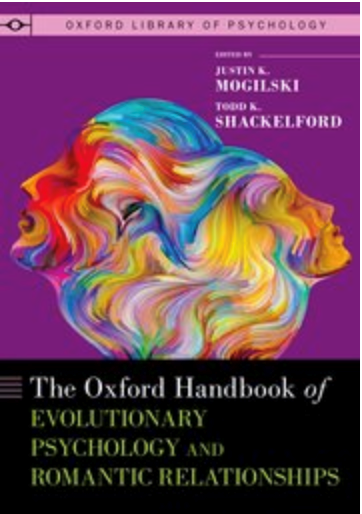 Citation: Mogilski, J. K. & Shackelford, T. K, (Eds.). (2023). New York: Oxford University Press (850 pages). ISBN: 9780197524718
The Oxford Handbook of Evolutionary Psychology and Romantic Relationships edited by Justin Mogilski and Todd Shackelford is a 30-chapter, modern, updated, and diverse volume that explores some new and historically ignored topics and populations. For instance, the authors touch on how technology such as social media and dating apps may be shaping romantic relationships. The contributors also discuss relationship processes in LGBTQ people, non-monogamous people, older adults, and divorced people, to name a few. The book is divided into three parts each with 10 chapters: Relationship Initiation, Relationship Maintenance, and Relationship Dissolution, which provide a helpful structure to comprehensive information.
In Part One, Relationship Initiation, the contributors discuss how people select and compete for mates, while staying attuned to cross cultural variation. This is done through various lenses such as physical cues, hormonal mechanisms, and social dynamics. The chapters build on each other and repeat important information from previous chapters, which can be helpful for learning the material. Most of the section (and the book) focuses on heterosexual dynamics and trends observed and replicated for cisgender men and women. There is one chapter devoted to the initiation of non-heterosexual relationships and one chapter devoted to relationship initiation among older adults.
In Part Two, Relationship Maintenance, the authors discuss various approaches people of different genders use to preserve their relationships. They discuss how reproduction and societal structures affect these strategies. More specifically, the authors discuss how jealousy, hormones, and other factors – such as how people protect investments in intimate partnerships – enable people to continue existing relationships. This section also explores interpersonal violence (IPV), parenting, consensual non-monogamy, sexual and gender diversity, older adults, and how relationship practices vary across cultures.
Part Three, Relationship Dissolution, discusses various ways relationships end. The first chapter, 21, discusses what leads people to being dissatisfied in relationships. It is followed by other interesting topics like infidelity, menstrual cycle variation, divorce and spousal death, and affective responses to relationships ending. There is one chapter focused on the dissolution of LGBTQ+ relationships. I found some of these articles refreshing as there has been little focus on some of these topics such as finding love after divorce.
Most of the articles in this handbook were comprehensive and thought-provoking. The reader may disagree with the author, but the articles provide a good foundation for discussion. It was helpful that each section began with an introduction and summary of all the articles in the section, and that each article began with an abstract, introductory paragraph and ended with directions for future research. This could help the reader select articles of interest and easily find ways to build upon existing literature.
My favorite articles centered LGBTQ+ (Valentova, Amaral and Varella’s article, Initiation of Non-Heterosexual Relationships) and non-monogamous people (Mogilski, Rodrigues, Lehmiller and Balzarini’s article, Maintaining Multipartner Relationships: Evolution, Sexual Ethics, and Consensual Nonmonogamy) because it was inspiring to see how these historically targeted, stigmatized and ignored populations were conceptualized through evolutionary psychological frameworks. For instance, the authors consider how relationship variance is beneficial for species evolution and progression. These articles also help us broaden our conceptions of relationships and challenge existing assumptions.
The handbook is likely most helpful for relationship researchers as it generally provides information about trends in populations. The book does not focus on interventions; however, clinicians working with couples and individuals on relationship issues may still find some of the articles helpful as they can provide context for certain behaviors or issues.
Being armed with general knowledge about relationships can help clinicians increase compassion and normalize desires. It can also help build shared language about relationship processes and support clients in feeling understood.