

 Review author: Lindsay Sycz, PsyD
Summary: PCOS consists of a collection of symptoms that includes menstrual irregularities, hyperandrogenism (e.g., high levels of testosterone, excess body/facial hair, acne), and/or the appearance of polycystic ovaries. It is also associated with a range of psychological and physical health concerns such as depression, anxiety, obesity, diabetes, infertility, and cardiovascular disease.
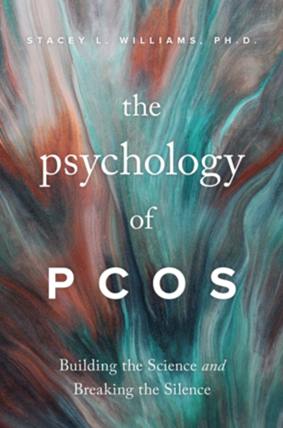
Citation: Williams, S. L. (2023). The Psychology of PCOS: Building the Science and Breaking the Silence. Washington, DC: American Psychological Association (192 pages).
There is currently limited understanding of the etiology and cause of PCOS, as well as no cure; rather, the focus of treatment is often symptom management. Despite its prevalence and negative impacts, there is a scarcity of literature on individuals living with PCOS.
To help fill this gap, Stacey L. Williams, PhD, a social-health psychologist, and professor at East Tennessee State University who studies stigma and health, wrote The Psychology of PCOS: Building the Science and Breaking the Silence. In this newly published book, Williams takes readers on a moving and deeply personal journey into an understudied area where health and psychology intersect. The book is based on the author’s own qualitative research, where she conducted 50 recorded, one-to-one phone interviews with individuals who self-reported a PCOS diagnosis. Participants ranged from 19 to 46 years and represented multiple racial/ethnic, gender, and sexual identities from across the United States. Williams was intentional in her recruitment and explicitly sought to include the voices of transgender, nonbinary, and gender diverse individuals who were living with PCOS. Notably, the author reports that 50% of participants indicated that their gender fit a label other than “woman.” Thus, it is important to acknowledge (as Williams does) that her sample is not a direct representation of the population with PCOS. To read more about the study’s methodology, the readers are directed to Appendix A.
In the introduction, Williams makes the argument for why we need a psychological science of PCOS. The rest of the book is divided into seven chapters, with two appendices. She starts with a brief but helpful overview of PCOS and names the silence and invisibility of the condition (Chapter 1). She then discusses the various ways that PCOS symptoms can be stigmatizing (Chapter 2). In Chapter 3, Williams correlates this stigma with a violation of societal expectations of womanhood, a section that I found particularly compelling. Typically understood as a “women’s health” issue, Williams explicitly tackles the misconception that cisgender females are the group affected and draws attention to the diversity of experiences across gender identities. Although many cisgender women experience PCOS symptoms as adverse because of their impact on body image, for example, the author noted the positive experiences described among the gender diverse because of the masculinizing effects of certain symptoms. This is a fascinating and important area of study that deserves further investigation.
Williams also explores the challenges and benefits of social support surrounding PCOS, the variable impacts of symptoms on sexual functioning and dating (Chapter 4), and potential reasons for increased psychological risk (Chapter 5). Again, she highlights a novel (and perhaps surprising) finding worthy of exploration: Some individuals described positive outcomes (“psychological growth”) despite or even because of their condition. There are also physical health risks and complications associated with PCOS (Chapter 6). Here, Williams labels participants’ dissatisfaction with their healthcare with themes, which include medical professionals’ lack of knowledge, delayed diagnosis, dismissive responses that were suggestive of race- and gender-based bias, and cultural incompetence.
In the final chapter, Williams puts forth a “PCOS call to action” and identifies three main areas of future work: clinical interventions (to address mental health and improve PCOS healthcare), advocacy, and psychological science. For those who desire a deeper dive into understanding PCOS (specifically) and the various related psychosocial aspects of life (more broadly), Williams shares a suggested reading list of medical, social science, and popular press sources that she says increased her own knowledge in these areas (Appendix B).
Early on, Williams “breaks her silence” and labels her own history with the diagnosis. Throughout the book, she seamlessly transitions between review of the academic research on the topic, excerpts from participant interviews, and description of her own experiences with PCOS. Using this approach, she manages to personalize the research and bring her participants’ reality to the forefront. The language of the book is not overly technical; it is thoughtfully written and researched. She is unassuming of her audience and provides accessible, digestible explanations for terminology and theoretical concepts that may be very familiar to some and novel to others (e.g., intersectionality). She approaches the topic from an ecological framework, highlighting the opportunities for intervention at the individual, interpersonal, community, and societal levels.
Given Williams’ call to “build the science,” the book is aimed toward scholars, researchers, and practitioners; namely, social, health, and clinical psychologists. However, as the author states, scholars in other disciplines (e.g., public health, nursing) and areas of study (e.g., women’s health, LGBTQ studies) may also find the topic relevant to their work.
Williams hopes the book will also serve those living—struggling and flourishing—with PCOS, by having their validating voices reflected back to them. This “PCOS Manifesto,” as the author lovingly calls it, demands that the silence be broken. This book engenders opportunities to do just that.