


Education research is built from narratives. Researchers weave events, actors, and conditions into coherent narratives that shape what feels plausible prior to analysis, structuring the explanations that follow. Narrative scholarship shows that such structures elevate some elements while muting others (Bruner, 1990; Polkinghorne, 1995). In educational contexts, narrative patterns reflect the cultural and institutional landscapes that shape how experience is interpreted and retold (Clandinin and Connelly, 1990). Some become so widely shared that they function as master narratives that guide what counts as a compelling explanation (McLean & Syed, 2015).
These master narratives matter because they guide reasoning in ways researchers may never name. A quick way to see this is to ask yourself what a “good” decision is and then try to explain what led you to that conclusion. This difficulty illustrates how such narratives operate. They shape what feels like a convincing explanation, including links between causes and outcomes that seem credible. Making these assumptions visible is essential for methodological clarity, a point underscored by a recent call to foreground the interpretive commitments underlying research practice (Pek and Bauer, 2023). Without reflection, researchers risk reproducing assumptions that limit the range of questions asked and the explanations considered.
Budgetary decision-making in public K-12 districts offers a clear illustration. A familiar narrative suggests that improved outcomes follow directly from increased investment, often expressed as “more money, more learning.” Research complicates this relationship (Grubb, 2009), but the narrative remains compelling because it aligns with cultural expectations about how resources should produce results. Even rigorous analyses can lean on this assumption. Its persistence highlights a methodological concern: narrative commitments embedded in a field can shape scholarly reasoning before any methodological choice occurs.
This raises a broader question: how can researchers identify the narrative commitments shaping their fields, and how might doing so support more reflective interpretation in areas where multiple traditions coexist? Identifying these commitments requires tools that map conceptual patterns, reveal explanatory habits, and surface assumptions rarely articulated in methods sections or positionality statements. The goal is not to challenge individual findings but to understand the interpretive structures that make certain explanations feel intuitive across a field.
I approached these questions using bibliometric mapping and meta-narrative synthesis. Bibliometric mapping uses citation patterns to visualize how research communities form and interact (van Eck & Waltman, 2010). Meta-narrative synthesis examines how different traditions develop their concepts and explanations over time (Greenhalgh et al., 2005; Wong et al., 2013). Together, these methods illuminate the narrative architecture of a field, making visible the assumptions and interpretive patterns that shape how researchers explain a shared phenomenon. Their value lies in making these elements visible.
To illustrate, I mapped ninety-five peer-reviewed publications on K-12 budgetary decision-making (Chase, 2025). Co-citation mapping showed which works were cited together and which clusters of scholarship later authors interpreted in relation to one another. Three interpretive communities emerged: governance (red), sociocultural leadership (green), and managerial practice (blue). These communities are rarely cross-cited, suggesting that the field draws on multiple explanatory logics with limited integration.
Figure 1
Co-Citation Map of K–12 Budgeting Decision-Making Scholarship
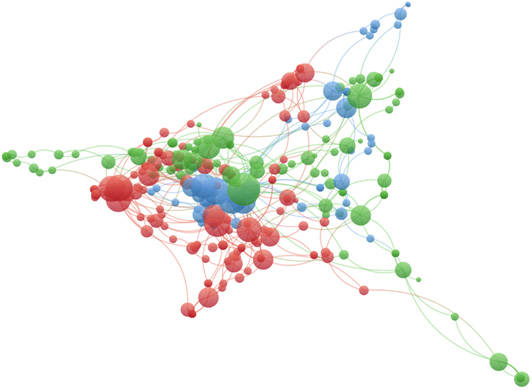
Map of K-12 Budgeting Decision-Making
Node sizes reflect how often publications were co-cited. Larger nodes represent “louder” narrative voices that later researchers treat as central. Proximity indicates how similarly publications are cited across studies, meaning nodes positioned close together are effectively in closer conversation. The uniformly thin links show that no pair of publications was co-cited more than once, suggesting the field rarely builds shared lines of argument around the same works. This pattern points to deeper interpretive differences across traditions.
A keyword co-occurrence map, supported by close reading of the publications, reinforced this pattern. Governance research emphasized efficiency, compliance, and resource optimization, reflecting a narrative of “rules shaping decisions.” Leadership studies focused on sensemaking, ambiguity, and identity, consistent with a narrative of “meaning shaping decisions.” Managerial work highlighted systems, routines, and performance metrics, reflecting a narrative of “systems shaping decisions.” These vocabularies signal distinct interpretive frames and show that each tradition operates with different assumptions about what matters most in budgeting.
Figure 2
Keyword Co-Occurrence Map of K–12 Budgeting Decision-Making Scholarship
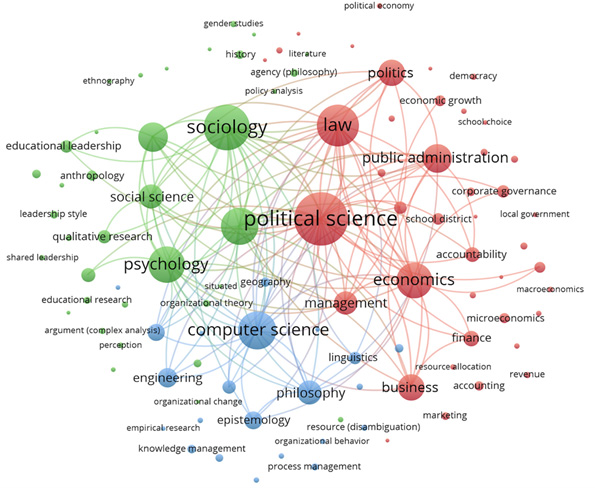
Co-Occurence Map of K-12 Budgeting
These patterns reveal how traditions construct different narratives of budgeting. Although my larger analysis produced eleven patterns (Chase, 2025), four illustrate how narrative assumptions function across traditions.
Narrative of constraint. Across traditions, budgeting is described through images of limits, scarcity, and trade-offs. Constraint becomes not only common but the defining condition of decision-making.
Narratives shaped by different lenses. Governance, leadership, and managerial scholarship interpret the same decisions through rules, meanings, or routines. These differences reflect distinct assumptions about what drives action, yet they are rarely acknowledged as competing explanations.
Narratives carried across fields without their foundations. Ideas from business, economics, or psychology often enter budgeting research without the assumptions that originally gave them meaning. This leads to conceptual drift where borrowed narratives no longer align with the contexts in which they are used.
Narratives that rarely surface. Psychological or ecological perspectives appear only occasionally, even though they offer tools for explaining how individuals interpret complexity, uncertainty, or risk. Their limited use shows that some interpretive possibilities remain largely outside the field’s shared sensemaking.
For methodological reflection, the importance of these patterns lies in what they reveal about scholarly reasoning. Fields often rely on narrative assumptions that remain implicit, shaping what counts as a persuasive explanation. Mapping these assumptions makes visible the interpretive foundations on which analyses rest (Pek and Bauer, 2023).
This transparency strengthens researchers’ ability to identify their commitments, question inherited logics, and consider alternatives that have received less attention. For reviewers, attending to a study’s explanatory logic supports deeper evaluation of methodological choices. For practitioners and policy leaders, recognizing circulating narratives helps distinguish between explanations grounded in evidence and those grounded in cultural familiarity.
Education research is shaped by narrative configurations. Methods that surface these configurations support more transparent and contextually grounded inquiry. Examining the assumptions shaping our explanations strengthens the field’s ability to engage with complexity. Approaches such as bibliometric mapping and meta-narrative synthesis reveal interpretive commitments that guide research and offer one path toward the methodological reflection scholars continue to call for.
References
Bruner, J. (1990). Acts of meaning. Cambridge: Harvard University Press.
Chase, C. (2025). What Narratives Have Shaped How Budgeting Decisions Are Understood in K–12 Education Research? A Meta-Narrative Review of Research Traditions. Unpublished manuscript. University of New Hampshire.
Connelly, F. M., & Clandinin, D. J. (1990). Stories of Experience and Narrative Inquiry. Educational Researcher, 19(5), 2–14. https://doi.org/10.3102/0013189X019005002opens in new window
Greenhalgh, T., Robert, G., Macfarlane, F., Bate, P., Kyriakidou, O., & Peacock, R. (2005). Storylines of research in diffusion of innovation: a meta-narrative approach to systematic review. Social science & medicine, 61(2), 417-430. https://doi.org/10.1016/j.socscimed.2004.12.001opens in new window
Grubb, W. N. (2009). The money myth: School resources, outcomes, and equity. Russell Sage Foundation.
McLean, K. C., & Syed, M. (2016). Personal, master, and alternative narratives: An integrative framework for understanding identity development in context. Human Development, 58(6), 318-349. https://doi.org/10.1159/000445817opens in new window
Pek, J., & Bauer, D. J. (2023). Refocusing on Methodology Versus Method. The Score, 45, 2-6.
Polkinghorne, D. E. (1995). Narrative configuration in qualitative analysis. International journal of qualitative studies in education, 8(1), 5-23. https://doi.org/10.1080/0951839950080103opens in new window
Van Eck, N., & Waltman, L. (2010). Software survey: VOSviewer, a computer program for bibliometric mapping. scientometrics, 84(2), 523-538. https://doi.org/10.1007/s11192-009-0146-3opens in new window
Wong, G., Greenhalgh, T., Westhorp, G., Buckingham, J., & Pawson, R. (2013). RAMESES publication standards: realist syntheses. BMC medicine, 11(1), 21. https://doi.org/10.1186/1741-7015-11-21opens in new window
Contact
 Cole Chase, EdM, MAT
Instructor and Doctoral Candidate
University of New Hampshire
Email