

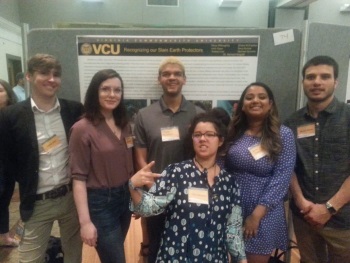
 Humanistic psychologist, Richard Bargdill, PhD, and his group of psychology student researchers at Virginia Commonwealth University (VCU) are investigating the fate of eco-martyrs murdered in the line of their activist environmental work. VCU students Josh Geen, Victoria Farnsler (student research coordinators) and Andrea Lee, Chelsea Brewer, Olivia Willoughby, Ian McFadden, Michael Somma, Devu Kumar and Patrick Daly (student researchers) contributed to this reporting.
According to the Goldman websiteopens in new window, the Goldman Environmental Prizes were awarded on April 29, 2019. The Goldman Award honors grassroots environmental heroes from the world’s six inhabited continental regions: Africa, Asia, Europe, Islands and Island Nations, North America and South and Central America. The prize recognizes individuals for sustained and significant efforts to protect and enhance the natural environment, often at great personal risk. The Goldman Prize views “grassroots” leaders as those involved in local efforts, where positive change is created through community or citizen participation in the issues that affect them. Through recognizing these individual leaders, the prize seeks to inspire other ordinary people to take extraordinary actions to protect the natural world.
On January 15, 2017, 51-year-old environmentalist Isidro Baldenegro López was killed by a hired gunman in the home of a relative after returning to his native land, the Tarahumara region of northern Mexico, following threats of violence and death from those taking advantage of the region’s resources through logging and mining. Like his late father before him, Baldenegro López had dedicated his life to protecting the region from those who wished to demolish forests and natural environment for personal gain. At the age of 7, Isidro witnessed the murder of his father for making efforts against logging in the Tarahumara region, the very same work Isidro continued up until his own death. In 2005, Baldenegro López won the Goldman Environmental Prize, an annual award given to six individuals to honor grassroots environmental efforts.
The Goldman Prize was first introduced by Richard and Rhoda Goldman in 1989 to bring attention to the issues we are creating by neglecting the proper care of our planet. Every year since 1990, the six winners are selected from each geographic region and awarded a prize that includes monetary support to continue their work. The hope is that these activists will serve as inspiration for others to live daily lives in which we are all more environmentally conscious.
However, a more sinister trend is being revealed about those who attempt to protect the environment. In March of 2016, 10 months before Baldenegro López’s murder, environmentalist Berta Cáceres was killed by a hired gunman in her home shortly after leading local protests to prevent the construction of a proposed dam that would negatively impact the habitats in her home country of Honduras. In addition to their efforts toward protecting the natural world, there is one important link between these environmental defenders: both Cáceres and Baldenegro López were recipients of the Goldman Prize. These two inspiring individuals have achieved global recognition for their ecological advocacy while simultaneously making them targets to those wishing to carry out the deeds of environmental destruction the activists have worked so hard prevent.
Unfortunately, Lopez and Cáceres are not alone. Global Witness has catalogued that, since 2002, over 1,600 individuals have been murdered in the same fashion as these renowned environmentalists. These “eco-martyrs” can range from environmental activists to anti-poachers to people who are just trying to protect their own land from being illegally taken. Richard Bargdill, PhD, and his group of psychology student researchers at Virginia Commonwealth University have been investigating the fate of these eco-martyrs in hopes of raising awareness and finding help for their plight. Some were threatened, some were kidnapped and some were tortured. All were murdered. Some were killed along with other environmentalists and some in front of their families and communities. All gave their lives attempting to stop profiteers from continuing to pillage the earth’s natural resources. Many defenders requested police protection and it was rarely granted. These people know they are fighting powerful forces that will not hesitate to use extreme violence, yet they still choose to advocate against what they know is wrong despite all the factors opposing them.
Jóse Cláudio Ribiero da Silva, an environmentalist who relies on the Amazon Rainforest for his livelihood, gave a TEDx talk in November of 2010 denouncing illegal logging and stated, “I could be here today talking to you and in one month you will get the news that I disappeared.” In fact, six months later, he and his wife, Maria do Espírito Santo, were shot and killed.
In April of 2007, P.D. Majhi spent five days in the Pakke Wildlife Sanctuary located in Arunachal Pradesh, India, searching for poachers who invaded the safe space to hunt tigers. At the end of the nearly weeklong chase, Majhi and three other men found themselves in combat with the poachers. Eventually they managed to push the illegal hunters out of the sanctuary, but only after Majhi had been fatally shot.
Ernesto Rabago Martinez was a lawyer who represented local peasant farmers who could not fight for themselves against cattle ranchers trying to rob the farmers of their land. After winning a lawsuit for these indigenous farmers, Martinez was shot by two gunmen in his own office while his wife was present.
As Susan R. Gelman, president of Goldman Environmental Foundation said in response to the murder of Baldenegro Lopez, “Unfortunately, too many governments are failing to create safe spaces where people can voice their dissent and organize movements free of persecution and violent acts.” Sadly, this is a statement that can apply to the hundreds who have been killed in the past seventeen years in the name of defending the natural world. The hope is that their pleas for protection will be taken more seriously.