Humanistic therapists have long been invested in viewing and treating clients from a holistic lens, and prizing cultural aspects of a person such as their gender, sexual orientation, and other identities (Hoffman et al., 2019; Vallejos & Johnson, 2020). In this article, we describe the context in which tailored interventions for LGBTQ+ people are helpful. Then, we describe our research program that is advancing humanistic expressive writing interventions to aid clients in processing heterosexist and transphobic experiences. We describe this process and share with you how to make these exercises available to any LGBTQ+ clients (or nonclients) who you think might benefit from these interventions. Our goal is to share some of our findings and to circulate and develop humanistic interventions that support LGBTQ+ people in processing stigma-related events.
The need for LGBTQ+ interventions
LGBTQ+ people face extensive and impactful stigma-based experiences. A systematic review found that these experiences include discrimination in healthcare, employment, housing, adoption, immigration, and accessing services, as well as school bullying, hate crimes, and rejection from religious communities (National Academies of Sciences, Engineering, and Medicine, 2020). These stigma-based experiences have been detrimental to LGBTQ+ individuals’ physical and mental health, leading to heightened anxiety and depression, among other mental health difficulties, especially for people of color and those with intersectional stressors (Smith et al., 2020; Velez et al., 2019).
With the current global rise of anti-LGBTQ+ legislation (Horne et al., 2019; 2022), LGBTQ+ people’s experiences of transphobia and heterosexism have been expanding and intensifying. Increasing hostile sociopolitical division and ongoing legislative violence against LGBTQ+ people mean that therapists should be aware of the need to make room to discuss heterosexism and/or transphobia in sessions, as they are pertinent for LGBTQ+ clients.
Although the American Psychological Association (2021, 2015) has created guidelines to encourage LGBTQ+-affirming therapy, few interventions have been developed that specifically address sexual and gender minority stress and trauma (Holt et al., 2021). Additionally, there has been a concerning paucity of research evaluating these interventions (Puckett & Matsuno, 2021). Online exercises for this population have appeared to be promising, however (e.g., Israel, 2019; Pachankis, 2020). In the next section, we briefly review some of our research that has led to the development of an empirically based expressive writing intervention. These interventions can be used either independently or as a homework exercise in therapy with LGBTQ+ clients who have had experiences of transphobia and heterosexism that remain troubling to them.
Our expressive writing intervention
Our first study on healing from heterosexism via expressive writing (Levitt et al., 2022) had positive responses, with over 99% of participants reporting progress in processing the event that they explored. The exercises also resulted in a decrease of event-related stress with a large effect, and a decrease of depression with a medium effect — which was surprising as we did not specifically recruit for depressed participants. These promising findings held across race, ethnicity, gender, and sexual orientation. Since this initial study, we have conducted studies that investigated the effectiveness of these exercises with specific LGBTQ+ populations, including bisexual men (Chickerella, 2021), trans and nonbinary (TNB) people (White, 2022), and LGBQ+ autistic people (Maroney et al., 2023). In those populations, the findings were similar overall to the initial study and demonstrated that the exercises led to progress for the overwhelming majority of participants.
The research now focuses on two types of writing exercises, which have found to have similar effects in reducing depression and stress (Levitt et al., 2022): (1) a condition where participants write about their deepest thoughts and feelings related to their heterosexist or transphobic event (note that this is an approach typical in expressive writing research); and (2) a structured emotion-focused therapy (EFT) based writing condition that offers asks participants to first explore their emotions about the heterosexist and transphobic event, then exploring their needs, and subsequently considering actions that those needs suggest.
The writing interventions are client-centered in nature. We do not tell participants how to resolve their heterosexist or transphobic experience or assign pre-determined strategies to apply in their lives. Instead, they progress through a guided self-reflective process to arrive at novel insights and plans for action that make sense for them within their own personal and cultural contexts. Participants engage in expressive writing exercises for 20 minutes per day for three consecutive days, followed by a self-assessment of progress. Psychological measures and demographics are collected in an intake survey the day before the full exercises, as well as in a follow up survey two months later in order to examine the effects. The study takes about three hours in total.
Research findings on processing heterosexism
Results from these studies indicated that it can be helpful for individuals to process heterosexism and transphobia. The findings also suggest it can be beneficial for therapists to talk with clients about these stigma-based experiences. These findings led us to the question of how to help clients process these experiences.
In answering this question, one of the most clinically-relevant studies conducted from this research was a task analysis by Collins and Levitt (2021). The authors identified four stages of working through heterosexist events, meant to provide therapists with a roadmap for helping clients process these issues. In focusing on the EFT condition, they found that clients passed through four stages of change: (1) being engulfed by emotional pain about the heterosexist event, (2) deepening self-reflection about their emotional experience in which they begin to view the stigma-based experience as harmful to them, (3) creating self-compassionate understandings of their own emotional experience and related needs, often beyond the specifics of the event itself, and (4) fostering empowerment through an understanding of heterosexism and transphobia as social processes and of LGBTQ+ community, mentors, and activism as ways to both resist stigma and celebrate their identities. Collins and Levitt (2021) further identified barriers to the healing process in the task analysis, including hopelessness, self-doubt and blame, and disengagement. These barriers can frequently prevent clients from reflecting on their own feelings and needs. More details on the clinical processes are available in the article by Collins & Levitt (2021).
Research has shown that even as clients in individual psychotherapy, LGBTQ+ individuals may still have distress related to their LGBTQ+ identities that goes unprocessed or underexplored. In sessions, clients may feel worried about being judged, unprepared to talk about their stigma-based experiences, or unsure that they are welcome to talk about their identities and related experiences (Hand, 2023). Therapists inviting discussion of these experiences of psychotherapy, when relevant, can demonstrate a willingness to address these issues.
How to share information about our expressive writing exercises
You may share information about our research on expressive writing exercises with clients if you think that these exercises could support them in a self-reflective process, either through their own writing or by participating in one of our research studies. In qualitative studies by Collins et al. (2020) and Levitt et al., (2022) participants indicated that structured reflection and guided writing facilitated self-reflection, emotion processing, and affirming self-attitudes. Participating in these exercises can be useful tools for supporting and supplementing therapy.
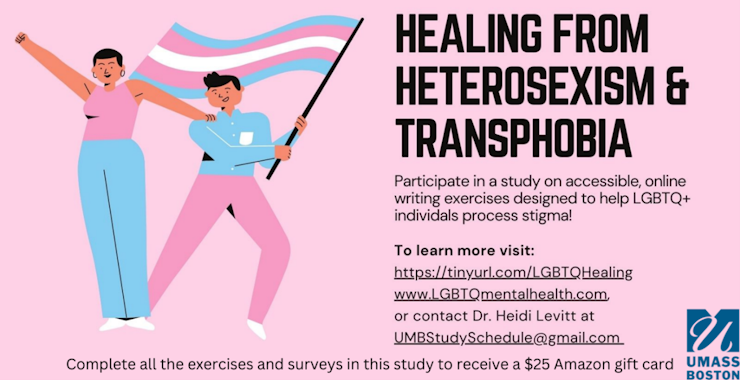
Our mission is to develop freely accessible exercises to support LGBTQ+ people in processing and developing affirming responses to stigma-based experiences when they are troubling. More information on the study in which these writing exercises are being examined is availableopens in new window.