In addition to grounding the book in the Zollikon Seminars, Aho introduces his readers to the relevant themes of phenomenological philosophy, the existential modes of embodiment, affectivity, and space and time, as well as a hermeneutic rendering of existence. A far more thorough introduction to these themes can be found in Aho’s previous work (e.g. 2008a, 2008b, 2017, 2018a, and 2018b [in press]) as well as the aforementioned special double issue of The Humanistic Psychologist on Daseinsanalysis.
The book begins with a chapter from phenomenological philosopher and cognitive scientist Shaun Gallagher — a peculiar contribution for a Heidegger series. Gallagher merges a Heideggerian account of authenticity with news from cognitive science presses in order to argue that the psychiatric condition of anxiety is social. He tells his readers, for example, “If Heidegger were a neuroscientist, he might say that Mitsein is hard-wired into the brain…” (p. 10). Such speculation, of course, does not follow the Heidegger of ZK, who explains how “we do not have any possibilities to know how the brain bodies forth in thinking” (p. 197) — a quote acknowledged by Swedish philosopher Fredrik Svenaeus in his contribution to the book, Chapter 9.
The direction is corrected, however, in Chapter 2, written by American philosopher and psychoanalyst Robert Stolorow. Stolorow begins by criticizing decades of phenomenological psychopathology research for failing to question the validity of the diagnoses set forth by the American Psychiatric Association. For example, a phenomenological account of depression that begins with the Diagnostic and Statistical Manual of Mental Disorders-Fifth Edition (DSM-V; APA, 2013) criteria has already begun with certain expectations about what counts (or does not count) as psychopathology and is therefore insufficiently phenomenological. Reminiscent of Heidegger, Stolorow argues that “the DSM is a direct descendent of Descartes’s metaphysical dualism” (p. 18). For an alternative, he recommends a conception of psychopathology that is based on the existential modes of affectivity and sociality.
In Chapter 3, American philosopher Anthony Vincent Fernandez deftly teases apart the subtle difference that Heidegger makes between ontic and ontological, that is, the “ontological difference.” In Being and Time, Heidegger differentiates between fundamental structures of human existence (such as temporality, attunement and situatedness) and their various modes. As a fundamental structure of existence, temporality is always a dimension of human being and is therefore ontological. Within this ontological structure, there can be many different ontic modes — such as experiencing the world as moving slowly or quickly. You and I can experience the same subway trip as fast or slow, depending on where we are going and how much time we have to get there, but for each of us this experience is always within the ontological structure of temporality — that does not change. Fernandez explains that phenomenological psychopathology has focused primarily on the shifts in ontic modes of being, but he suggests that they must also seriously consider the possibility that for some, the ontological structures themselves may also be altered. For example, traditional phenomenological psychopathology would understand that the depressed person is still situated within an affective milieu (mood or attunement) but that the particular mode has a deflated quality. Fernandez argues how, in some cases, persons with severe depression are actually experiencing a breakdown of these ontological structures, such as the loss of affective attunement with the world and with others (citing Fuchs, 2013). The possibility of such a breakdown would be profoundly consequential to the phenomenological understanding of depression.
Philosophers Martin Kusch and Matthew Ratcliffe make a unique contribution to the volume in Chapter 5. Kusch does not speak as a philosopher but as a chronic pain patient. Ratcliffe, who specializes in the philosophy of medicine, provides an analysis of Kusch’s experience. After a routine dental surgery, Kusch began to experience what became a lifetime of chronic dental pain. He describes the many specialists he visited and the various ways of being treated like a set of dental x-rays. The combination of these two perspectives results in an existential analysis of chronic pain as well as an indictment against the depersonalizing treatment of patients by specialists and health management organizations.
If the personal narrative and analysis given in Chapter 5 is not the highlight of the book, then that distinction would have to go to Fredrik Svenaeus in Chapter 9. Svenaeus gives a damning critique of medicalization in the practice of contemporary medicine and the latter’s reliance on technological developments. Heidegger was famously cautious regarding technology, careful to point out that it must be useful for human beings and not the reverse. What Svenaeus calls the “perils of medicalization” (chapter title) can be summarized by the following quote:
The annihilation of human being, not as biological being, of course, but as a being-in-the-world, is therefore a problem and danger that stems from choosing the scientific method as the only one relevant in medicine. …[T]he danger is that the scientific attitude finds a dominating hold by way of the technology that makes the attitude in question harder to critically scrutinize and complement with the phenomenological point of view. (p. 136)
When medicine is effective in extending the life of a human being by ten years, what does this mean? When defined biomechanically, a beating heart is all that is required to keep someone living, but what kind of “life” is this? If living is defined scientifically, then technologies may be employed to this objective. These, however, do not and cannot touch the existence [Da-sein] of the person.
Svenaeus urges his readers to re-examine the goals of medicine and particularly what is meant by health the way hermeneutic philosopher Hans Georg Gadamer has done in his famous Enigma of Health. Health is not the success of medical science but the state in which one is unaware of health. Health “cannot be produced by the doctor using technical and scientific skills” Svenaeus reminds us, “rather, health must be re-established (p. 139).
Existential Medicine does not end without reference to Heidegger’s (1927) famous broken hammer, made by American professors Piemonte and Ramsey in Chapter 14. Like the weight and heft of a hammer that only becomes apparent when the latter becomes broken as a tool, the authors argue that human beings only become aware of health when it breaks down. Their attention then shifts to the notion of authenticity when dealing with a traumatic illness, describing the possibility that an inauthentic mode of being might be understandable. For example, instead of meditating on the full implications of a stage four cancer diagnosis, a patient may reasonably choose to pretend nothing is wrong and follow-along with the behavioral expectations of “the they [people].”
The book concludes with a shift in focus to elder care. In Chapter 15, American physician and philosopher Drew Leder explores the question of what it means to “age well” — reminiscent of Joan Erikson’s chapter on Gerotranscendence (Erikson & Erikson, 1998, pp. 123-131). The modern medical model, Leder argues, “associate[s] later life with a series of potential diminishments to be defeated: sickness, destitution, disability and the loss of enjoyment” (p. 225). These, he explains, might be replaced with examples of what he calls “aging well.” For example:
elderhood may be a time to reap the wisdom accumulated over decades of experience; explore new territories; meet and surmount extreme challenges; become more vulnerable, and thereby more compassionate; turn to matters of the spirit with an urgency or maturity that was lacking in youth; and so on. (pp. 225-226)
To demonstrate these possibilities, he introduces four historical, cultural, spiritual and religious archetypal elder figures: Contemplative, Contributor, Compassionate Companion and Creative: “four ways to see the elder anew while avoiding ageist presumptions” (p. 226).

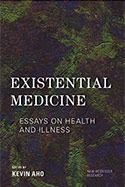 In Existential Medicine, authors come together from fields of philosophy, psychology, psychiatry and medicine to revisit the collaboration between the Swiss physician Medard Boss and the German philosopher Martin Heidegger, which culminated in Zollikon Seminars (ZK, 1959-1969). It would be a mistake to assume that this work is the first of its kind since ZK was translated into English in 2001. For many decades, its authors have been busy applying existentialism, phenomenology and hermeneutics in order to better understand health, wellness and patient care. That they have come together with contributions to a single volume is a treat.
  Patrick M. Whitehead, PhD, teaches psychology at Albany State University in Albany, Ga. His existential-phenomenological approach to general psychology has been published as an anti-textbook (R&L:2016. He studied existential humanistic psychology (MA, 2011) and phenomenological psychology (PhD, 2014) at the University of West Georgia under the guidance of Christopher Aanstoos. Whitehead also organized parts of his master’s thesis into a monograph titled Education in a Postfactual World: From Knowing to Understanding (Brownwalker, 2018). His PhD thesis has been organized into a monograph titled Expanding the Human: Posthumanism, Nonhumanism and Humanistic Psychology (Lexington Books, 2017).