

 Partners in all intimate relationships experience irritations, disagreements, differences in personalities, styles, core values, intellectual and emotional ability and on major and trivial issues. While the adage opposites attract may be true, shared issues and preferences are also important during courtship and the pair-bonding process. As partners get to know each other, differences become more apparent and are dealt with in a number of ways: they may be glossed over and tolerated or even highly appreciated, or they may also cause friction that is dealt with through humor or argument. Ideally, they will be brought out into the open and negotiated so that an understanding occurs about how they affect the other person.
A key for the therapist to sort out the relative importance of partners' gripes with each other is to help them prioritize their differences into categories such as the following:
- Complementary traits and behaviors that are endearing to the partner and he or she actually appreciates.
- Tolerable annoyances or irritations.
- Constant sources of irritation that create tension and conflict, often resulting in nagging and frustration.
- Those that absolutely cannot be tolerated and will result in alienation and perhaps separation.
A model for presenting these concepts to couples is drawn from the Behavior Window, originally developed in the 70s in Thomas Gordon's Parent Effectiveness Training. It is widely seen as an effective guide for determining which aspects of another's behavior (in this case, those of an intimate partner) should be addressed directly and which should be accepted. The model to the left indicates first determining whose problem it is and recommended strategies and phases for decision-making.
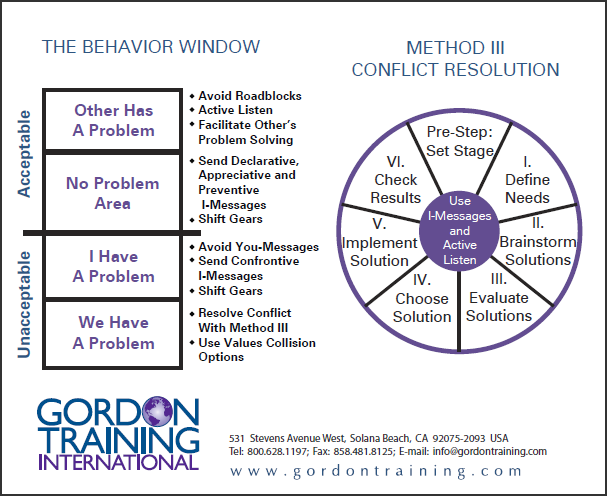
In considering a partner's actions in category two, tolerable annoyances or irritations, think of your partner whose home office is in a separate room and is cluttered but clean and accessible to him or her. You may be quite organized and neat, and your partner's cluttered office often annoys you. As you look at the Gordon Behavior Window, you realize you are in the third box (I have a problem) unacceptable area, but it's actually low on your priority list, so you shift to the second box and decide that it is in the (No problem) acceptable area. Clutter is fine with your partner so you move on to other things, still wishing he were neater but appreciating that it's ok to be different from you.
Other behaviors, such as your partner constantly checking his phone when he is with you and being distracted from engaging with you fall in category three, constant sources of irritation that create tension and conflict, or are unacceptable and fall into the third, then fourth windows (We have a problem). These require resolution through nonblaming discussion and I messages.
The fourth category, those that absolutely cannot be tolerated, might involve affairs, excessive spending from a joint account, interpersonal violence or chronic substance abuse. They also fall into boxes three and four of the window and require an intense focus on the six stages of the conflict resolution wheel. An attitude of trust but verify is applicable here, and if the intolerable behaviors continue, alienation ensues and the offended partner may decide to take steps toward separation or divorce.
When deal breakers occur, partners may tend to bring up the issue tentatively, delay, avoid and even enable an intolerable behavior when it persists. Continuing to tolerate an unacceptable behavior may also involve nagging, defined as criticizing over and over without the desired results, which pushes the offender away further and brings out their rebellious nature. At this point the offended partner needs to draw a line and a clear, direct discussion with a skilled clinician to explore options may be warranted.
In dealing with difficult behaviors in a partner, a level of self-awareness and values clarification (see Twohig & Crosby, 2008) is essential so that expectations such as do things my way do not dominate one's thinking and low-level irritations do not loom larger than necessary. In any discussion however, no matter how much self-focus or nonblaming occurs, a partner may not be open to listen about any aspect of his or her behavior. In such situations a more basic level of exploration is needed with a therapist to uncover issues of mistrust, entrenched resentments and perceptions of being controlled by the other.
As couple therapists, we need to assertively assist clients to recognize their own positions in these dilemmas and guide them through a process that can facilitate greater acceptance and the ability to engage in fruitful discussions with their partners. We must be aware of our own countertransference in responding to couples' conflicts in all clinical interactions (Whisman, Dixon & Johnson, 1997) and carefully guide couples through their own decision-making processes. In this way they can make sound decisions to either accept or confront their partner's traits and behaviors productively, or to clearly set limits that will not prolong the undesirable behaviors.
References
Behavior Window. Retrieved from Gordonmodel.comopens in new window.
Twohig, M.P., Crosby J.M. (2008). Values Clarification. In O'Donohue, W.T., Fisher, J.E.(Eds.), Cognitive Behavior Therapy: Applying Empirically Supported Techniques in Your Practice (2nd ed.) (583-588). Hoboken, New Jersey: Wiley & Sons.
Whisman, M.A., Dixon, A.E., & Johnson, B. (1997). Therapists' perspectives of couple problems and treatment issues in couple therapy. Journal of Family Psychology, 11(3), 361-366.