


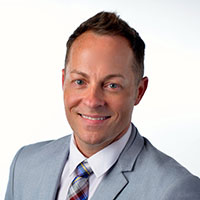
 The amount of immeasurable loss thus far in 2020 is overwhelming. Black lives have been senselessly murdered—among them are Rayshard Brooks, George Floyd, Tony McDade, Nina Pop, Ahmaud Arbery, Breonna Taylor, and so many more. There have already been at least 28 trans lives lost this year, most of whom were trans women of color (TWOC). In addition to these tragic losses, we recently lost a civil rights legend, John Lewis. Please join me in a moment of silence to honor all these lives and those we have lost to the coronavirus. May they all rest in power.
All I can say is, what a year! This virtual format has created an awkward dynamic for delivering this address. While there have been many ups and downs both personally and professionally for me this last year, I am grateful for the opportunity to have served as president of Div. 44 as we celebrate our 35th year, and I feel even better that today has arrived. I know I have grown immensely from this experience, and my ability to be flexible was certainly tested throughout this journey. I want to thank my earliest mentors Armand Cerbone and Gregory Sarlo in Chicago for pushing me to get involved with Div. 44 while I was completing my postdoctoral training.
I recently shared memories from my first convention in San Diego in 2010, one that was not without controversy and stirred a lot of discussion on our Listserv. When I arrived in San Diego, I had no idea what to expect. After seeing things play out on the listserv, I was uncertain as to what I was getting myself into. I saw marriage equality shirts sprinkled through the crowd, heard a gay men’s chorus, and there were so many choices for workshops that addressed every aspect of the clinical work I aspired to do in my own practice. Although my initial reaction was filled with excitement that there was a professional home at APA for me, I suddenly felt overwhelmed at trying to take everything in and trying to make the most out of my first convention. I had never been to a conference where I had so many LGBT options to choose from – so many programs about sexual and gender minorities. Like others before me and some more recently, it was challenging to connect in the suite and intimidating to see the people I had just referenced in my dissertation. I met Bev Greene for the first time and could barely squeak out my name. I was a newly licensed psychologist and ready to absorb as much as I could, but I was still intimidated by the leaders in the room.
After leaving that convention, I had no clue that I would be involved in leadership on the Executive Board so soon. I have a special place in my heart for Arlene Noriega, who gave me an opportunity to serve as her Division 44 Programming Chair for the 2013 convention in Hawaii. Allen Omoto roped me into coordinating my first fundraising dinner at the 2014 convention in Toronto until I wrapped up with my fifth official dinner in 2018. The last eight years have flown by, but not nearly as fast as this year seems to have come and gone.
Before I begin discussing my path to Division 44 and my initiatives for this past year, I want to recognize a few people. I appreciate Chris Davids, Antoinette Kavanaugh, Arlene Noriega, David Pantalone, Kimberly Balsam, Mira Jourdan, Margie Rosario, Michael Hendricks, and so many others who have reached out or offered support over this last year. I started my leadership experience in the division as a suite coordinator, so I especially want to thank Roberto Abreu and Em Matsuno for their work in transitioning us very quickly to a virtual format. The behind the scenes work, volunteer work at that, is a lot to coordinate every year. Please give them a round of applause. I want to thank Carlton Green for helping me secure our amazing diversity trainers at the 2020 Midwinter Meeting. Timea Webster and Sika Wheeler really did a phenomenal job pushing our board to examine white supremacy culture in Division 44 and urged us to hold each other accountable for anti-racism work. I personally believe the diversity training session needs to be given more time, if not a full day, going forward. It was important for me to yield a lot of our meeting time to continuing a post-training dialogue, which was a success because of Carlton. So, thank you again for the emotional labor you gave that day to create a space for anti-racism work. While it was only the first step of a very long road ahead, this training and Carlton’s discussion set many wheels in motion for the work that has been done since our Midwinter Meeting. I also want to thank Carlton Green, Christina Patterson, Chris Davids, Roberto Abreu, and Laura Alie for facilitating our recent discussion groups. They put a lot of time and emotional labor into planning and running a series of three discussions across nine separate sessions since February. I know they had a lot of debriefing and processing outside of facilitating those discussions, so I want to sincerely thank you all again for doing this work.
I was not on this journey alone. I also I have to thank Jose for his love, understanding, and constant support during my presidency. We take on these roles as volunteers, in addition to our other career obligations, which means our significant others deal with thwarted plans, late night projects, irritability, conference call after conference call, and all the other responsibilities that come with these roles. Just when we you say, “I promise this will be the last thing I do for a while, someone else ropes you into taking a new position and the cycle repeats.” I have another year in my role with Division 44, and I anticipate that being away from the board will be hard given I spent my entire early career years with you all.
I have done a lot of reflecting this week and found myself going much further back than anticipated. Some of my earlier memories remind me of why I do the work I do. I am proud to have grown up with a single mom who taught me that love is love and who pushed me to see the world through a lens of humility, respect, and to always fight for what I believe in; and most of all to live authentically. Poverty was a reality that she tried hard to get us out of. After a tragic car accident, when I was 10 years old, she faced a lot of obstacles with her physical limitations. We still struggled a lot, but it shaped my worldview and made me appreciate things that many of my friends took for granted. Unfortunately, I lost her when I was barely 21 years old, but she’s never really left my side. I have many memories of her to carry me through the darkest of times and know she would be proud of my journey thus far. In looking back at her life now, I am inspired by her resiliency. I realized while organizing my thoughts for this address that I have not dusted off some of these memories in a quite a while. My mom was a closeted lesbian for most of her life, but most people knew Carol was not just her roommate. I saw her struggle and knew my struggle would be similar in a small town, so it took me a while to figure out how to live authentically. I also have more knowledge now of the role privilege had on my personal experiences and queer development.
I found myself working at a local AIDS Service Organization in my small, rural hometown of Sherman, Texas. There were so many days I wanted to quit and struggled to see value in what we were doing. It was hard work as a 19-year-old prevention worker to deal with so much bigotry and denial across three counties, but it was harder for my colleague as a Black, heterosexual man doing the same work. My first conversations about privilege and power started with him and really set the course for being an ally. We had many discussions and debriefing sessions after spending all day out in the community doing prevention work and HIV testing, which put my struggles into perspective and pushed me to be a better friend and ally. It also helped me stay the course and keep doing the work. The work was taxing and having to tell people they were HIV positive in the late 1990s and early 2000s was a struggle when I was so young. I found myself wanting to do more, which really drove my passion for advocacy and clinical work. Those conversations allowed me to be more open and equipped me with knowledge that most of my family still chooses to ignore. I know anti-Blackness and anti-racism work never ends and I am personally committed to doing the work for the rest of my life.
I left rural Texas for Chicago and completed my doctoral training at Adler University, where I spent a lot of time focusing on social justice work and developing my advocacy skills. My dissertation focused on the use of the Rorschach with gay men and the need to evaluate scoring and interpretation with this population. Adler truly helped build a foundation for the work I have done over the last 10–12 years. All that I do in my practice, my advocacy roles, and teaching is guided by the principles of being a socially responsible practitioner.
I have spent the vast majority of my career doing clinical work and training clinicians. Prior to taking on an academic role in a clinical psychology doctoral program at Florida School of Professional Psychology in Tampa, I was the clinical director at a group practice in Chicago, where I expanded the program and oversaw the clinical training of 22 practicum students and 3 predoctoral interns. I love teaching and mentoring students but also value my clinical work with patients. In my current role, I get the best of both worlds. I split time between teaching, mentoring, supervising, and providing clinical services. Most of my clinical work involves working with the sexual and gender minority (SGM) community. I spend a lot of time working with trans and nonbinary kids and adults as well as their parents. It is both rewarding and exhausting work, especially during this pandemic where folx1 are spending more time in unaccepting and sometimes physically and emotionally abusive home environments.
Who would have believed that so many children and adolescents would miss the school settings where they may have been bullied because of their sexual orientation and/or gender identity? It is a common theme among those I work with who are forced to be at home where they are not allowed to live authentically. Many are not able to talk freely via telehealth out of fear their parents or caregivers are listening to our psychotherapy sessions. These are struggles that even college students are experiencing when forced to leave dorms or campus housing and return home as the pandemic rages on.
When I started my role as president-elect, I already knew this year was going to be challenging well before it began. I was not aware it would be as challenging as it has been. Since 2016, the sexual and gender minority community has been under siege, and it seems the last year has involved one attack after another. We are living in a reality where anti-Blackness, racism, hatred, bigotry, xenophobia, and violence are amplified and celebrated. Each day brings a new challenge and need for reality testing among trusted colleagues, patients, students, friends, family, and others. Frankly, I am not surprised by what I see anymore because every extreme I never thought was possible has happened. There are times where it seems as though we are trapped in an alternate universe, much like some Netflix series, where we are the subjects of a sick social experiment testing our resiliency and ability to thrive. One such event recently triggered these feelings. While remembering the lives lost on the anniversary of the Pulse Nightclub shooting, the current administration announced a plan to roll back protections of SGM people in the Affordable Care Act. The timing seemed intentional, it was obviously calculated and sent a clear message to our community. In my practice, we saw an influx of crisis calls and patients were struggling. I am so proud of the work Michele and Christina do with our Division 44 Public Policy Committee in an effort to stay ahead of the issues and their response time is always impressive. They had a statement ready to go and that was one of many, many statements from this last year that were made to address the attacks toward SGM people.
I recall when the 2016 election ended. Some of those same kids from my first trans youth support group are now eligible to vote. Many of them were traumatized at the time, in tears for weeks, and some wanted to stop their social and medical transition until we had a president who valued their lives and existence. That year had been fairly difficult for all intersections of our community because we were suddenly devalued in a sociopolitical climate where a platform of legitimized bigotry and hatred flourished, the Pulse shooting was a call to action for the SGM and Latinx communities, and all the work toward equality was suddenly disposable with the stroke of a pen and an executive order. As I say this, nothing has really changed, and situations have only worsened. More trans lives have been taken, and the senseless murders of Black lives continues. We have a long fight ahead and Black, Indigenous, People of Color (BIPOC), whether they identify as SGMs or not, need our support.
I have shared with some of you that I have a personal goal of naming things more in the moment and not being complicit with silence anymore. It is a challenge when fighting a system so deeply entrenched in white supremacy culture when you are conditioned to be conflict avoidant with a sense of urgency. I am getting better at recognizing this more as I immerse myself in the work. As I evaluate my own journey, I am noticing more and more that these values have been passed down or embraced by mentors and that has really made me examine my own mentoring relationships with students.
I am actively trying, and committed to being more accountable, to avoid perpetuating a system of anti-Blackness and racism. I shared some of my frustrations and disappointment in a few groups during this conference and apologized for my silence and not naming overt and covert sexism during a meeting that Kimberly was running as president of Division 44. I think back on times that I have been complicit in my silence with regard to anti-Blackness and racism and can only commit to pushing myself to do more, show up in the conversation, and not to avoid the conflict or be afraid of saying the wrong thing. As I reflect on some of our conversations from this week and at our Midwinter meeting in January, I cannot help feeling sad and disappointed that we are still struggling with white supremacy culture in our division, which is certainly embedded in our 35-year history and serves to preserve anti-Black racism. It is time to lean into the discomfort and develop a system of accountability that will help deconstruct the white supremacy culture and create a space where BIPOC will feel safe joining and staying involved with the division. David Pantalone spent a lot of time surveying our membership during his presidency, and we all know that these issues have been an issue and still exist within our professional home. We are finally taking steps as a division to expose the white supremacy culture and it is not easy, yet we must be more mindful of not bringing in Black members to do this work for us. Power hoarding is a consistent problem and admitting and owning that dynamic is necessary for us to make progress.
Much of my presidential year and initiatives have been overshadowed by a pandemic that has been politicized and weaponized to further marginalize already oppressed folx, both in and outside our SGM community. The silencing of scientists and healthcare professionals seems to be a given by the current administration. The coronavirus has dramatically impacted our world in ways we could not have imagined five or so months ago, and, more specifically for our field, it has changed the way we deliver clinical services, the way we teach, conduct research, and conduct business for our division.
Most of my clinical work intersects with the trans community, and I have a general concern for their safety and wellbeing. It is extremely difficult to see so many TWOC killed each year, I wanted to bring forth an initiative that would potentially benefit the community and shed light on this problem and use the power of APA to facilitate larger systemic changes. When looking back, Allen Omoto challenged the division to think bigger and stay true to our mission as a social justice division. As I reflected on his words, we are still missing important opportunities in the pursuit of building relationships with other organizations that would create partnerships and alliances for greater systemic changes while helping to center the voices we are trying to uplift. This is relevant for both my initiative and the process for updating the APA Guidelines for Psychological Practice for Transgender and Gender Nonconforming People in Everyday Practice. We are at the beginning stages of pulling together a task force to update these (TGNC) guidelines. In my conversation with Annaliese and lore, it was clear that we need more community voices this time around and for a longer part of the process. The task force needs more trans and non-binary representation and especially Black trans and non-binary folx.
After our last Division 44 Midwinter Meeting, we held our first working group meeting, which was just before the coronavirus took over. I decided to postpone our second meeting because it was around the time George Floyd was murdered and the protests were beginning to spread. One of the greatest things about the working group is its diverse composition; however, the vast majority of people volunteering are part of the queer BIPOC community. We took a pause in an effort to not further burden people with more work. When we reconvened in July, two co-chairs were assigned, and strategies were implemented to develop a formal proposal for APA Council to evaluate and hopefully vote on forming an APA Task Force to address violence against TWOC.
The working group is aligning the proposal with APA’s strategic plan as well as identifying rationale for the task force. We feel it is also important to ensure voices from TWOC and community agencies already doing the work are included. For both the update to the TGNC guidelines and this proposed task force, there needs to be a budget specifically for compensating the work done by members from the trans and nonbinary community as well as for any consultation or participation from community agencies already centering TWOC. The working group received an outpouring of support from multiple divisions. We have 35 members involved in the working group at this point. We have established four teams to develop a comprehensive proposal (Racism, Violence, Impact, and Resources). It is important to simultaneously address issues of racism and cissexism2 in our efforts. The Racism Team will provide a comprehensive look at how anti-Black racism perpetuates violence against TWOC. The aim of the Violence Team will be to provide data about the implications of violence on TWOC. Vicarious trauma for other TWOC should be considered in this process as well. The Impact Team goal is to align the work of the proposed task force to the APA Strategic Plan and explore policy issues that affect TWOC broadly and at the intersections of violence, racism in general, and anti-Black racism. The aim of the Resources Team is to connect with groups and/or communities outside of APA. It will involve a bottom-up approach that is driven by narratives from the community. This team will connect the actual task force to groups already doing this centering work well, and these collaborative relationships would be supported by stipends. We are researching best practices for compensating this work and will include them in the proposal. We have one more meeting this month and hope to have our proposal completed by the end of August. The partnership connections are already being made; in fact, one of those agencies will receive my Presidential Citation today. This work is a priority for me, and I plan to continue overseeing the process to completion in my role as past-president.
My second initiative was to increase People of Color in our division and among our leadership. This will have more bearing on the 2021 Division 44 election that I will be recruiting for over the next few months. Our division has to be welcoming and committed to the anti-Black racism and anti-racism work for progress in this endeavor.
I will conclude with a takeaway from a mentoring discussion I attended yesterday. Jill Barber shared a quote and a charge from Jim Croteau at the University of Western Michigan: “Why as a White gay man is racism not my issue?” His challenge was for them to take the next year to think first through the lens of the other, where we have power rather than always looking at things through the lens of our own oppression. So, I will share the same charge with you.
I also suggest that we think about a virtual retreat, potentially with an outside consultant to do a deep dive into this work. It is a necessary step and another way for us to further demonstrate our commitment to this work!
Thank you for your support this year. I am looking forward to finishing my work with the Task Force Proposal and supporting our incoming President, Mira Jourdan, in whatever way I can. Thank you!
Footnotes
1 This term, often used online in LGBTQ+ discussions, is intended as a more-inclusive version of “folks”
2 Cissexism refers to norms that assume a binary concept of gender resulting in the oppression of gender variant, or transgender individuals.