


Review by: Douglas C. Haldeman, PhD
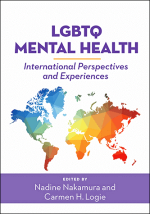 Have you ever wondered what it is like to be queer in Mongolia? Or Malaysia? If you’re like most American psychologists, you probably haven’t. I certainly didn’t until I began working in a refugee camp for gay male refugees and asylum seekers in Sweden ten years ago. Queer psychology in American culture has tended, in parallel with mainstream psychology, to focus on American cultural values and practices. The dominant paradigms supporting queer mental health in the US, Canada, and Western Europe – which account for just 12% of the world’s population – have typically informed the lens through which queer people in the rest of the world are viewed. Nakamura and Logie challenge this ethnocentrism by presenting the work of scholars representing collectivist cultures in context from South America to Asia, Africa and Eastern Europe.
Despite the diversity among the cultures represented in the book, Nakamura and Logie offer a number of takeaway messages reflecting common themes among them. One theme that repeats frequently across the volume’s chapters is the inappropriateness of applying the values of LGBTQ psychology as endorsed in the Global North (the US, Canada and Western Europe) to cultures in the developing world. Queer research in the 1980s promoted the concept that coming out is a necessary step toward optimal mental health for LGBTQ people. This concept, borne of the Global North’s individualistic cultures, may have little relevance when superimposed on collectivist cultures. For example, throughout the book, the authors suggest that staying closeted in the service of family harmony is a common practice for queer people in many cultures because of adherence to traditional values around sex, relationships and gender role expectations. One poignant story from a transwoman in Africa illustrates how staying closeted is actually far better for her mental health than coming out and risking rejection and isolation from the familial and social world to which she belongs.
Another repetitive theme in the book is the degree to which colonial influences contaminated centuries-old tolerant and affirming cultural and spiritual practices of indigenous persons around the globe. Countries as diverse as India, Ecuador and Mongolia had longstanding tolerance and even celebration of diverse gender identities and sexual orientations until the advent of Western colonizers. These colonizers from Britain, Spain, Portugal and elsewhere in the Western world brought with them Christian prohibitions against same-sex behavior and diverse gender expression. To this day, anti-queer religious dogma is responsible for repressive laws and discrimination and violence against queer persons. Even in countries such as Colombia, where there are laws on the books prohibiting anti-LGBTQ discrimination, many queer people have to flee from their home towns to big cities to avoid persecution.
Religious affiliation can also be a source of spiritual and social support, however, if the religious organization in question is queer-affirming. In Africa, where most countries actively oppose queer identity and expression, LGBTQ individuals take care of each other through community-based organizations and networks. Affirming religious institutions can assist greatly in these efforts. In any case, the book’s array of queer lived experiences in repressive cultures paints a picture of resilience in the face of oppression, and a determination to disrupt prevailing sociopolitical structures. This can be assisted with continued dissemination of accurate information about sexual orientation and gender identity, as well as support for queer-positive mental health programs.
Research can be challenging to conduct in cultures where, due to shame and fear, many queer persons live their lives in secret, and are reluctant to publicly acknowledge their sexual orientation and/or gender identity, let alone participate in studies. As a result, the majority of chapter authors in this book employ qualitative methods with small sample sizes, making the results difficult to generalize. The study cited in the chapter on Malaysia, a Muslim majority (87%) country under Sharia law, does not even include any queer Muslim participants due to the risk of public whipping and imprisonment. Regardless, if there is one overarching theme in the book, it is this: queer people in any circumstance may, in the negotiation of their own intersecting identities, find ways to live in relative peace through mutual and community support – and find a balance between the often-incompatible demands of family/community and personal life.
If there is one limitation of this book – and it is a significant one – there is no representation from Middle Eastern cultures in any of the chapters. The authors point out that it is not possible to cover every culture outside the Western world. While this is true, it must also be noted that many countries in the Middle East-North Africa (MENA) region are those most responsible for the imprisonment, torture and execution of queer individuals, particularly gay men and transwomen. Many countries in this region, along with Pakistan and Afghanistan, support the cruelest treatment of queer people anywhere in the world. Anecdotal reports abound of individuals outed by their families, sexually abused and tortured in prison, and sometimes put to death. Further research on international LGBTQ psychology should take this into account.
If there is such a thing as a “page-turner” in the scholarly literature on queer psychology, this book qualifies. The stories gleaned from researchers all over the world are as inspiring as they are gripping. A book such as this is long overdue, and much needed for those who seek to understand international queer issues from a culturally accurate perspective. Nakamura and Logie are to be commended for raising our awareness in this important area.