


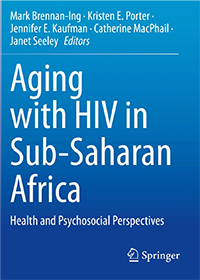
 To celebrate the publication of Aging with HIV in Sub-Saharan Africa: Health and Psychosocial Perspectives, edited by Division 44 Fellow Mark Brennan-Ing and colleagues, Hunter College’s Roosevelt House and the Brookdale Center for Healthy Aging held an in-person discussion to present the major findings of this volume on October 12.
Because of the success of antiretroviral therapies (ART), people 50 and older now make up most people with HIV in high-income countries and other places where ART is accessible. The aging of the HIV epidemic is a global trend that is also being observed in low- and middle-income countries, including countries in sub-Saharan Africa, where the greatest number of older people with HIV reside (3.7 million).
At present, however, our understanding of HIV and aging is dominated by information from the U.S. and Western Europe, where the epidemiology of HIV and the infrastructure to provide social care are markedly different than in sub-Saharan Africa. Aging with HIV in Sub-Saharan Africa (Springer, 2022) provides a unique and timely overview of growing older with HIV in this context, covering such topics as epidemiology, health and functioning, and social support, as well as policy and program implications to support those growing older with HIV.
Authors on the panel included Mark Brennan-Ing, Brookdale’s director of research and evaluation; Ruth Finkelstein, Brookdale’s executive director; Charlotte Bernard, University of Bordeaux, France; Xavier Gómez-Olivé, University of the Witwatersrand, South Africa; Jepchirchir Kiplagat, Moi University, Kenya; Kabo Matlho, University of Sydney, Australia; Catherine MacPhail, University of Wollongong, Australia; and Kristen E. Porter, University of Massachusetts Boston.