


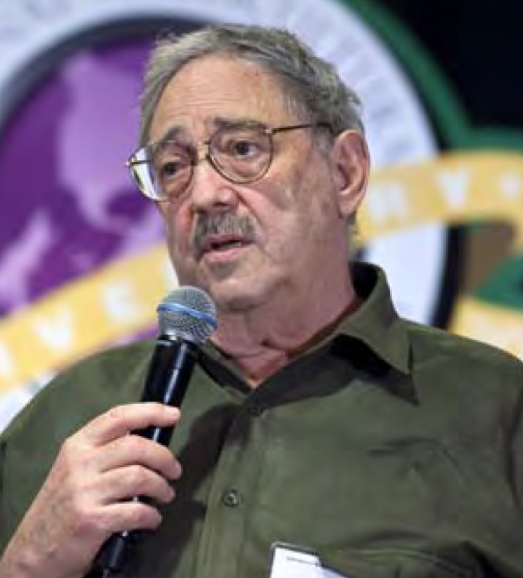
 There have been so many beautiful and well-deserved tributes to Chuck, as he was known to many of us. There are very detailed obituaries in the New York Timesopens in new window, Gay City Newsopens in new window, and elsewhere, that adequately document his professional, academic and literary works and awards. They are all very accurate in showing his national and global influence in establishing what is the foundation for much of what is now accepted as acceptable theory in our field. There is no need to reproduce them here. What follows is what I would have said at a memorial service for our loved friend and colleague, Charles Silverstein.
I want to tell you about Chuck from another perspective from having known him since the late sixties where we both worked at Lincoln Hospital in the South Bronx. At that time, he was seen as the tall, slender and handsome non-gay man-about-town who was going on another skiing vacation. We lost contact so I could hardly believe it when in the early 1970s I heard about his now being an out gay man. We reconnected immediately. He was active in the Gay Activist Alliance’s Saturday night dances at the Firehouse in New York City's SOHO neighborhood. He didn’t dance but loved being there and absorbing the atmosphere. He treasured an important moment there when he started a conversation with an older Black woman who also watched from the sidelines as he did. When he asked why she was there, she told him that she brought her teenage son there as he was “that way” and though he was too young to have sex, she felt he should know his community. That conversation had a lasting impact on him as Chuck had struggled for years with his sexuality and tried to live a non-gay lifestyle. For him, this was a concrete example of how the liberation movement could have such far reaching effect and helped give him a direction to his activism.
He used his professional knowledge to create two significant organizations in New York City – Identity House, and later, the Institute for Human Identity. He and I reconnected at that time when he was director of Identity House, a peer counseling service. Unfortunately, we disagreed on how I was to be brought in as clinical director. His authoritarian stance caused the first and only conflict we had – though it did last for a couple of years. While he never lost his authoritativeness, it greatly softened over the years.
It was no surprise that he later got involved with a newly formed activist organization, the National Gay Task Force. It was his theoretical position paper that was successfully used in their 1973 fight with the America Psychiatric Association about removing “Homosexuality" as a diagnostic category of mental illness. In this brilliant essay, he applied his academic knowledge, his keen intellect and his sense of humor to skewer the psychiatric diagnostic system. While all the recent obituaries reference the importance of this paper, they missed a significant point that Chuck made with ironic humor. In order to show how many psychiatric diagnoses were reinforcements of prevalent societal thinking and not of scientifically researched empirical evidence, Chuck referred to “Drapetomania,” a psychiatric diagnosis given to slaves who had a compulsion to run away from their masters. He successfully showed this parallelism so that, after taking a vote, the APA no longer considered being a homosexual a sign of mental illness. The ramifications of this made it so much easier when we did the same thing in 1974 with the American Psychological Association.
We know of the global impact that his books, The Joy of Gay Sex and The New Joy of Gay Sex, had on our community. Its genesis had many sources. One had to do with surprising information that his clients shared with him that opened his eyes. He also had his own experience from his own lack of knowledge for many years. It was this realization of the vast amount of information that needed to be shared that helped propel him to take on this incredible task to produce this work. These two volumes are an indication of how much he wanted his community to grow as also was his creation of the Journal of Homosexuality.
Knowledge was to be shared and this was reflected in his personal life as well. He began having a “Gay Pride Morning Brunch” on the day of the march until we all got older so that the brunch had to be moved to the day before the march since our energy became more limited. These brunches and countless parties were always so special since all his contacts were invited. It was not only psychologists but activist psychiatrists and social workers as well as his neighbors. He also developed sex therapy programs and included the teachers and co-leaders as guests. What was so delightful about these events was the knowledge that there were always going to be interesting people there that you wanted to talk with. He loved bringing all these people together though he did not have much time to talk – he was too busy getting the food out. He did all the excellent cooking (including many delicious desserts which he could not eat because of his diabetes!). We could always count on a performance of his “theatrical group” for which he usually wrote the script (with help). It was atrocious humor and usually in bad taste, which he loved. It was hysterical to watch unbelievably bad performances, which only heightened our amusement – especially when he went in drag.
Luckily, he had the space for all these gatherings. His apartment was filled with the many artifacts from his annual world-wide travels and reflected his excellent taste of local art from around the world. He was the only person I know whose suitcase upon departure was already half-filled with bubble wrap. Many of his travel companions were close friends with whom he maintained friendships until his death. He was a man who was clearly loved by many friends. Unfortunately, he outlived Will, the love of his life, who died from complications of AIDS.
His friends, colleagues, former students and supervisees were an integral part of his life. It was always a pleasure to be at his dinner parties – again, he did all the cooking. He had true joy in bringing friends together. Though he loved throwing these big parties, he could also enjoy intimate evenings with friends. I had many dinners with just him and my husband, John.
In closing, I want you to know that while he had received many awards over the years, it was the recent ones given in recognition of his global influence that were his most treasured ones. He could finally take in what he was being recognized for. In a sense, he died knowing and feeling the kind of eulogies that are now being given.
Chuck was a loved man from those who knew him personally and from those who benefitted from his wisdom, dedication and love for our community.
–Editor's note: The Association for Behavioral and Cognitive Therapies (ABCT)opens in new window honored Dr. Charles Silverstein, PhD, with the establishment of the Charles Silverstein Lifetime Achievement Award in Social Justice in November. ABCT cited Silverstein’s significant contributions in combatting pathologization of LGBTQ+-identified people as integral to its decision to establish the new award in his name. “This is obviously the greatest honor I have received in my career and especially so coming from the premier behaviorist organization in the world,” Silverstein said.
Spontaneous tributes were circulated on the Div44 Listserv following news of his death:
“Sorry to hear this sad news about Charles Silverstein. He was a pathbreaking figure and fought hard for gay rights with mental health from the very beginning of the movement. I had the pleasure of working with him on projects and he epitomized the activist psychologist. I was pleased that Jack and I could include his own account of early LGB psychology history in a book on activism and psychology years ago. He leaves the world a better place, may he rest in power.”
–Judith Glassgold, PsyD
“Chuck was a giant in our field, on whose shoulders so many subsequent generations stand.”
–Douglas C. Haldeman, PhD
“I am saddened to learn of Charles Silverstein's recent passing. While I did not know him personally, I had the opportunity to review his book, The Initial Psychotherapy Interview: A Gay Man Seeks Treatment, for the Division 44 Newsletter: “What I appreciate about this book is Silverstein's willingness to so openly acknowledge his own clinical errors. Many of us are likely to see ourselves in his retelling of the session, with the inevitable awkward silences, equivocations, and personal insecurities that we all experience as therapists. Silverstein resists the narcissistic temptation to be viewed as the all-knowing therapist and instead allows himself to be seen as he really is: vulnerable, unsure, brash, and even self-important.' He was truly a pioneer and will be missed.”
–Tyger Latham, PsyD
“He was a central figure in the APA decision to remove homosexuality from the DSM-II (as shown in the documentary, CURED) – and that was just one of his many accomplishments over the years. His Wikipedia page is hereopens in new window.
“Charles helped many; he will be missed by many; may he rest in peace.”
–Jack Drescher, MD
Charles Silverstein was noted in several previous issues of the Division 44 Newsletter:
-
Silverstein Wins Gold Medal Award for Practiceopens in new window (Division 44 Newsletter, Summer 2011, p. 19.)
-
Origin of the “Ten Percent” Estimate in the 1970sopens in new window by Charles Silverstein (Division 44 Newsletter, Fall 2011, pp. 15–16.)
-
Events in New York City Leading to the Deletion of Homosexuality as a Mental Disorder by the American Psychiatric Associationopens in new window by Charles Silverstein (Division 44 Newsletter, Spring 2011, pp. 13–15.)
-
Silverstein Resigns as Presidentopens in new window (Division 44 Newsletter, Fall 2009, p. 2)
Books by Silverstein that have been reviewed:
-
The Initial Psychotherapy Interview: A Gay Man Seeks Treatmentopens in new window. Charles Silverstein (Ed.). Burlington, MA: Elsevier, 2011, 321 pp. (Division 44 Newsletter Spring 2011, p. 5.)
-
For the Ferryman: A Personal History. Charles Silversteinopens in new window. New York, NY: Chelsea Station Editions, 2011, 340 pp. (Division 44 Newsletter Spring 2012, pp 10–11, two reviews)
Additional resources:
Oral history interviews of Charles Silverstein