

Review author: Glenda Russell, PhD
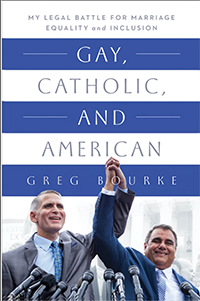 Citation: Bourke, Greg. (2021). Gay, Catholic and American: My legal battle for marriage equality and inclusion. Notre Dame, IN: University of Notre Dame Press (229 pages).
The still unfolding story of the changes in the status of lesbian, gay, bisexual, transgender, and queer (LGBTQ) people in the United States is a compelling one. It is a story that has moved from the deepest of closets to the largest of legislative and judicial venues in a matter of mere decades. However, readers of most of the histories of LGBTQ rights could easily come away with the impression that the movement for these rights was played out on one of the two coasts. Certainly, many–but not all–of the most impactful institutional events in the LGBTQ movement took place in larger cities on both sides of the country. And just as certainly, the coasts had not only institutional contexts where big changes occurred but also the mass media resources that focused on the movement as it, well, moved.
It is also true that queer people are everywhere. And queer people from all parts of the country participated in the movement toward visibility and social change. Even those who hung back and played no active role were inevitably affected by the movement. It changed not only laws and practices; it changed how we thought about ourselves and one another. There have been relatively few historical or personal descriptions of these changes from the so-called flyover states. Greg Bourke's book, Gay, Catholic and American, provides a welcome addition to the small library that does exist.
Greg Bourke is a Kentucky native who lives with his husband, Michael De Leon, in Louisville. The two of them have been central figures in marriage equality efforts. Thanks to a judicial move that combined 37 plaintiffs in the Obergefell case, Greg and Michael had first-hand knowledge as that case wound its way through lower courts, culminating in a US Supreme Court decision in June of 2016. In addition, Greg was a long-time Boy Scout leader who was pushed out of his position by the forces of discrimination. Although Greg fought back, he never managed to overcome the discrimination.
Bourke tells his story using a linear approach, moving from one incident to the next, with little in the way of analysis, either personal or political. Nor does he take the opportunity to delve into some aspects of his journey that might well be of interest to readers. As an example, he only mentions the difference in his and Michael's ethnicities quite late in the book and then only once. Bourke also never discusses the ethnicities of the couple's two adopted sons, though their pictures in a rich photographic section suggest the possibility of an interesting story. The neglect of such potentially rich topics lends an impression of a color-blind approach that may reveal something of how much discussion there is about such matters in some parts of the country.
Bourke's narrative does provide details of his relationships with people in his community, and those may also say something about life in those same parts of the country. Greg and Michael are both practicing Roman Catholics who have had active and visible roles in the same parish for decades. While, in his role as a Boy Scout leader, Greg faced discrimination by two institutions, the Boy Scouts of America and the Catholic archdiocese that sponsored the troop, he was apparently supported by his troop members and their parents throughout the process. In his depictions of his life as gay and Catholic in Louisville, Greg has written a story that has the potential to disrupt some stereotypes while letting others remain unexamined.