

Note: This article is adapted from a similar article by this author published in the APA Division 18 newsletter.
The Society for Child and Family Policy and Practice (APA Division 37) will retain its one representative APA’s Council of Representatives (Council) at least through 2024. But what is Council and how is its composition determined? This article answers these questions alongside recent APA data about Division 37.
What is Council? Council is the policymaking body of APA and consists of members from divisions, SPTAs, and ethnic minority psychological associations, and the APA Board of Directors. Of note, Cindy Miller-Perrin, PhD currently represents Division 37 on Council and Division 37 member Mary Ann McCabe, PhD, ABPP, currently sits on the APA Board of Directors. As examples of the types of items before Council, at its February 2023 meeting Council passed an offer of apology to the First Peoples of the United States, the Resolution on Confidentiality and Reproductive Health, APA Principles for Quality Undergraduate Education in Psychology, Educational Guidelines for Equitable and Respectful Treatment of Students in Graduate Psychology Training Programs, and the Resolution on Equity, Diversity, Inclusion, and Accessibility in Quality Continuing Education and Professional Development. Council also regularly passes psychology practice guidelines, including the APA Guidelines for Child Custody Evaluations in Family Law Proceedings. More informationopens in new window about Council, as well as all Council meeting minutes since 2010, is available. Having active Division 37 representation ensures that APA and APA Council consider the child and family issues that matter to Division 37.
How is the composition of Council determined? Each fall, APA sends an apportionment ballot electronically to all APA members. Results from this ballot determine the composition of Council. Each voter allocates ten votes across divisions or state, provincial or territorial associations (SPTAs) of their choice. For example, you can give all ten of your votes to Division 37 or spread them across divisions and SPTAs. APA then tabulates the number and percentage of votes each division and SPTA receives and allocates Council representation accordingly. Put simply, the higher percentage of votes that Division 37 receives, the more representation Division 37 has on Council.
What does the APA apportionment data show? In December 2022, APA released the most recent apportionment ballot results. Divisions 9 (Society for the Psychological Study of Social Issues), 17 (Counseling Psychology), and 32 (Humanistic Psychology) each lost a seat on Council, while Divisions 2 (Teaching), 5 (Quantitative and Qualitative Methods), and 14 (Industrial and Organizational Psychology) each gained a seat. Division 37 will maintain its one Council representative for the 2024 term but, as shown in Table 1 below, received fewer votes in 2022 than in the prior five years of apportionment ballots (2017-2021).
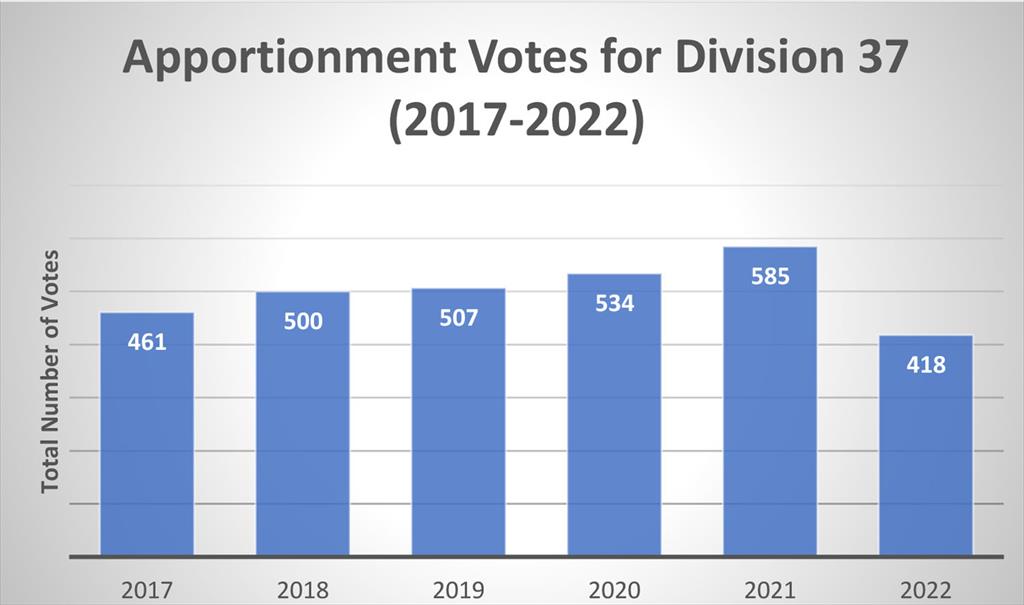
Table 1. Apportionment Votes Allocated to Division 37 as Percentage of Total Votes (2017-2022).
However, it’s not only Division 37 receiving fewer apportionment votes. An examination of the data for all divisions and SPTAs shows a decrease in overall votes in 2022. Although the number of Division 37 votes in 2022 were at a six-year low (see Table 1), Division 37 actually matched its six-year high in the percentage of all APA votes apportioned to Division 37. Still, there is room for improvement. The percentage of APA member votes for Division 37 has been consistently low the past six years, ranging from 0.48% of all votes (in 2017) to 0.59% of all votes (in both 2021 and 2022). The APA data also reveals that very few members allocate all ten of their votes to Division 37, ranging from only 10 (in 2017 and 2022) to 16 (in 2018).
With the next apportionment ballot coming this fall, these data should inspire Division 37 to further educate members about why the apportionment ballot matters, what Council does, and what Council offers Division 37. It should also encourage members to vote for Division 37. More votes for Division 37 on the apportionment ballot and further representation on Council could result in expanded APA action on matters related to child and family policy and practice.